


Comparison of Patients Infected With Delta Versus Omicron COVID-19 Variants Presenting to Paris Emergency Departments : A Retrospective Cohort Study
- PMID: 35286147
- PMCID: PMC8941485
- DOI: 10.7326/M22-0308
Comparison of Patients Infected With Delta Versus Omicron COVID-19 Variants Presenting to Paris Emergency Departments : A Retrospective Cohort Study
Abstract
Background: At the end of 2021, the B.1.1.529 SARS-CoV-2 variant (Omicron) wave superseded the B.1.617.2 variant (Delta) wave.
Objective: To compare baseline characteristics and in-hospital outcomes of patients with SARS-CoV-2 infection with the Delta variant versus the Omicron variant in the emergency department (ED).
Design: Retrospective chart reviews.
Setting: 13 adult EDs in academic hospitals in the Paris area from 29 November 2021 to 10 January 2022.
Patients: Patients with a positive reverse transcriptase polymerase chain reaction (RT-PCR) test result for SARS-CoV-2 and variant identification.
Measurements: Main outcome measures were baseline clinical and biological characteristics at ED presentation, intensive care unit (ICU) admission, mechanical ventilation, and in-hospital mortality.
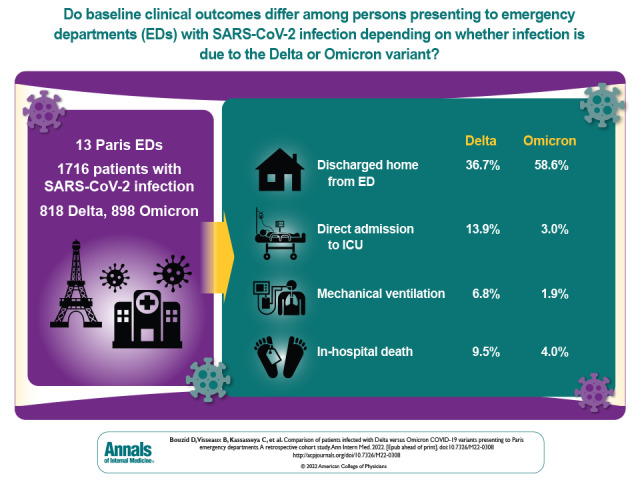
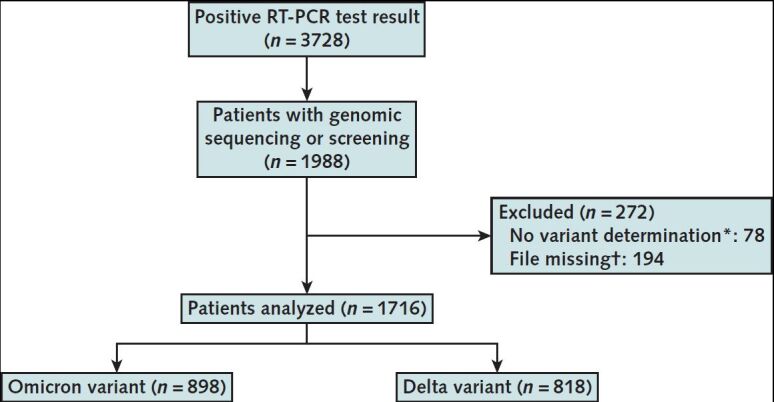
Results: A total of 3728 patients had a positive RT-PCR test result for SARS-CoV-2 during the study period; 1716 patients who had a variant determination (818 Delta and 898 Omicron) were included. Median age was 58 years, and 49% were women. Patients infected with the Omicron variant were younger (54 vs. 62 years; difference, 8.0 years [95% CI, 4.6 to 11.4 years]), had a lower rate of obesity (8.0% vs. 12.5%; difference, 4.5 percentage points [CI, 1.5 to 7.5 percentage points]), were more vaccinated (65% vs. 39% for 1 dose and 22% vs. 11% for 3 doses), had a lower rate of dyspnea (26% vs. 50%; difference, 23.6 percentage points [CI, 19.0 to 28.2 percentage points]), and had a higher rate of discharge home from the ED (59% vs. 37%; difference, 21.9 percentage points [-26.5 to -17.1 percentage points]). Compared with Delta, Omicron infection was independently associated with a lower risk for ICU admission (adjusted difference, 11.4 percentage points [CI, 8.4 to 14.4 percentage points]), mechanical ventilation (adjusted difference, 3.6 percentage points [CI, 1.7 to 5.6 percentage points]), and in-hospital mortality (adjusted difference, 4.2 percentage points [CI, 2.0 to 6.5 percentage points]).
Limitation: Patients with COVID-19 illness and no SARS-CoV-2 variant determination in the ED were excluded.
Conclusion: Compared with the Delta variant, infection with the Omicron variant in patients in the ED had different clinical and biological patterns and was associated with better in-hospital outcomes, including higher survival.
Primary funding source: None.
Conflict of interest statement
Figures
References
-
- World Health Organization. Update on Omicron. Accessed at www.who.int/news/item/28-11-2021-update-on-omicron on 7 January 2022.
-
- Santé publique France. InfoCovidFrance: Chiffres clés et évolution de la COVID-19 en France et dans le Monde. Accessed at www.santepubliquefrance.fr/dossiers/coronavirus-covid-19/coronavirus-chi... on 7 January 2022.
MeSH terms
Supplementary concepts
LinkOut - more resources
Full Text Sources
Medical
Miscellaneous
