


Risk and Outcome of Breakthrough COVID-19 Infections in Vaccinated Patients With Cancer: Real-World Evidence From the National COVID Cohort Collaborative
- PMID: 35286152
- PMCID: PMC9061155
- DOI: 10.1200/JCO.21.02419
Risk and Outcome of Breakthrough COVID-19 Infections in Vaccinated Patients With Cancer: Real-World Evidence From the National COVID Cohort Collaborative
Abstract
Purpose: To provide real-world evidence on risks and outcomes of breakthrough COVID-19 infections in vaccinated patients with cancer using the largest national cohort of COVID-19 cases and controls.
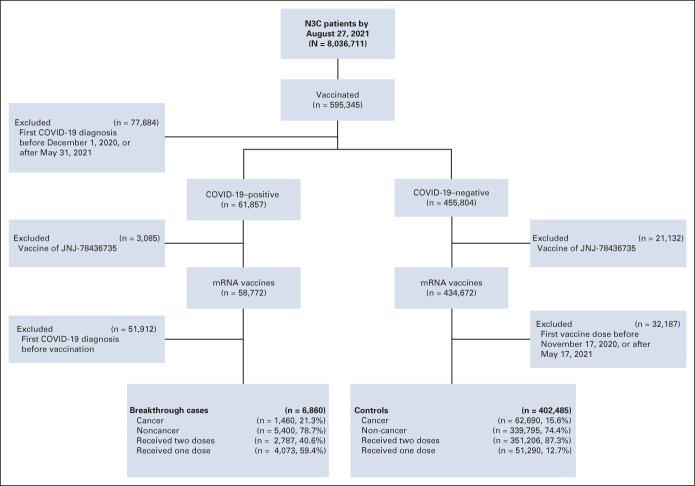
Methods: We used the National COVID Cohort Collaborative (N3C) to identify breakthrough infections between December 1, 2020, and May 31, 2021. We included patients partially or fully vaccinated with mRNA COVID-19 vaccines with no prior SARS-CoV-2 infection record. Risks for breakthrough infection and severe outcomes were analyzed using logistic regression.
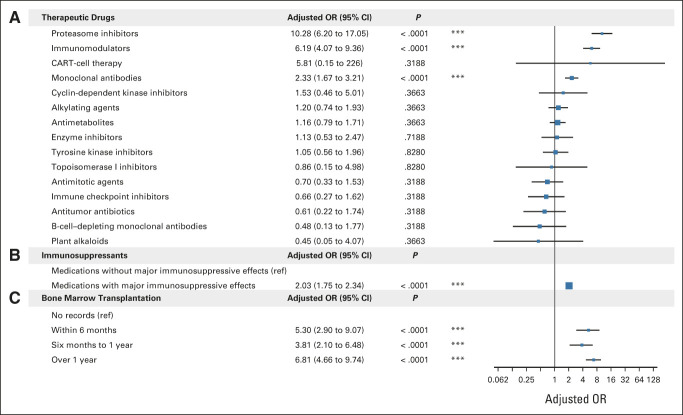
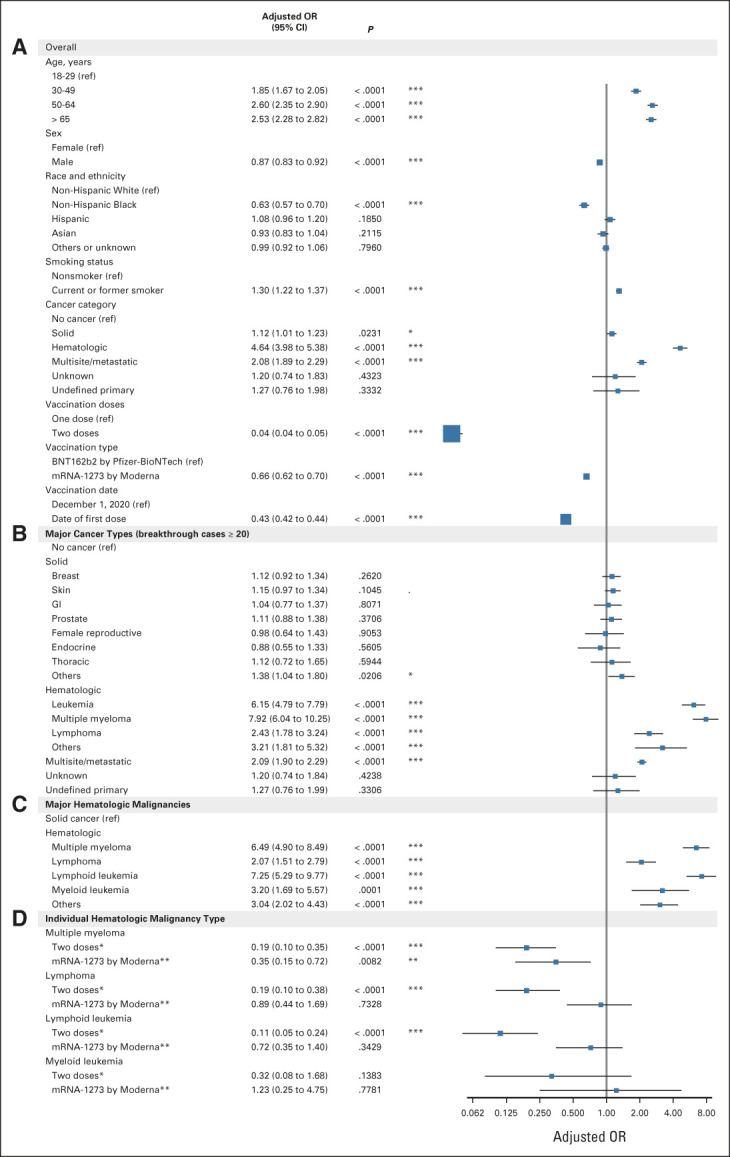
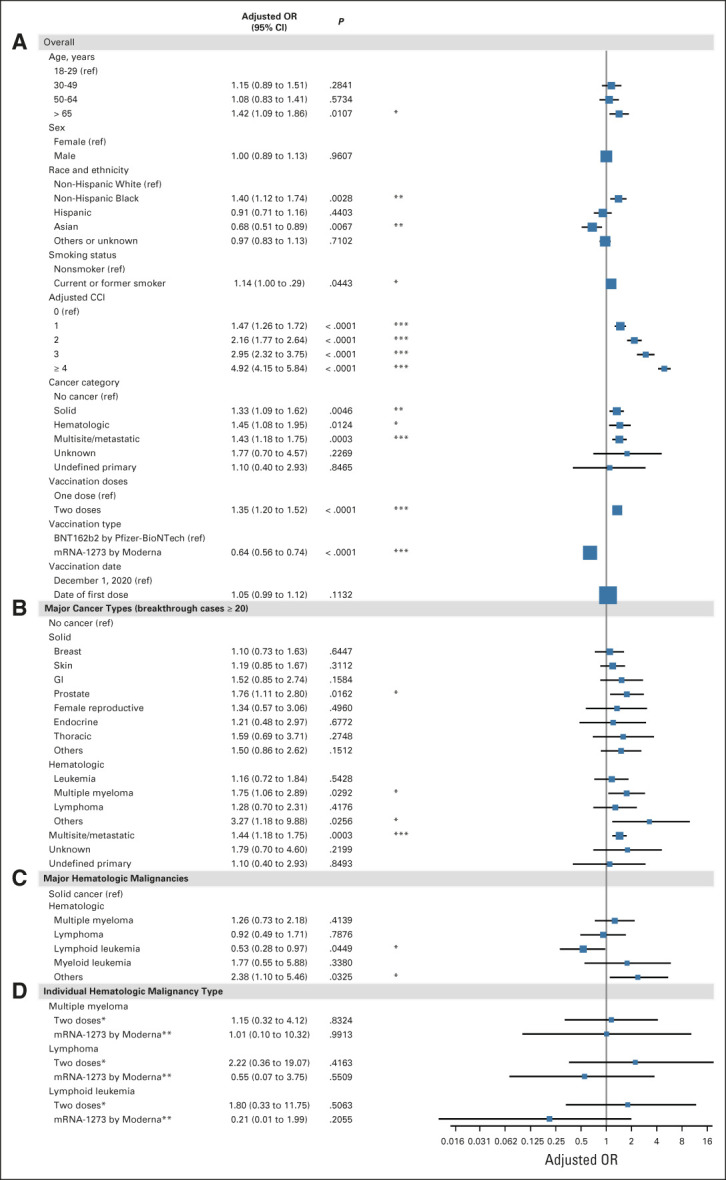
Results: A total of 6,860 breakthrough cases were identified within the N3C-vaccinated population, among whom 1,460 (21.3%) were patients with cancer. Solid tumors and hematologic malignancies had significantly higher risks for breakthrough infection (odds ratios [ORs] = 1.12, 95% CI, 1.01 to 1.23 and 4.64, 95% CI, 3.98 to 5.38) and severe outcomes (ORs = 1.33, 95% CI, 1.09 to 1.62 and 1.45, 95% CI, 1.08 to 1.95) compared with noncancer patients, adjusting for age, sex, race/ethnicity, smoking status, vaccine type, and vaccination date. Compared with solid tumors, hematologic malignancies were at increased risk for breakthrough infections (adjusted OR ranged from 2.07 for lymphoma to 7.25 for lymphoid leukemia). Breakthrough risk was reduced after the second vaccine dose for all cancers (OR = 0.04; 95% CI, 0.04 to 0.05), and for Moderna's mRNA-1273 compared with Pfizer's BNT162b2 vaccine (OR = 0.66; 95% CI, 0.62 to 0.70), particularly in patients with multiple myeloma (OR = 0.35; 95% CI, 0.15 to 0.72). Medications with major immunosuppressive effects and bone marrow transplantation were strongly associated with breakthrough risk among the vaccinated population.
Conclusion: Real-world evidence shows that patients with cancer, especially hematologic malignancies, are at higher risk for developing breakthrough infections and severe outcomes. Patients with vaccination were at markedly decreased risk for breakthrough infections. Further work is needed to assess boosters and new SARS-CoV-2 variants.
Conflict of interest statement
Figures
References
Publication types
MeSH terms
Substances
Supplementary concepts
Grants and funding
- U54 GM104938/GM/NIGMS NIH HHS/United States
- UL1 TR002649/TR/NCATS NIH HHS/United States
- UL1 TR003167/TR/NCATS NIH HHS/United States
- UL1 TR001433/TR/NCATS NIH HHS/United States
- U54 GM104942/GM/NIGMS NIH HHS/United States
- UL1 TR001439/TR/NCATS NIH HHS/United States
- UL1 TR002243/TR/NCATS NIH HHS/United States
- UL1 TR001445/TR/NCATS NIH HHS/United States
- UL1 TR003096/TR/NCATS NIH HHS/United States
- UL1 TR002537/TR/NCATS NIH HHS/United States
- UL1 TR001412/TR/NCATS NIH HHS/United States
- UL1 TR001872/TR/NCATS NIH HHS/United States
- UL1 TR001878/TR/NCATS NIH HHS/United States
- UL1 TR002529/TR/NCATS NIH HHS/United States
- UL1 TR001863/TR/NCATS NIH HHS/United States
- UL1 TR002494/TR/NCATS NIH HHS/United States
- UL1 TR002736/TR/NCATS NIH HHS/United States
- U54 GM115516/GM/NIGMS NIH HHS/United States
- UL1 TR002369/TR/NCATS NIH HHS/United States
- UL1 TR002541/TR/NCATS NIH HHS/United States
- UL1 TR002001/TR/NCATS NIH HHS/United States
- UL1 TR002538/TR/NCATS NIH HHS/United States
- U54 GM115458/GM/NIGMS NIH HHS/United States
- UL1 TR001442/TR/NCATS NIH HHS/United States
- UL1 TR002535/TR/NCATS NIH HHS/United States
- UL1 TR001866/TR/NCATS NIH HHS/United States
- UL1 TR001449/TR/NCATS NIH HHS/United States
- UL1 TR001453/TR/NCATS NIH HHS/United States
- UL1 TR002489/TR/NCATS NIH HHS/United States
- P30 CA082709/CA/NCI NIH HHS/United States
- U54 GM104940/GM/NIGMS NIH HHS/United States
- UL1 TR003107/TR/NCATS NIH HHS/United States
- UL1 TR003015/TR/NCATS NIH HHS/United States
- UL1 TR002733/TR/NCATS NIH HHS/United States
- UL1 TR001422/TR/NCATS NIH HHS/United States
- P30 CA012197/CA/NCI NIH HHS/United States
- UL1 TR001860/TR/NCATS NIH HHS/United States
- P20 GM121176/GM/NIGMS NIH HHS/United States
- P30 CA177558/CA/NCI NIH HHS/United States
- UL1 TR001420/TR/NCATS NIH HHS/United States
- U24 TR002306/TR/NCATS NIH HHS/United States
- UL1 TR002003/TR/NCATS NIH HHS/United States
- UL1 TR001876/TR/NCATS NIH HHS/United States
- UL1 TR001436/TR/NCATS NIH HHS/United States
- UL1 TR002378/TR/NCATS NIH HHS/United States
- UL1 TR002384/TR/NCATS NIH HHS/United States
- UL1 TR002553/TR/NCATS NIH HHS/United States
- UL1 TR002389/TR/NCATS NIH HHS/United States
- UL1 TR001414/TR/NCATS NIH HHS/United States
- U54 GM104941/GM/NIGMS NIH HHS/United States
- UL1 TR002014/TR/NCATS NIH HHS/United States
- UL1 TR002550/TR/NCATS NIH HHS/United States
- UL1 TR002319/TR/NCATS NIH HHS/United States
- UL1 TR001855/TR/NCATS NIH HHS/United States
- UL1 TR001425/TR/NCATS NIH HHS/United States
- UL1 TR002373/TR/NCATS NIH HHS/United States
- UL1 TR002240/TR/NCATS NIH HHS/United States
- UL1 TR002556/TR/NCATS NIH HHS/United States
- UL1 TR003017/TR/NCATS NIH HHS/United States
- UL1 TR001998/TR/NCATS NIH HHS/United States
- UL1 TR001873/TR/NCATS NIH HHS/United States
- UL1 TR001881/TR/NCATS NIH HHS/United States
- UL1 TR002645/TR/NCATS NIH HHS/United States
- UL1 TR001450/TR/NCATS NIH HHS/United States
- UL1 TR002366/TR/NCATS NIH HHS/United States
- U54 GM115428/GM/NIGMS NIH HHS/United States
- UL1 TR002345/TR/NCATS NIH HHS/United States
- UL1 TR002377/TR/NCATS NIH HHS/United States
- U54 GM115677/GM/NIGMS NIH HHS/United States
- UL1 TR002544/TR/NCATS NIH HHS/United States
- UL1 TR003098/TR/NCATS NIH HHS/United States
- UL1 TR001430/TR/NCATS NIH HHS/United States
- UL1 TR003142/TR/NCATS NIH HHS/United States
LinkOut - more resources
Full Text Sources
Other Literature Sources
Medical
Miscellaneous
