Review
. 2023 May;12(5):269-287.
doi: 10.1089/wound.2021.0126. Epub 2022 May 26.

Skin Inflammation with a Focus on Wound Healing

Affiliations
Review

Skin Inflammation with a Focus on Wound Healing

Dany Y Matar et al. Adv Wound Care (New Rochelle). 2023 May.

Abstract

Significance: The skin is the crucial first-line barrier against foreign pathogens. Compromise of this barrier presents in the context of inflammatory skin conditions and in chronic wounds. Skin conditions arising from dysfunctional inflammatory pathways severely compromise the quality of life of patients and have a high economic impact on the U.S. health care system. The development of a thorough understanding of the mechanisms that can disrupt skin inflammation is imperative to successfully modulate this inflammation with therapies. Recent Advances: Many advances in the understanding of skin inflammation have occurred during the past decade, including the development of multiple new pharmaceuticals. Mechanical force application has been greatly advanced clinically. Bioscaffolds also promote healing, while reducing scarring. Critical Issues: Various skin inflammatory conditions provide a framework for analysis of our understanding of the phases of successful wound healing. The large burden of chronic wounds on our society continues to focus attention on the chronic inflammatory state induced in many of these skin conditions. Future Directions: Better preclinical models of disease states such as chronic wounds, coupled with enhanced diagnostic abilities of human skin, will allow a better understanding of the mechanism of action. This will lead to improved treatments with biologics and other modalities such as the strategic application of mechanical forces and scaffolds, which ultimately results in better outcomes for our patients.

Keywords: chronic wound; diabetic wound; inflammation; negative pressure wound therapy; tissue regeneration; wound healing.


Conflict of interest statement

None declared. This work was funded by The Gillian Reny Stepping Strong Center for Trauma Innovation and is in part supported by NIH T35 HL110843 fellowship to Brian Ng.

Figures

None
Dennis P. Orgill, MD
None
Adriana C. Panayi, MD
Figure 1.
Figure 1.
Histological components of healthy skin and key inflammatory skin conditions. Healthy skin consists of a layer of epidermis covering a layer of dermis. The epidermis itself is composed of several different layers, from superficial to deep: stratum corneum, stratum lucidum, stratum granulosum, stratum spinosum, and stratum basale. The dermis is an extracellular matrix predominantly comprising collagens, containing fibroblasts and the neurovascular network. In psoriasis, the stratum corneum becomes abnormal and is characterized by parakeratosis (retention of nuclei) and hyperkeratosis (thickening), manifesting clinically as scale formation. The epidermis is thickened, the rete ridges become elongated, and the vascular network becomes dilated. A lymphocytic infiltrate can be seen within the dermis, with a predominance of T cells and Langerhans cells. Munro's microabscesses, collections of polymorphonuclear leucocytes, can be seen within the stratum corneum. Hidradenitis suppurativa is characterized initially by keratin plug formation, subsequent follicular occlusion, and dilatation, followed by accumulation of cellular debris and cyst formation. This can result in extensive immune cell infiltration, including T cells, B cells, macrophages, and neutrophils. The follicle may eventually rupture and can lead to sinus tract formation. Contact dermatitis is triggered by exposure to contact allergens called haptens that induce a T cell-mediated inflammation. Epidermal edema leads to acanthosis (thickening of the epidermis) with hyperkeratosis and parakeratosis. The inflammatory infiltrate predominately comprises Langerhans cells and extensive cytokine release. In pyoderma gangrenosum, an initial intradermal abscess of a characteristic neutrophilic nature can be followed by epidermal ulceration and superficial dermal necrosis. Surrounding the ulcer is peripheral erythema, and the ulcer site has an undermining border and tenderness. Rosacea has been associated with physical triggers such as heat and certain foods, leading to increased activity of cathelicidin in its active form LL-37. Response is mediated by TRPA1, TRPV1, and TRPV4 channels leading to changes in neurovasculature that manifest as erythema and flushing. TEN is characterized by detachment of skin and mucosa, with an implication of CD8+ T cells that produce Granulysin, resulting in keratinocyte death. TEN, toxic epidermal necrolysis.
Figure 2.
Figure 2.
Phases of wound healing. There are four classic phases of wound healing: hemostasis, inflammation, proliferation, and resolution, with inflammation further separated into two sub-phases: early and late. During the first few hours of healing, the endothelial cells release anti-thrombotic agents to induce platelet aggregation. Factor X induces cleavage of fibrinogen to fibrin, which then cross-links and binds to the platelet aggregate to form a thrombus. The thrombus stops the bleeding and provides the preliminary matrix for healing. Histamine release from mast cells triggers a neutrophilic influx and the onset of inflammation. Through a series of immune responses, debris is removed to prevent infection. Inflammation can be further subdivided into early and late processes, distinguished primarily by their macrophage population. Early inflammation is characterized by a neutrophilic infiltrate and M1 macrophage population, and late inflammation comprising mainly M2 macrophages. During proliferation, an eschar (scab) covers the surface of the wound whereas keratinocytes migrate across the surface for wound closure. At the same time, fibroblasts promote the replacement of the initial fibrin clot with granulation tissue. This stage is also characterized by angiogenesis. The final stage is resolution, during which scar tissue is formed. This typically starts after 3 weeks and can last for longer than 2 years depending on the wound. The deposited matrix undergoes a fibroblast-based remodeling process, blood vessels regress, myofibroblasts are activated, and wound contraction ensues.
Figure 3.
Figure 3.
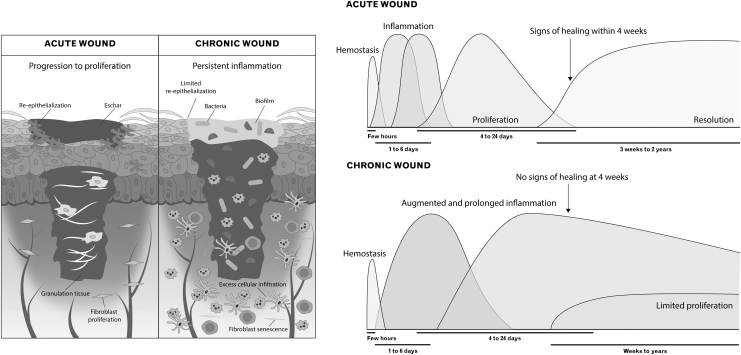
Chronic and acute wounds. Acute wounds typically progress through four phases of healing, with inflammation having two sub-phases, and are characterized by early re-epithelization. Signs of healing tend to occur within 4 weeks. In chronic wounds, hyperproliferation of inflammatory cells, particularly macrophages and neutrophils, results in an augmented and prolonged inflammatory phase. Further, angiogenesis is over-induced, resulting in numerous, but immature and friable microvessels. This establishes a microenvironment that is prone to bacterial infection and biofilm formation. Taken together, these factors limit and delay the proliferative phase and can lead to a lack of resolution even 2 years after wounding.
Figure 4.
Figure 4.
Effects of NPWT. NPWT exerts both macrodeformational and microdeformational forces, both of which are believed to induce angiogenesis and lymphangiogenesis. The mechanisms are multifactorial, but they include increased release of growth factors, edema-induced changes in hydrostatic compression and osmotic tension, and leucocyte elimination during exudate removal. In a recent murine experiment from our group (unpublished data), we showed that NPWT is able to stimulate lymphangiogenesis in diabetic wounds, leading to an overall promotion of healing. NPWT, negative pressure wound therapy.
Figure 5.
Figure 5.
Wound-healing effects of scaffold application. The effects of scaffolds are multiple and varied but can be broadly classified under three main groups: surface adaptation, immune modulation, and structural modification. Superficially, scaffolds can help maintain a moist environment, promoting healing while inhibiting bacterial contamination and biofilm formation. At the immune level, scaffolds have been shown to be able to modify the macrophage population, to reduce cytokine production, and to increase leucocyte migration. Finally, structurally, scaffolds can promote re-epithelization, enhance granulation tissue formation, and improve angiogenesis. The three categories illustrated aim at providing an overview of the effects of scaffold application. Undoubtedly, the response to implanted material is complex and depends on multiple factors beyond the physico-chemical, biomechanical, and immunogenic properties of the scaffold.

References

    1. Soller EC, Tzeranis DS, Miu K, So PTC, Yannas IV. Common features of optimal collagen scaffolds that disrupt wound contraction and enhance regeneration both in peripheral nerves and in skin. Biomaterials 2012;33:4783–4791. - PubMed
    1. Jans R, Sartor M, Jadot M, Poumay Y. Calcium entry into keratinocytes induces exocytosis of lysosomes. Arch Dermatol Res 2004;296:30–41. - PubMed
    1. Liezmann C, Klapp B, Peters EM. Stress, atopy and allergy. Dermatoendocrinol 2011;3:37–40. - PMC - PubMed
    1. Botchkarev VA, Yaar M, Peters EM, et al. . Neurotrophins in skin biology and pathology. J Invest Dermatol 2006;126:1719–1727. - PubMed
    1. Roosterman D, Goerge T, Schneider SW, Bunnett NW, Steinhoff M. Neuronal control of skin function: the skin as a neuroimmunoendocrine organ. Physiol Rev 2006;86:1309–1379. - PubMed

Publication types

LinkOut - more resources