


Using intervention mapping for hookah smoking cessation: a quasi-experimental evaluation
- PMID: 35287728
- PMCID: PMC8919552
- DOI: 10.1186/s13722-022-00287-5
Using intervention mapping for hookah smoking cessation: a quasi-experimental evaluation
Abstract
Background: The present study aimed to evaluate the results of a theory-based and systematic intervention on Hookah Tobacco Smoking (HTS) cessation in women local to Bandar Abbas, Iran.
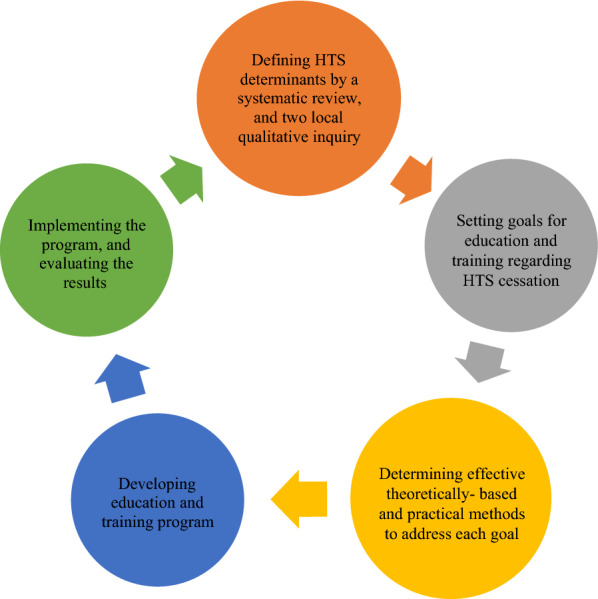
Methods: In the present quasi-experimental research, we used an intervention mapping approach to develop, implement, and evaluate an education and training course as our intervention. Applying the results of a systematic review and two prior local qualitative studies, we identified six HTS determinants and set goals for the intervention. We selected 212 eligible women through systematic stratified random sampling and enrolled them in control and intervention groups. The course was presented to the intervention group in 17 sessions for four months. The educational material was developed to address the goals of the intervention, improve HTS determinants, and change the HTS behavior. We used a questionnaire to collect data on participants' characteristics, HTS behavior, and detailed determinants of HTS in the control and intervention groups at the beginning of the study, at the end of the intervention, and at three- and six- months follow-up. All work done in the study was guided by ethical considerations.
Results: The results showed no significant difference between women enrolled in control and intervention groups regarding participants' characteristics and HTS behavior. At baseline, there were no differences between groups for six determinants of HTS (knowledge, attitude, social norms, self-efficacy, habit, and intention). At the end of the intervention and at three and six months follow-up, the women in the intervention group had significantly better results in all six domains, compared with those in the control group. The rate of HTS abstinence at the end of the intervention and at the three- and six-month follow-ups was 61.3%, 48.5%, and 45.5% for the intervention and 16%, 14.4%, and 10% for the control groups, respectively.
Conclusions: HTS is a complicated behavior, and its cessation is hard. However, Intervention Mapping (IM) can be a powerful integrative, purposeful, theory-based, and participation-based method to reduce or cease HTS. This method should be tested in other settings.
Trial registration: IRCT20190126042494N1, Registered 3.3.2019. https://en.irct.ir/trial/37129.
Keywords: Experiment; Hookah smoking; Intervention mapping; Tobacco; Women.
© 2022. The Author(s).
Conflict of interest statement
The authors have no competing interests to declare.
Figures


References
-
- Mostafa A. Self-reported addiction to and perceived behavioural control of waterpipe tobacco smoking and its patterns in Egypt: policy implications. EMHJ. 2020;26(1-2020):18–28. - PubMed
-
- Shearston JA, Park SH, Lee L, Oshinsky C, Sherman S, Weitzman M. Increasing hookah use among adolescent females in the US: analyses from the 2011–2014 National Youth Tobacco Survey (NYTS) Tobacco Prevent Cessat. 2016;2(September):74.
-
- Villanti AC, Cobb CO, Cohn AM, Williams VF, Rath JM. Correlates of hookah use and predictors of hookah trial in US young adults. Am J Prev Med. 2015;48(6):742–746. - PubMed
-
- Daou KN, Bou-Orm IR, Adib SM. Factors associated with waterpipe tobacco smoking among Lebanese women. Women & Health. 2018;58(3):1–11. - PubMed
Publication types
MeSH terms
Associated data
LinkOut - more resources
Full Text Sources
Medical
Research Materials
