


Over-the-counter provision of emergency contraceptive pills: a systematic review
- PMID: 35288384
- PMCID: PMC8921871
- DOI: 10.1136/bmjopen-2021-054122
Over-the-counter provision of emergency contraceptive pills: a systematic review
Abstract
Objective: To synthesise evidence around over-the-counter (OTC) emergency contraceptive pills (ECPs) to expand the evidence base on self-care interventions.
Design: Systematic review (PROSPERO# CRD42021231625).
Eligibility criteria: We included publications comparing OTC or pharmacy-access ECP with prescription-only ECPs and measuring ECP uptake, correct use, unintended pregnancy, abortion, sexual practices/behaviour, self-efficacy and side-effects/harms. We also reviewed studies assessing values/preferences and costs of OTC ECPs.
Data sources: We searched PubMed, CINAL, LILACS, EMBASE, clinicaltrials.gov, WHO International Clinical Trials Registry Platform, Pan African Clinical Trials Registry, Australian New Zealand Clinical Trials Registry, Cochrane Fertility Regulation and International Consortium for Emergency Contraception through 2 December 2020.
Risk of bias: For trials, we used Cochrane Collaboration's tool for assessing risk of bias; for other studies, we used the Evidence Project risk of bias tool.
Data extraction and synthesis: We summarised data in duplicate using Grading of Recommendations Assessment, Development and Evaluation (GRADE) Evidence Profile tables, reporting findings by study design and outcome. We qualitatively synthesised values/preferences and cost data.
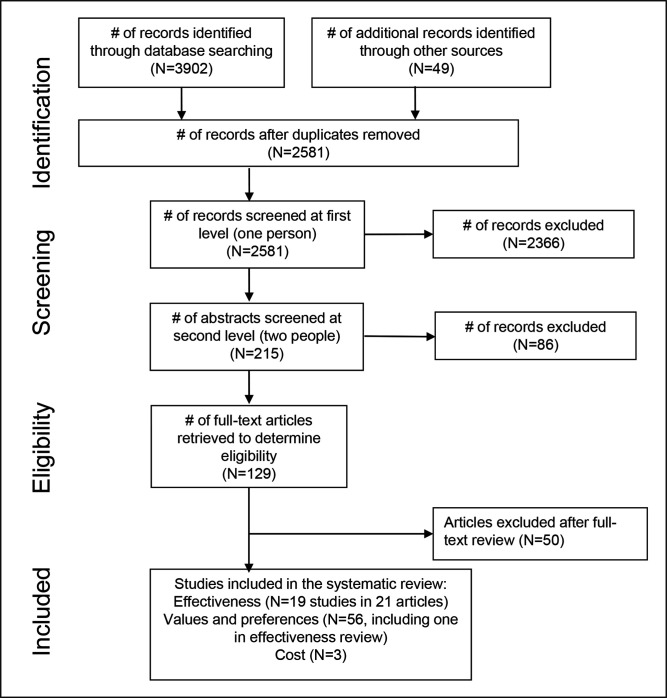
Results: We included 19 studies evaluating effectiveness of OTC ECP, 56 on values/preferences and 3 on costs. All studies except one were from high-income and middle-income settings. Broadly, there were no differences in overall ECP use, pregnancy or sexual behaviour, but an increase in timely ECP use, when comparing OTC or pharmacy ECP to prescription-only ECP groups. Studies showed similar/lower abortion rates in areas with pharmacy availability of ECPs. Users and providers generally supported OTC ECPs; decisions for use were influenced by privacy/confidentiality, convenience, and cost. Three modelling studies found pharmacy-access ECPs would lower health sector costs.
Conclusion: OTC ECPs are feasible and acceptable. They may increase access to and timely use of effective contraception. Existing evidence suggests OTC ECPs do not substantively change reproductive health outcomes. Future studies should examine OTC ECP's impacts on user costs, among key subgroups and in low-resource settings.
Keywords: maternal medicine; organisation of health services; public health; reproductive medicine.
© Author(s) (or their employer(s)) 2022. Re-use permitted under CC BY-NC. No commercial re-use. See rights and permissions. Published by BMJ.
Conflict of interest statement
Competing interests: None declared.
Figures
References
-
- World Health Organization . Medical eligibility criteria for contraceptive use. 5th edn. World Health Organization, 2015. - PubMed
-
- World Health Organization . Selected practice recommendations for contraceptive use. 3rd edn. World Health Organization, 2016. - PubMed
-
- World Health Organization . Emergency contraception. World Health Organization, 2021.
-
- International Consortium for Emergency Contraception . EC status and availability: countries with non-prescription access to EC 2021. Available: https://www.cecinfo.org/country-by-country-information/status-availabili...
Publication types
MeSH terms
Substances
Grants and funding
LinkOut - more resources
Full Text Sources
Research Materials
