. 2022 Mar 14;13(1):1335.
doi: 10.1038/s41467-022-28940-2.

DNA methylation-free Arabidopsis reveals crucial roles of DNA methylation in regulating gene expression and development

Affiliations

DNA methylation-free Arabidopsis reveals crucial roles of DNA methylation in regulating gene expression and development

Li He et al. Nat Commun. .

Abstract

A contribution of DNA methylation to defense against invading nucleic acids and maintenance of genome integrity is uncontested; however, our understanding of the extent of involvement of this epigenetic mark in genome-wide gene regulation and plant developmental control is incomplete. Here, we knock out all five known DNA methyltransferases in Arabidopsis, generating DNA methylation-free plants. This quintuple mutant exhibits a suite of developmental defects, unequivocally demonstrating that DNA methylation is essential for multiple aspects of plant development. We show that CG methylation and non-CG methylation are required for a plethora of biological processes, including pavement cell shape, endoreduplication, cell death, flowering, trichome morphology, vasculature and meristem development, and root cell fate determination. Moreover, we find that DNA methylation has a strong dose-dependent effect on gene expression and repression of transposable elements. Taken together, our results demonstrate that DNA methylation is dispensable for Arabidopsis survival but essential for the proper regulation of multiple biological processes.


Conflict of interest statement

The authors declare no competing interests.

Figures

Fig. 1
Fig. 1. DNA methylation is eliminated in the mddcc mutant.
a Diagrams of the MET1 gene showing the mutation sites in met1-8 (upper) and met1-9 (lower) mutants. Purple bars indicate the position of the sgRNAs used. b Genome-wide distribution of DNA methylation in all three sequence contexts in the indicated mutants. Wireframes are zoom-in of the indicated regions. Biological replicates were combined as one sample. Independent biological replicates are shown in Supplementary Fig. 2a. It should be noted that the lines of the WT overlap with those of ddcc in the mCG row. c Screenshot of DNA methylation levels over one representative locus in the indicated mutants. Orange and blue bars indicate TEs and genes, respectively. TEs and genes oriented 5′–3′ and 3′–5′ are shown above and below the line, respectively. Biological replicates were combined as one sample. Independent biological replicates are shown in Supplementary Fig. 2b. d Comparison of the DNA methylation levels between nuclear and chloroplast genomes in the indicated genotypes. Biological replicates were combined as one sample. Independent biological replicates are shown in Supplementary Fig. 2c. The horizontal line within the box represents the median; the whiskers represent minimum and maximum values; and the lower and upper boundaries of the box represent the 25th and 75th percentiles, respectively.
Fig. 2
Fig. 2. DNA methylation regulates genes expression in a dose-dependent manner.
a Numbers of differentially expressed genes (DEGs) in the indicated mutants relative to WT. b, c Venn diagrams showing the overlap among up-regulated genes (b) or down-regulated genes (c) in ddcc, met1-9, and mddcc mutants. d Flow diagram indicating the criteria for gene classification according to the DNA methylation status in the WT background. Genes with no detectable expression (FPKM < 0.5) in any genotype were excluded. FPKM: fragments per kilobase of exon model per million mapped fragments. e Heat maps showing the expression and DNA methylation patterns of the indicated groups of up-regulated in DNA methyltransferase-deficient mutants. Based on their expression pattern, DEGs methylated in the WT were classified in the following categories: Redundancy (expression increased only in mddcc); Dosage I (expression mildly increased upon loss of CG methylation (in met1-9), and further increased upon loss of non-CG methylation (in mddcc)); Dosage II (expression mildly increased upon loss of non-CG methylation (in ddcc), and further increased upon loss of CG methylation (in mddcc)); and Dosage III (expression weakly increased upon loss of either CG or non-CG methylation (in both met1-9 and ddcc) and further increased upon complete loss of DNA methylation (in mddcc)). f Proportion of DEGs in the gbM, teM, pM, dM, or UM categories in the indicated genotypes. Down: down-regulated; up: up-regulated. Numbers over the bars indicate the total number of genes in each category. Bottom, we randomly selected the same numbers of genes to perform the overlap analysis. g Relative proportion of different categories of methylated genes. The number of genes in each category is indicated. h Proportion of gene types in the indicated DEG subsets. Numbers above the bars indicate the total number of DEGs. i Snapshots of expression and DNA methylation levels over two Intron-teM genes in the indicated mutants. Structure of genes are shown in the bottom. + and − indicate forward and reverse strands in the genome, respectively. Source data are provided as a Source Data file.
Fig. 3
Fig. 3. CG and non-CG methylation jointly repress TE activation and movement.
a Number of differentially expressed TEs (DETs) in the indicated mutants relative to WT. b Venn diagram showing the overlap among up-regulated TEs in ddcc, met1-9, and mddcc mutants. c Heat maps showing the expression and DNA methylation patterns of TEs in the indicated groups. Based on the expression patterns of TEs, TEs were classified into the following categories: Redundancy, Dosage I, Dosage II, and Dosage III (for details, see Fig. 2e). df Circle plots showing TE transposition in different mddcc individual plants. Arrows start and end represent the original and inserted sites of transposed TEs, respectively. The red/green/blue arrows indicate that the transposed TE belongs to the ATCOPIA21, ATENSPM3, or VANDAL21 subfamily, respectively. gi Products of PCR amplification with paired primers flanking new insertion sites or a transposon-specific primer and a primer flanking the new insertion site in the indicated genotypes. Black arrows indicate primers. Upper panels: screenshots from Integrative Genomic Viewer (IGV) showing split-reads for TE insertions. Lower panels, coordinate lines indicate the sequence contexts of the new insertion sites. j Snapshots of expression and DNA methylation levels over transposed TEs in the indicated mutants. Source data are provided as a Source Data file.
Fig. 4
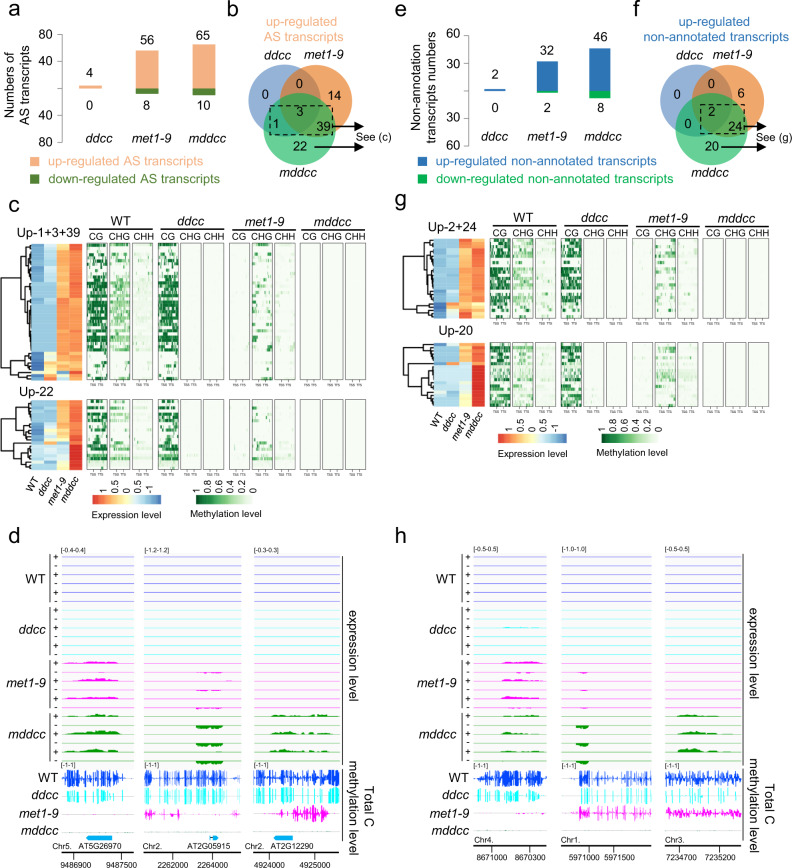
Fig. 4. DNA methylation represses the expression of antisense and non-annotated transcripts.
a Numbers of differentially expressed antisense (AS) transcripts in the indicated mutants relative to WT. b Venn diagram showing the overlap among up-regulated AS transcripts in ddcc, met1-9, and mddcc mutants. c Heat maps showing the expression and DNA methylation patterns of the antisense transcripts in the indicated groups. d Snapshots of expression and DNA methylation levels over three antisense transcript genes in the indicated mutants. e Number of differentially expressed non-annotated transcripts in the indicated mutants relative to WT. f Venn diagram showing the overlap among up-regulated non-annotated transcripts in ddcc, met1-9, and mddcc mutants. g Heat maps showing the expression and DNA methylation patterns of the non-annotated transcripts in the indicated groups. h Snapshots of expression and DNA methylation levels over three non-annotated transcripts in the indicated mutants.
Fig. 5
Fig. 5. The mddcc mutant exhibits a suite of extreme developmental defects and fails to flower.
a Phenotypes of 11-day-old seedlings of the indicated genotypes on 1/2 MS media. Scale bar, 1 cm. b Phenotypes of 35-day-old plants of the indicated genotypes. After growing for 14 days on 1/2 MS media, the plants were transplanted into soil for 21 days of growth. Based on the rosette radius, the phenotypes of the mddcc mutant were classified into Weak, Medium and Strong, as indicated; the bar plot shows the relative abundance of each of these categories. c The mddcc mutant never flowers. Left, bar pot showing the flowering times of the indicated genotypes grown in long-day conditions. The data are the means ± SD of the biological repeats (n = 13). Right, phenotypes of 84-day-old and 125-day-old mddcc plants. After growing for 14 days on 1/2 MS media, the plants were transplanted into soil for 70 or 111 days of growth. Scale bar, 1 cm. d Heat maps showing the expression and DNA methylation patterns of flower development-related genes (upper panel), cytoskeleton organization-related genes (middle panel), and trichome differentiation-related genes (lower panel) in the indicated genotypes. Flower development-related genes (see Supplementary Data 1) were selected from the overlap between GO:0009908 (flower development) and DEGs in mddcc. Cytoskeleton organization-related genes (see Supplementary Data 1) were selected from microtubule-related GO terms over-represented in the subset of down-regulated genes common to met1-9 and mddcc (Fig. 2c). Trichome differentiation-related genes (see Supplementary Data 1) were identified from the overlap between GO:0010026 (trichome differentiation) and down-regulated genes in mddcc. e Snapshots of expression and DNA methylation levels over AT4G25530 (FWA) in the indicated mutants. f Representative images of pavement cell morphology of cotyledons from 11-day-old WT, ddcc, met1-9, and mddcc seedlings. Cell outlines were visualized with PI. Scale bar: 100 μm. Experiments were independently repeated two times with similar results. g Trichome branch number in WT, ddcc, met1-9, and mddcc. The numbers above the bars indicate the total number of trichomes analyzed. Trichomes were observed from the first true leaf of 11-day-old plants. Source data are provided as a Source Data file.
Fig. 6
Fig. 6. CG and non-CG methylation jointly regulate the activity of RAM.
a Quantification of root length of 9-day-old WT, ddcc, met1-9, and mddcc seedlings. The data are the means ± SD of the biological repeats. b Representative images of EdU labeling in the RAM of roots of 11-day-old WT, ddcc, met1-9, and mddcc seedlings. Images framed with a red dotted line show a higher exposure version of the images on the left. Scale bar: 50 μm. Experiments were independently repeated two times with similar results. c Distance from the QC to xylem lignification in roots of 9-day-old WT, ddcc, met1-9, and mddcc mutants. The data are the means ± SD of the biological repeats. d Cleared roots stained with calcofluor white (blue) and basic fuchsin (red). White arrowheads indicate the site of appearance of the first protoxylem cells; red arrowheads indicate root hairs. Scale bar: 100 μm. Experiments were independently repeated two times with similar results. e Representative images of root meristems from 9-day-old WT, ddcc, met1-9, and mddcc seedlings. Cell outlines were visualized with calcofluor white. Blue and white arrowheads indicate the QC and the cortex transition boundary, respectively. Scale bars: 100 μm. Experiments were independently repeated two times with similar results. Source data are provided as a Source Data file.

References

    1. Zhang H, Lang Z, Zhu JK. Dynamics and function of DNA methylation in plants. Nat. Rev. Mol. Cell Biol. 2018;19:489–506. - PubMed
    1. Law JA, Jacobsen SE. Establishing, maintaining and modifying DNA methylation patterns in plants and animals. Nat. Rev. Genet. 2010;11:204–220. - PMC - PubMed
    1. Jullien PE, Susaki D, Yelagandula R, Higashiyama T, Berger F. DNA methylation dynamics during sexual reproduction in Arabidopsis thaliana. Curr. Biol. 2012;22:1825–1830. - PubMed
    1. Bond DM, Baulcombe DC. Small RNAs and heritable epigenetic variation in plants. Trends Cell Biol. 2014;24:100–107. - PubMed
    1. Pikaard CS, Mittelsten, Scheid O. Epigenetic regulation in plants. Cold Spring Harb. Perspect. Biol. 2014;6:a019315. - PMC - PubMed

Publication types

MeSH terms

Substances