. 2022 Apr 18;145(2):700-712.
doi: 10.1093/brain/awab350.

Diagnostic accuracy of cerebrospinal fluid biomarkers in genetic prion diseases

Affiliations

Diagnostic accuracy of cerebrospinal fluid biomarkers in genetic prion diseases

Matthias Schmitz et al. Brain. .

Abstract

Genetic prion diseases are a rare and diverse group of fatal neurodegenerative disorders caused by pathogenic sequence variations in the prion protein gene, PRNP. Data on CSF biomarkers in patients with genetic prion diseases are limited and conflicting results have been reported for unclear reasons. Here, we aimed to analyse the diagnostic accuracy of CSF biomarkers currently used in prion clinical diagnosis in 302 symptomatic genetic prion disease cases from 11 prion diagnostic centres, encompassing a total of 36 different pathogenic sequence variations within the open reading frame of PRNP. CSF samples were assessed for the surrogate markers of neurodegeneration, 14-3-3 protein (14-3-3), total-tau protein (t-tau) and α-synuclein and for prion seeding activity through the real-time quaking-induced conversion assay. Biomarker results were compared with those obtained in healthy and neurological controls. For the most prevalent PRNP pathogenic sequence variations, biomarker accuracy and associations between biomarkers, demographic and genetic determinants were assessed. Additionally, the prognostic value of biomarkers for predicting total disease duration from symptom onset to death was investigated. High sensitivity of the four biomarkers was detected for genetic Creutzfeldt-Jakob disease associated with the E200K and V210I mutations, but low sensitivity was observed for mutations associated with Gerstmann-Sträussler-Scheinker syndrome and fatal familial insomnia. All biomarkers showed good to excellent specificity using the standard cut-offs often used for sporadic Creutzfeldt-Jakob disease. In genetic prion diseases related to octapeptide repeat insertions, the biomarker sensitivity correlated with the number of repeats. New genetic prion disease-specific cut-offs for 14-3-3, t-tau and α-synuclein were calculated. Disease duration in genetic Creutzfeldt-Jakob disease-E200K, Gerstmann-Sträussler-Scheinker-P102L and fatal familial insomnia was highly dependent on PRNP codon 129 MV polymorphism and was significantly associated with biomarker levels. In a large cohort of genetic prion diseases, the simultaneous analysis of CSF prion disease biomarkers allowed the determination of new mutation-specific cut-offs improving the discrimination of genetic prion disease cases and unveiled genetic prion disease-specific associations with disease duration.

Keywords: biomarker; cerebrospinal fluid; diagnostic marker; genetic prion diseases.


Figures

Figure 1
Figure 1
Evaluation of biomarker values in the different diagnostic groups. The levels of 14-3-3 (measured by ELISA) (A), t-tau (B) and α-syn (C) were measured in healthy controls (HC), neurological disease controls (ND), gCJD-E200K, gCJD-V210I, GSS-P102L and FFI cases. (D) RT-QuIC maximum RFU was also recorded in the same diagnostic groups. Data are plotted on a logarithmic scale, except RT-QuIC RFU data. Horizontal bars represent mean and standard error (SE). Differences among diagnostic groups were tested with Tobit models and Tukey contrasts after controlling the effect of age, sex and cohort, as explained in the ‘Materials and methods’ section. Resultant corrected P-values for pair-wise group comparisons: HC versus ND 14-3-3 P < 0.0001, t-tau P = 0.7421, α-syn P = 0.7880, RT-QuIC not available (NA); HC versus gCJD-E200K P < 0.0001, t-tau P < 0.0001, α-syn P < 0.0001, RT-QuIC NA; HC versus gCJD-V210I 14-3-3 P < 0.0001, t-tau P < 0.0001, α-syn P < 0.0001, RT-QuIC NA; HC versus GSS-P102L 14-3-3 P < 0.0001, t-tau P < 0.0001, α-syn P < 0.0001, RT-QuIC NA; HC versus FFI 14-3-3 P < 0.0001, t-tau P < 0.0001, α-syn P = 0.0107, RT-QuIC NA; ND versus gCJD-E200K P < 0.0001, t-tau P < 0.0001, α-syn P < 0.0001, RT-QuIC NA; ND versus gCJD-V210I 14-3-3 P < 0.0001, t-tau P < 0.0001, α-syn P < 0.0001, RT-QuIC NA; ND versus GSS-P102L 14-3-3 P < 0.0001, t-tau P < 0.0001, α-syn P < 0.0001, RT-QuIC NA; ND versus FFI 14-3-3 P < 0.0001, t-tau P < 0.0001, α-syn P = 0.1084, RT-QuIC NA; gCJD-E200K versus gCJD-V210I 14-3-3 P = 0.0113, t-tau P = 0.0020, α-syn P = 0.0060, RT-QuIC P = 0.9430; gCJD-E200K versus GSS-P102L 14-3-3 P = 0.1383, t-tau P = 0.0099, α-syn P = 0.0057, RT-QuIC P < 0.0001; gCJD-E200K versus FFI 14-3-3 P < 0.0001, t-tau P < 0.0001, α-syn P < 0.0001, RT-QuIC P < 0.0001; gCJD-V210I versus GSS-P102L 14-3-3 P < 0.0001, t-tau P < 0.0001, α-syn P < 0.0001, RT-QuIC P < 0.0001; gCJD-V210I versus FFI 14-3-3 P < 0.0001, t-tau P < 0.0001, α-syn P < 0.0001, RT-QuIC P < 0.0001; GSS-P102L versus FFI 14-3-3 P = 0.0004, t-tau P = 0.0789, α-syn P = 0.0327, RT-QuIC P = 0.8256.
Figure 2
Figure 2
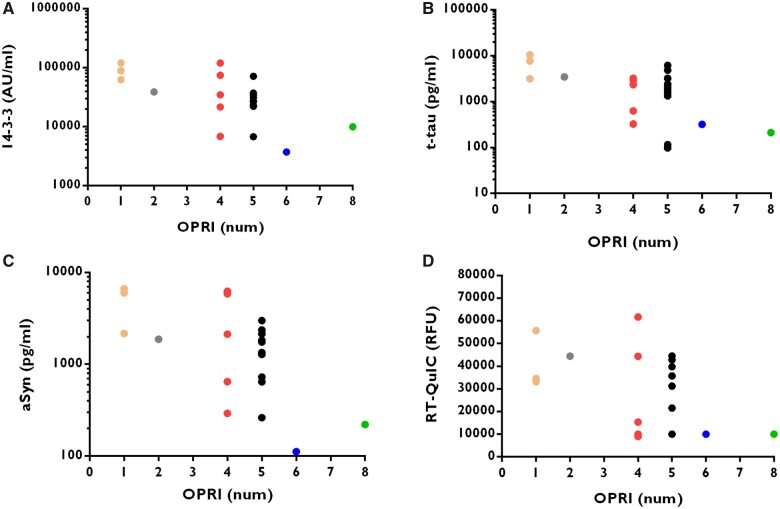
Biomarker concentration is related to the number of OPRI. The levels of 14-3-3 (A), t-tau (B) and α-syn (C) were measured in genetic OPRI cases. RT-QuIC maximum RFU was also recorded in the same cases (D). Data are plotted on a logarithmic scale, except RT-QuIC RFU data. Association between the biomarker value and number of insertions was measured with Kendall’s tau (shown together with related P-value), which is a non-parametric correlation coefficient (cc) as explained in the ‘Materials and methods’ section. For 14-3-3 we calculated cc = −0.433, P = 0.0035, for t-tau cc = −0.3714, P = 0.0125, for α-syn cc = −0.4190 P = 0.0045, and for RT-QuIC cc = −0.2810, P = 0.0486. The figure shows that the number of OPRI is indirectly related to the biomarker level—the lower the OPRI, the higher the biomarker level.
Figure 3
Figure 3
Disease duration (and the effect of codon 129 MV genotype) in the four most common genetic prion disease mutations in our cohort. (A) Disease duration in gCJD-E200K, gCJD-V210I, GSS-P102L and FFI cases is represented as Kaplan–Meier survival curves. (BE) Hazard ratios (HR) and associated Tukey-corrected P-values were obtained with Cox proportional hazards (PH) models for each disease group (B: gCJD-E200K; C: gCJD-V210I; D: GSS-P102L; and E: FFI).Differences in disease duration depending on PRNP codon 129 MV genotype were represented with Kaplan–Meier curves. Hazard ratios and associated P-values are shown. Because of low case numbers, the VV genotype was not included. Accommodating age, sex and PRNP codon 129 MV genotype as covariates, we obtained following pair-wise differences between diagnostic groups: gCJD-E200K versus FFI HR = 1.8239, P = 0.010; GSS-P102L versus FFI HR = 0.1469, P < 0.001; gCJD-V210I versus FFI HR 2.3580, P < 0.001; GSS-P102L versus gCJD-E200K HR = 0.0806, P < 0.001; gCJD-V210I versus gCJD-E200K HR 1.2928, P = 0.528; gCJDV210I versus GSS-P102L HR 16.0483, P < 0.001. *No statistics were computed in the GSS-P102L group due to low number of MV cases.

References

    1. Tee BL, Longoria Ibarrola EM, Geschwind MD. Prion Diseases. Neurol Clin. 2018;36(4):865–897. - PubMed
    1. Schmitz M, Dittmar K, Llorens F, et al. . Hereditary human prion diseases: An update. Mol Neurobiol. 2017;54(6):4138–4112. - PubMed
    1. Takada LT, Kim M-O, Cleveland RW, et al. . Genetic prion disease: Experience of a rapidly progressive dementia center in the United States and a review of the literature. Am J Med Genet Part B Neuropsychiatr Genet. 2017;174(1):36–69. - PMC - PubMed
    1. Gambetti P, Kong Q, Zou W, Parchi P, Chen SG.. Sporadic and familial CJD: Classification and characterisation. Br Med Bull. 2003;66:213–239. - PubMed
    1. Goldfarb LG, Petersen RB, Tabaton M, et al. . Fatal familial insomnia and familial Creutzfeldt–Jakob disease: Disease phenotype determined by a DNA polymorphism. Science. 1992;258(5083):806–808. - PubMed

Publication types

MeSH terms