Classification of 27 Corynebacterium kroppenstedtii-Like Isolates Associated with Mastitis in China and Descriptions of C. parakroppenstedtii sp. nov. and C. pseudokroppenstedtii sp. nov
- PMID: 35289670
- PMCID: PMC9045094
- DOI: 10.1128/spectrum.01372-21
Classification of 27 Corynebacterium kroppenstedtii-Like Isolates Associated with Mastitis in China and Descriptions of C. parakroppenstedtii sp. nov. and C. pseudokroppenstedtii sp. nov
Abstract
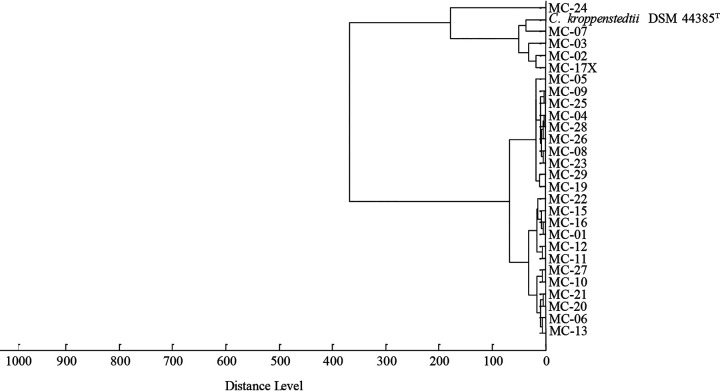
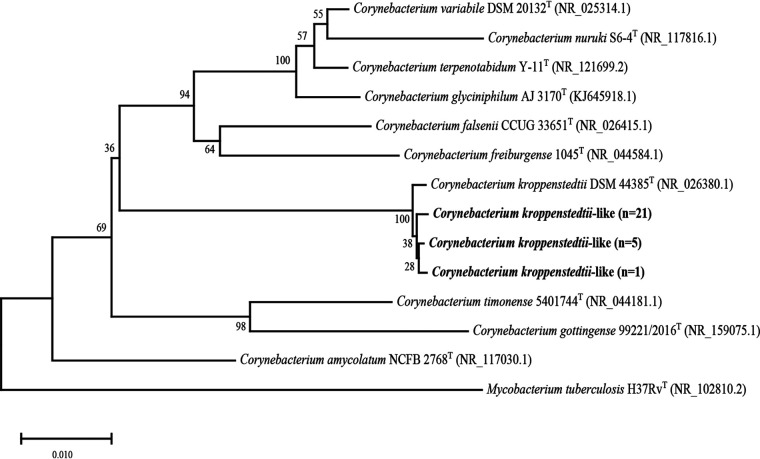
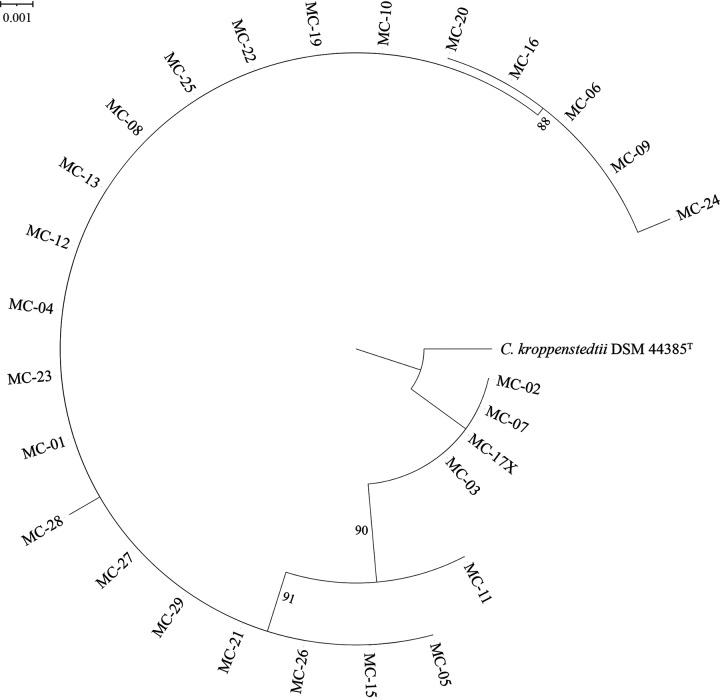
Corynebacterium, particularly Corynebacterium kroppenstedtii, has been increasingly recognized as an important pathogen causing mastitis. However, no clear taxonomic, microbiological, or clinical identification for C. kroppenstedtii-related Corynebacterium species is recognized. During the investigation of isolates cultured from female patients with mastitis, 27 lipophilic C. kroppenstedtii-like isolates were obtained from clinical breast specimens from 2017 to 2019 in Guangzhou, China. These isolates were identified by phenotypic characterization, matrix-assisted laser desorption ionization-time of flight mass spectrometry (MALDI-TOF MS), partial sequencing of the 16S rRNA, rpoB, and fusA genes, and whole-genome sequencing methods. By phylogenetic analyses, two major clusters were identified that were closely related to C. kroppenstedtii DSM 44385T. Comparative genome analyses suggested that these isolates formed two distinct genospecies within the genus Corynebacterium. The digital DNA-DNA hybridization (dDDH) values for the two genospecies were 45.5 to 47.8% between them and 47.4 to 47.7% and 49.9% to C. kroppenstedtii DSM 44385T, respectively. Based on these results, it can be concluded that these isolates need to be recognized as two new species of the genus Corynebacterium, for which we proposed the names Corynebacterium parakroppenstedtii sp. nov. and Corynebacterium pseudokroppenstedtii sp. nov. The type strain for the novel species Corynebacterium parakroppenstedtii is MC-26T (NBRC 115146T; CCTCC AB 2020210T), and that for Corynebacterium pseudokroppenstedtii is MC-17XT (NBRC 115143T; CCTCC AB 2020199T). IMPORTANCE In this study, we characterized two novel species that were closely related to but hard to distinguish from C. kroppenstedtii by routine identification methods used in clinical laboratories. Since all 27 C. kroppenstedtii-like isolates were obtained from breast specimens of female patients with mastitis, they may be potential pathogens causing mastitis. We hope to perform further epidemiological investigation of these strains and explore their role in mastitis.
Keywords: Corynebacterium; antimicrobial susceptibility; breast pathogens; mastitis; taxonomy.
Conflict of interest statement
The authors declare no conflict of interest.
Figures
References
Publication types
MeSH terms
Substances
Supplementary concepts
LinkOut - more resources
Full Text Sources
Medical
Molecular Biology Databases