. 2022 Apr 27;10(2):e0201321.
doi: 10.1128/spectrum.02013-21. Epub 2022 Mar 15.

A Novel Antimicrobial Peptide Derived from Bony Fish IFN1 Exerts Potent Antimicrobial and Anti-Inflammatory Activity in Mammals

Affiliations

A Novel Antimicrobial Peptide Derived from Bony Fish IFN1 Exerts Potent Antimicrobial and Anti-Inflammatory Activity in Mammals

Xun Xiao et al. Microbiol Spectr. .

Abstract

Type I interferons (IFN-Is) are critical antiviral cytokine in innate immunity but with limited direct defense ability against bacterial infections in mammals. In bony fish, despite all the IFN-Is (IFN1-4) act in antiviral immunity, studies demonstrate that IFN1 can remarkably contribute to host defense against bacterial infections. In this study, we found that IFN1 from grass carp (Ctenopharyngodon idella) contains an unusual cationic and amphipathic α-helical region (named as gcIFN-20, sequence: SYEKKINRHFKILKKNLKKK). The synthesized peptide gcIFN-20 could form α-helical structure in a membrane environment and exerts potent antimicrobial activity against multiple species of Gram-negative (G-) and Gram-positive (G+) bacteria with negligible toxicity. Mechanism studies showed gcIFN-20 kills G+ bacteria through membrane disruption and cytoplasm outflow while G- bacteria through membrane permeation and protein synthesis inhibition. In two mouse bacterial infection models, gcIFN-20 therapy could significantly reduce tissue bacterial loads and mortalities. In addition to the direct antibacterial activity, we also found that gcIFN-20 could significantly suppress the lipopolysaccharide (LPS)-induced pro-inflammatory cytokines in vitro and in vivo, obviously alleviated lung lesions in a mouse endotoxemia model. The mechanism is that gcIFN-20 interacts with LPS, causes LPS aggregation and neutralization. The antimicrobial and anti-inflammatory activities in vivo of gcIFN-20 in mammalian models suggested a promising agent for developing peptide-based antibacterial therapy. IMPORTANCE Type I interferons play crucial role in antiviral immunity in both vertebrates and invertebrates. The powerful antimicrobial activity is recently reported in nonmammalian vertebrates. The present study identified a novel antimicrobial peptide (gcIFN-20) derived from grass carp interferon 1, found gcIFN-20 exhibits forceful bactericidal and anti-inflammatory activity in mammals, and efficient therapeutic effect against two clinical severe extraintestinal pathogenic Escherichia coli and a mouse endotoxemia models. The antimicrobial mechanisms are membrane disruption and cytoplasm overflow for Gram-positive bacteria, while membrane permeation and protein synthesis inhibition for Gram-negative bacteria. The anti-inflammatory mechanisms can be aggregating and neutralizing lipopolysaccharide to attenuate the binding with receptors and facilitate phagocytosis. The results indicate that gcIFN-20 can be a promising novel therapeutic agent for bacterial diseases and inflammatory disorders, especially as a potential weapon for multidrug resistant strain infections.

Keywords: anti-inflammation; antimicrobial peptide; bactericidal activity; gcIFN-20; lipopolysaccharide neutralization.


Conflict of interest statement

The authors declare no conflict of interest.

Figures
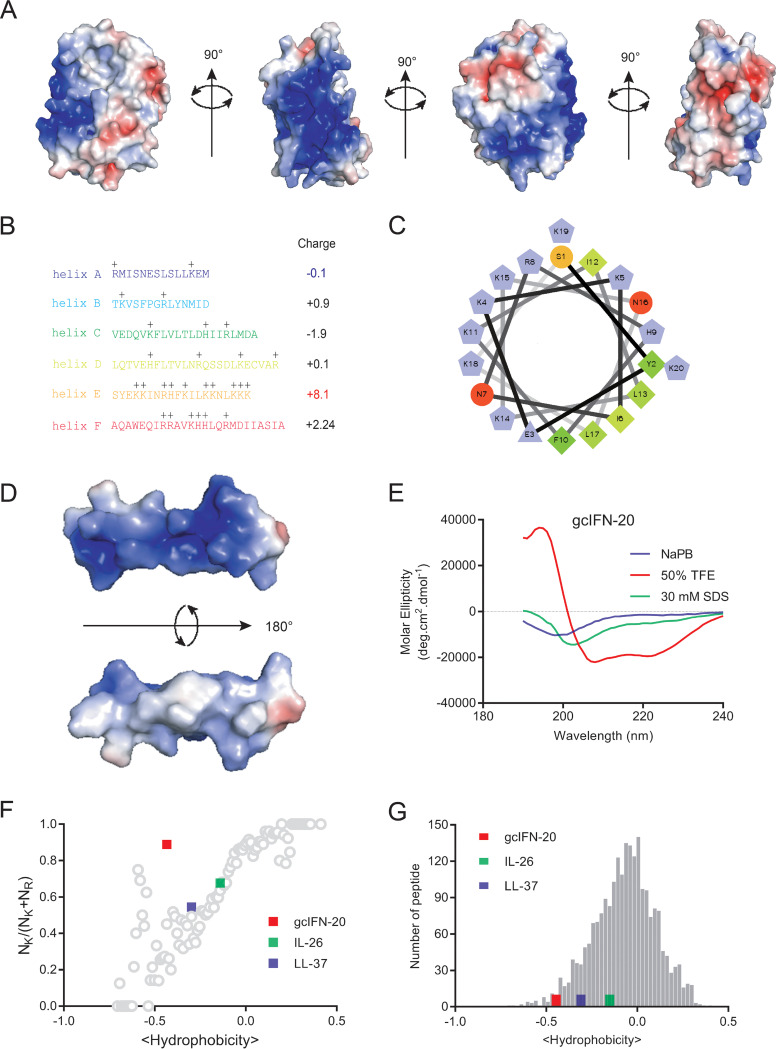
FIG 1
FIG 1
The structural features of gcIFN-20. (A) Color-coded electrostatic potentials were mapped onto the surfaces of gcIFN1. Areas with positive charges are shown in blue, negative charges are in red, and hydrophobic residues are in white. (B) Amino acid sequences and positive charges in gcIFN1 α-helices. Total net charge of every helix is shown on the right. (C) Helical wheel plot of gcIFN-20 illustrates the facial amphipathicity along the helical axis. Charged hydrophilic residues are in violet (positive residues K, R, H in pentagons and negative residue E in triangle), uncharged hydrophilic residues are in orange (S) and red (N), and hydrophobic residues are in green (F, L, I, Y). (D) Color-coded electrostatic potentials were mapped onto the surface of gcIFN-20. Areas with positive charges are shown in blue, negative charge is in red, and hydrophobic residues are in white. (E) The CD spectra of gcIFN-20 (70 μM) in 50 μM NaPB, 50% TFE, or 30 mM SDS. (F) Relationship between positively charged amino acid residues (NK/[NK + NR]) and average peptide hydrophobicity for 2,237 cationic AMPs in the AMP database (gray circles). Human LL-37 and IL-26 were plotted for references. (G) Comparison of hydrophobicity between gcIFN-20 and AMPs. Histograms depict the distribution of hydrophobicity among the 2,237 cationic AMPs in the AMP database (gray bars). Human LL-37 and IL-26 were presented for references.
FIG 2
FIG 2
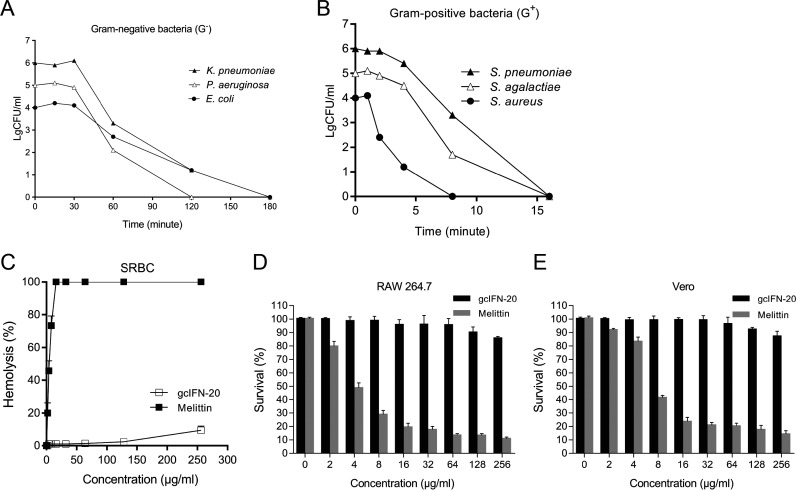
Potent bactericidal activity and low toxicity of gcIFN-20 in vitro and in vivo. (A and B) Time-kill curves of gcIFN-20 (4×MBC90) against G and G+ bacteria, respectively. The six bacterial strains are K. pneumoniae (ATCC 13883), P. aeruginosa (ATCC 9027), E. coli (ATCC 25922), S. pneumoniae (ATCC 49619), S. agalactiae (ATCC 13813) and S. aureus (ATCC 25923). (C) Hemolytic activity of gcIFN-20 was measured with SRBC, and melittin was used as the control. (D and E) The cytotoxicity of gcIFN-20 toward RAW 264.7 cells and Vero cells were examined by MTT assay, respectively. All the experiments were performed in triplicate. Data were presented as means ± SD.
FIG 3
FIG 3
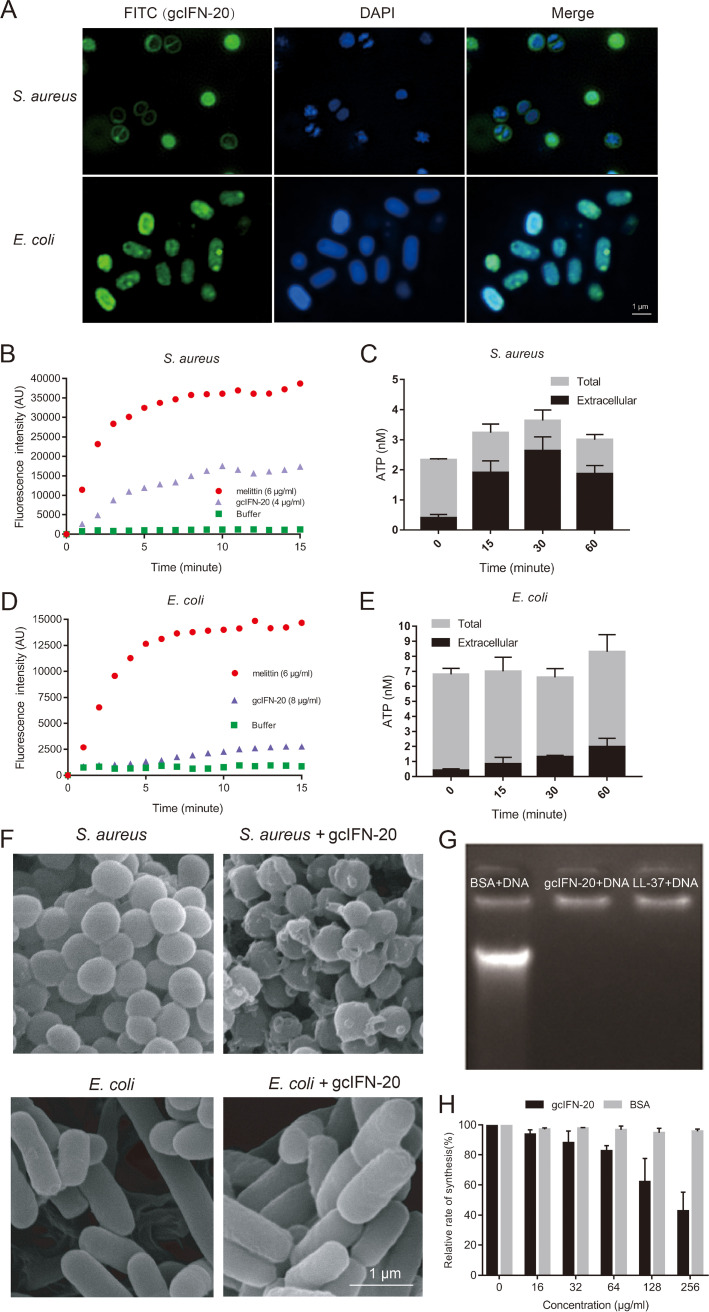
Bactericidal mechanisms of gcIFN-20. (A) Localizations of FITC-gcIFN-20 in bacteria. S. aureus and E. coli were incubated with FITC-gcIFN-20 (0.5×MBC90), respectively. The cultures were washed and stained with DAPI (blue). Images were taken using SIM. (B) SYTOX Green uptake in S. aureus. Melittin was used as the positive control. Fluorescence was recorded every minute. (C) The measurement of total and extracellular ATP at different time after treatment of S. aureus with gcIFN-20 (2×MBC90) (n = 3). (D) SYTOX Green uptake in E. coli. (E) The measurement of total and extracellular ATP at different time after treatment of E. coli with gcIFN-20 (2×MBC90) (n = 3). (F) S. aureus (upper panel) and E. coli (lower panel) were cultured for 15 min without or with 10 μM gcIFN-20 and then visualized by SEM, respectively. (G) Gel shift assay for E. coli DNA mixed with gcIFN-20. BSA and LL-37 serve as the negative and positive controls, respectively. (H) The effect of gcIFN-20 and BSA (control) with different concentrations on the relative rate of E. coli bacterial protein synthesis in a cell-free assay. All the experiments were run in triplicate. Data were shown as means ± SD.
FIG 4
FIG 4
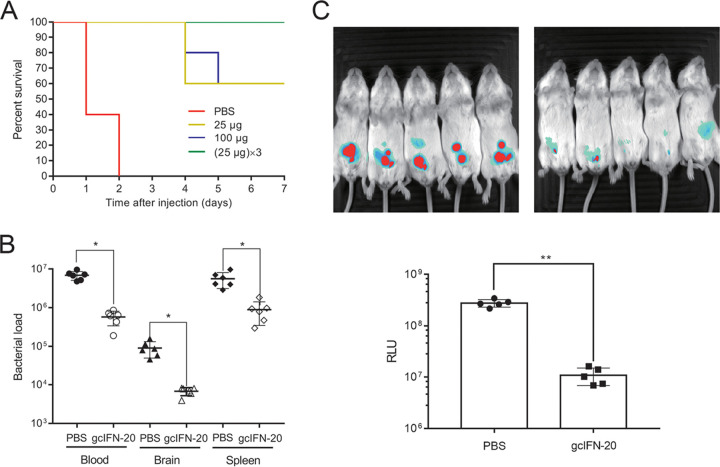
Potent bactericidal activity of gcIFN-20 in vivo. (A) Survival rates in mice were examined by injection with E. coli PCN033 and gcIFN-20 (n = 10). (B) Bacterial loads in mouse blood (CFU/mL), brain (CFU/g), and spleen (CFU/g) (gcIFN-20 25 μg/mouse) at 12 h post bacterial injection (n = 6). (C) IVIS analysis of the antimicrobial activity of gcIFN-20 (25 μg/mouse) in vivo against E. coli RS218. Bacterial loads were displayed in the image with an overlay of bioluminescence. False color imaging for strong luminescence was in red and mild luminescence in blue. The total flux was quantified by the IVIS software (n = 5). Data were presented as means ± SD. In vivo data were statistically analyzed via unpaired nonparametric Mann-Whitney U-test. * indicates P ≤ 0.01.
FIG 5
FIG 5
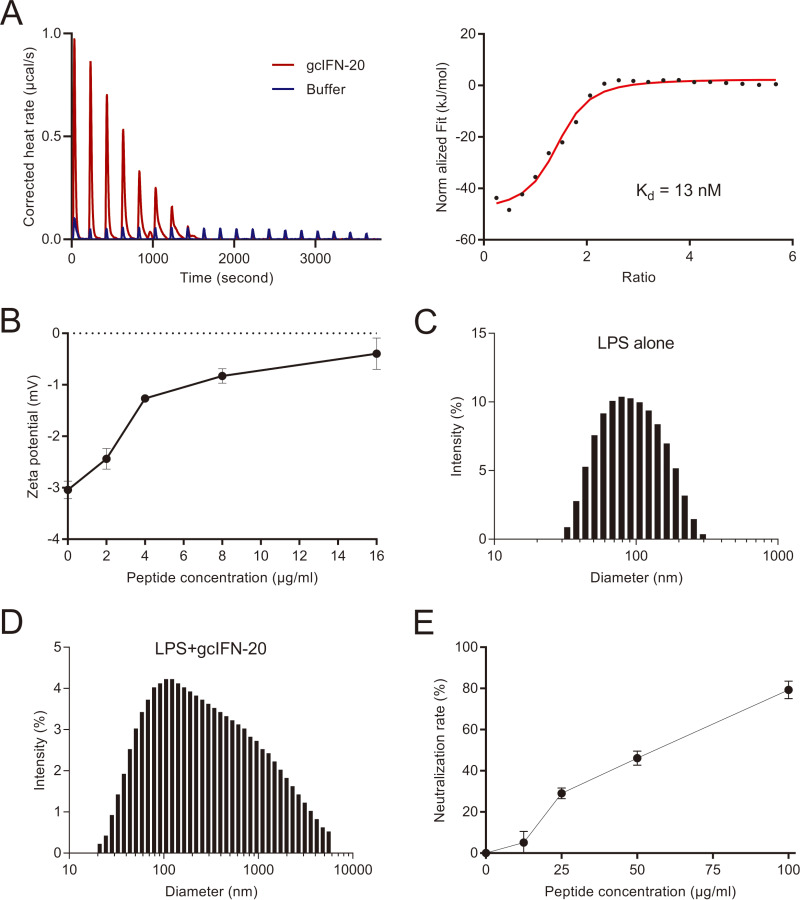
LPS neutralization activity and mechanisms of gcIFN-20. (A) The specific interaction between gcIFN-20 and LPS was investigated by ITC. The corrected titration data and integrated heat measurements were shown on the left and right plots, respectively. The solid line on the right panel represents the best fit to a one-site binding model for the interaction between gcIFN-20 and LPS. (B) The effect of gcIFN-20 on the zeta potentials of LPS aggregates. (C) Particle size distribution of ultrapure LPS. (D) Particle size distribution of LPS in the presence of gcIFN-20 (200 μg/mL). (E) LPS neutralization activity of gcIFN-20 was examined by LAL assay. All the experiments were conducted in triplicate. Data were shown as means ± SD.
FIG 6
FIG 6
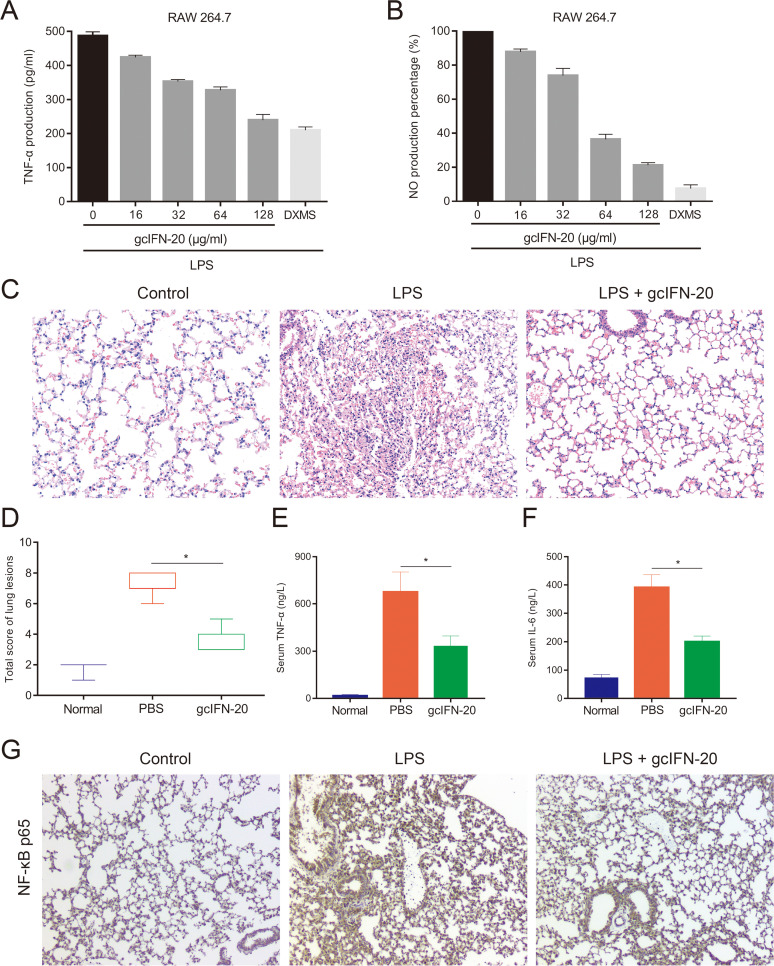
Anti-inflammatory activity of gcIFN-20 in LPS-induced RAW 264.7 cells and mice. The productions of TNF-α (A) and NO (B) were investigated in RAW 264.7 cells, respectively. Dexamethasone serves as the control. (C) The protective effect of gcIFN-20 on lung tissue in an endotoxemia mouse model (n = 6). (D) The total lung lesion scores were generated in a blinded manner by a certified pathologist according to a semiquantitative scoring method. (E and F) The suppression of the LPS-stimulated TNF-α and IL-6 release in endotoxemia mice by gcIFN-20, respectively. (G) Immunohistochemical analysis of NF-κB p65 in the lung slices of experimental mice. All the experiments were performed in triplicate. Data were presented as means ± SD.

References

    1. Hancock RE, Haney EF, Gill EE. 2016. The immunology of host defence peptides: beyond antimicrobial activity. Nat Rev Immunol 16:321–334. doi: 10.1038/nri.2016.29. - DOI - PubMed
    1. Nguyen LT, Haney EF, Vogel HJ. 2011. The expanding scope of antimicrobial peptide structures and their modes of action. Trends Biotechnol 29:464–472. doi: 10.1016/j.tibtech.2011.05.001. - DOI - PubMed
    1. Hancock REW, Alford MA, Haney EF. 2021. Antibiofilm activity of host defence peptides: complexity provides opportunities. Nat Rev Microbiol 19:786–797. doi: 10.1038/s41579-021-00585-w. - DOI - PubMed
    1. Haney EF, Straus SK, Hancock REW. 2019. Reassessing the host defense peptide landscape. Front Chem 7:43. doi: 10.3389/fchem.2019.00043. - DOI - PMC - PubMed
    1. Magana M, Pushpanathan M, Santos AL, Leanse L, Fernandez M, Ioannidis A, Giulianotti MA, Apidianakis Y, Bradfute S, Ferguson AL, Cherkasov A, Seleem MN, Pinilla C, de la Fuente-Nunez C, Lazaridis T, Dai T, Houghten RA, Hancock REW, Tegos GP. 2020. The value of antimicrobial peptides in the age of resistance. Lancet Infect Dis 20:e216–e230. doi: 10.1016/S1473-3099(20)30327-3. - DOI - PubMed

Publication types

LinkOut - more resources