


Evolution and conservation genetics of an insular hemiparasitic plant lineage at the limit of survival: the case of Thesium sect. Kunkeliella in the Canary Islands
- PMID: 35289923
- PMCID: PMC9415105
- DOI: 10.1002/ajb2.1830
Evolution and conservation genetics of an insular hemiparasitic plant lineage at the limit of survival: the case of Thesium sect. Kunkeliella in the Canary Islands
Abstract
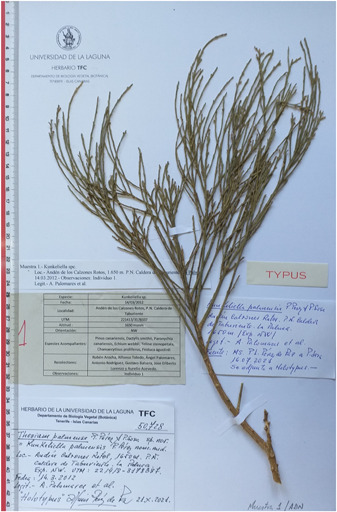
Premise: The diversification of island flora has been widely studied. However, the role of environmental niches in insular radiation processes has been less investigated. We combined population genetic analyses with species distribution modelling to clarify the genetic relationships, diversification patterns, species niche requirements, and conservation of Thesium sect. Kunkeliella, a clade of rare hemiparasitic plants endemic to the Canaries.
Methods: We studied the three extant Thesium species and a new taxon from La Palma Island. We developed 12 microsatellites and performed population genetic analysis and studied the demographic history of the group. To evaluate the role of niche conservatism in the diversification of the group, we performed species distribution modelling (ESM) with four algorithms.
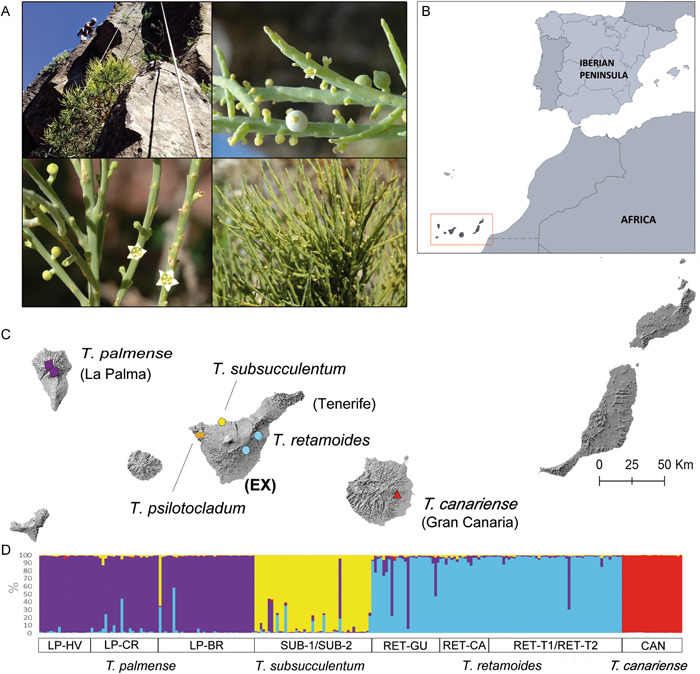
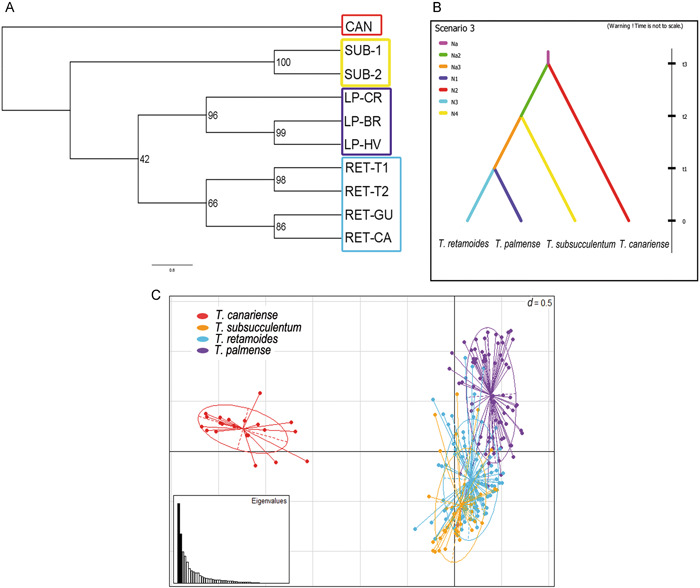
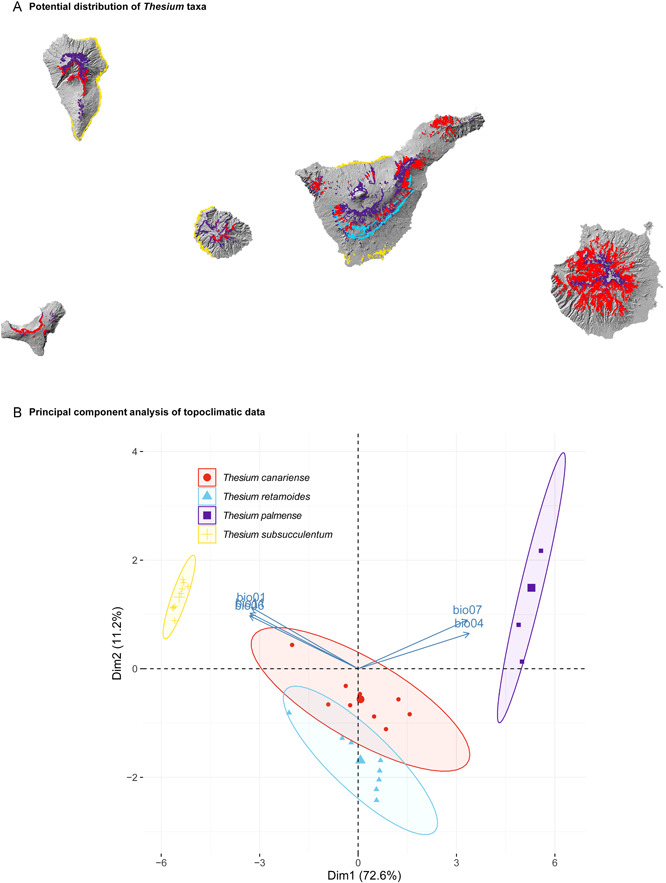
Results: All species presented moderate genetic diversity values for rare endemics. Thesium canariense (Gran Canaria) showed high differentiation, whereas T. subsucculentum, T. retamoides (Tenerife), and La Palma populations are closely related. The lineage may have undergone a recent diversification with colonization proceeding east to west, with T. canariense as sister to the others. We detected a climatic niche shift, as taxa showed different distributions across the temperature gradient. There is enough evidence to describe La Palma populations as a new species.
Conclusions: We characterized the evolutionary history of Thesium sect. Kunkeliella by integrating genetic and ecological assessments. Our results indicate that this clade has undergone a recent radiation process with niche differentiation among species. The results increase our knowledge about insular radiations and will inform the conservation management of the study species.
Keywords: Santalaceae; endangered species; endemic; insular radiation; microsatellites; niche conservatism; species distribution modeling.
© 2022 Botanical Society of America.
Figures
References
-
- Aguilar, R. , Quesada M., Ashworth L., Herrerias‐Diego Y., and Lobo J.. 2008. Genetic consequences of habitat fragmentation in plant populations: susceptible signals in plant traits and methodological approaches. Molecular Ecology 17: 5177–5188. - PubMed
-
- Albaladejo, R. G. , Martín‐Hernanz S., Reyes‐Betancourt J. A., Santos‐Guerra A., Olangua‐Corral M., Aparicio A., Reyes‐Betancort J. A., et al. 2020. Reconstruction of the spatio‐temporal diversification and ecological niche evolution of Helianthemum (Cistaceae) in the Canary Islands using genotyping‐by‐sequencing data. Annals of Botany 9: mcaa0 90. - PMC - PubMed
-
- Ascaso, J. , and Pedrol J.. 2002. Santalaceae. In López Sáez J. L., Catalán P., and Sáez Ll. [eds.], Plantas parásitas de la Península Ibérica y Baleares, 300–320. Ediciones Mundi Prensa, Madrid, Spain.
-
- Bañares‐Baudet, Á. , Blanca G., Güemes J., Moreno‐Saiz J. C., and Ortiz S.. 2004. Atlas y libro rojo de la flora vascular amenazada de España. Dirección General de Conservación de la Naturaleza, Madrid, Spain.
-
- Barrera Acosta, J. , González González R., and Beltrán Tejera E.. 2011. Kunkeliella subsucculenta. The IUCN red list of threatened species: e.T161943A5517012. International Union for Conservation of Nature, Gland, Switzerland. Website: https://www.iucnredlist.org/species/161943/5517012 [accessed 8 February 2022].
Publication types
MeSH terms
LinkOut - more resources
Full Text Sources
