doi: 10.3201/eid2805.220197.
Epub 2022 Mar 15.
Duration of Infectious Virus Shedding by SARS-CoV-2 Omicron Variant-Infected Vaccinees
- PMID: 35290176
- PMCID: PMC9045443
- DOI: 10.3201/eid2805.220197
Item in Clipboard
Duration of Infectious Virus Shedding by SARS-CoV-2 Omicron Variant-Infected Vaccinees
Emerg Infect Dis.
2022 May.
Abstract
To determine virus shedding duration, we examined clinical samples collected from the upper respiratory tracts of persons infected with severe acute respiratory syndrome coronavirus 2 Omicron variant in Japan during November 29-December 18, 2021. Vaccinees with mild or asymptomatic infection shed infectious virus 6-9 days after onset or diagnosis, even after symptom resolution.
Keywords: 2019 novel coronavirus disease; COVID-19; Japan; Omicron; SARS-CoV-2; coronavirus disease; respiratory infections; severe acute respiratory syndrome coronavirus 2; vaccines; variant of concern; viral shedding; viruses; zoonoses.
Figures
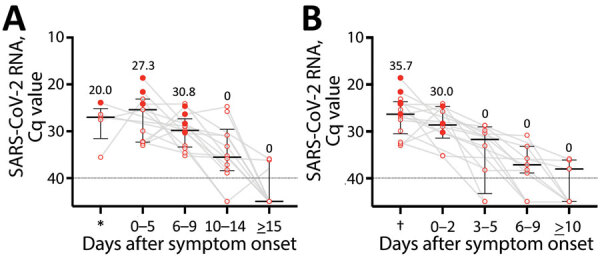
SARS-CoV-2 RNA level and infectious virus shedding in upper respiratory samples from symptomatic patients infected with the SARS-CoV-2 Omicron variant, Japan, November 29–December 18, 2021. A) SARS-CoV-2 RNA levels and presence of the infectious virus, by date of symptom onset. Each closed circle indicates case-patients from whom virus was isolated. Numbers above each plot indicate the proportion of case-patients from whom virus was isolated in each period. Black lines indicate median Cq values and error bars interquartile ranges; dotted lines indicate negative cutoff values. *Before symptom onset. B) SARS-CoV-2 RNA levels and presence of infectious virus, by date of symptom resolution. Closed circles indicate patients from whom virus was isolated. Numbers above each plot indicate the proportion of persons from whom virus was isolated in each period. Black lines indicate median Cq values and error bars interquartile ranges; dotted lines indicate cutoff values. †Before symptom resolution. Cq, quantification cycle; SARS-CoV-2, severe acute respiratory syndrome coronavirus 2.
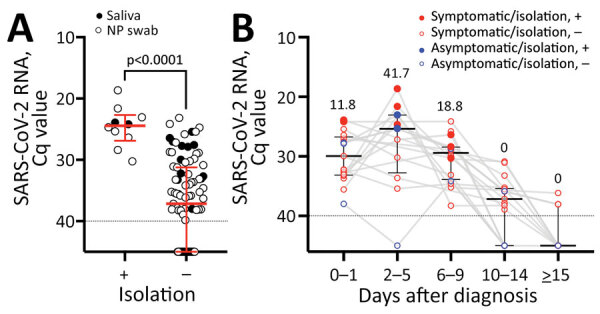
SARS-CoV-2 RNA level and infectious virus shedding in all upper respiratory samples from patients infected with the SARS-CoV-2 Omicron variant, Japan, November 29–December 18, 2021. A) SARS-CoV-2 RNA levels in NP swab samples (open circles) and saliva (closed circles) with or without infectious virus. Red lines indicate median Cq values and error bars interquartile ranges; dotted lines indicate negative cutoff values. The Cq values between samples from which infectious virus was isolated and samples from which infectious virus was not isolated were compared by using the Mann-Whitney test. B) SARS-CoV-2 RNA levels and presence of infectious virus organized by the days after diagnosis. Red circles indicate symptomatic case-patients; blue circles indicate asymptomatic case-patients; each closed circle indicates case-patients from whom virus was isolated. Numbers above each plot indicate the proportion of case-patients from whom virus was isolated in each period. Black lines indicate median Cq values and error bars interquartile ranges; dotted lines indicate negative cutoff values. Cq, quantification cycle; NP, nasopharyngeal; SARS-CoV-2, severe acute respiratory syndrome coronavirus 2; +, with infectious virus; –, without infectious virus.
References
-
- World Health Organization. Classification of omicron (B1.1.529): SARS-CoV-2 variant of concern [cited 2022 Mar 9]. https://www.who.int/news/item/26-11-2021-classification-of-omicron-(b.1....
-
- Maruki T, Iwamoto N, Kanda K, Okumura N, Yamada G, Ishikane M, et al. Two cases of breakthrough SARS-CoV-2 infections caused by the Omicron variant (B.1.1.529 lineage) in international travelers to Japan. [Online ahead of print.]. Clin Infect Dis. 2022;•••:ciab1072. 10.1093/cid/ciab1072 - DOI - PMC - PubMed
-
- The National Institute for Communicable Diseases. The daily COVID-19 effective reproductive number (R) in the public sector of South Africa (week 48 of 2021) [cited 2022 Mar 10]. https://www.nicd.ac.za/wp-content/uploads/2021/12/The-Daily-COVID-19-Eff...
-
- UK Health Security Agency. SARS-CoV-2 variants of concern and variants under investigation in England: technical briefing 32 [cited 2022 Mar 10]. https://assets.publishing.service.gov.uk/government/uploads/system/uploa...
MeSH terms
Supplementary concepts
LinkOut - more resources
Full Text Sources
Other Literature Sources
Medical
Miscellaneous