


Battery technology and recycling alone will not save the electric mobility transition from future cobalt shortages
- PMID: 35292628
- PMCID: PMC8924274
- DOI: 10.1038/s41467-022-29022-z
Battery technology and recycling alone will not save the electric mobility transition from future cobalt shortages
Abstract
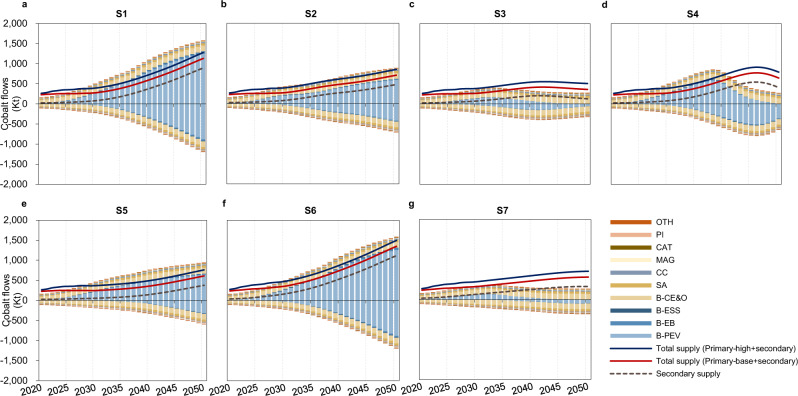
In recent years, increasing attention has been given to the potential supply risks of critical battery materials, such as cobalt, for electric mobility transitions. While battery technology and recycling advancement are two widely acknowledged strategies for addressing such supply risks, the extent to which they will relieve global and regional cobalt demand-supply imbalance remains poorly understood. Here, we address this gap by simulating historical (1998-2019) and future (2020-2050) global cobalt cycles covering both traditional and emerging end uses with regional resolution (China, the U.S., Japan, the EU, and the rest of the world). We show that cobalt-free batteries and recycling progress can indeed significantly alleviate long-term cobalt supply risks. However, the cobalt supply shortage appears inevitable in the short- to medium-term (during 2028-2033), even under the most technologically optimistic scenario. Our results reveal varying cobalt supply security levels by region and indicate the urgency of boosting primary cobalt supply to ensure global e-mobility ambitions.
© 2022. The Author(s).
Conflict of interest statement
The authors declare no competing interests.
Figures



References
-
- van Vuuren DP, et al. Alternative pathways to the 1.5 °C target reduce the need for negative emission technologies. Nat. Clim. Change. 2018;8:391–397.
-
- Kitzing L, Jensen MK, Telsnig T, Lantz E. Multifaceted drivers for onshore wind energy repowering and their implications for energy transition. Nat. Energy. 2020;5:1012–1021.
-
- Li J, et al. Critical rare-earth elements mismatch global wind-power ambitions. One Earth. 2020;3:116–125.
-
- Rasmussen KD, Wenzel H, Bangs C, Petavratzi E, Liu G. Platinum demand and potential bottlenecks in the global green transition: a dynamic material flow analysis. Environ. Sci. Technol. 2019;53:11541–11551. - PubMed
Publication types
MeSH terms
Substances
LinkOut - more resources
Full Text Sources
Miscellaneous
