


Clinical and demographic factors associated with pediatric difficult intravenous access in the operating room
- PMID: 35293066
- PMCID: PMC9310763
- DOI: 10.1111/pan.14438
Clinical and demographic factors associated with pediatric difficult intravenous access in the operating room
Abstract
Background: Pediatric intravenous catheter insertion can be difficult in the operating room due to the technical challenges of small diameter vessels and the need to rapidly gain intravenous access in anesthetized children. Few studies have examined factors associated with difficult vascular access in the operating room, especially accounting for the increased possibility to use ultrasound guidance.
Aims: The primary aim of the study was to identify factors associated with pediatric difficult vascular access in the operating room. Our primary hypothesis was that Black race, Hispanic ethnicity, and ultrasound use would be associated with pediatric difficult vascular access.
Methods: We performed a retrospective analysis of prospectively collected data from a cohort of pediatric patients who had intravenous catheters inserted in the operating room at an academic tertiary care children's hospital from March 2020 to February 2021. We measured associations among patients who were labeled as having difficult vascular access (>2 attempts at access) with demographic, clinical, and hospital factors.
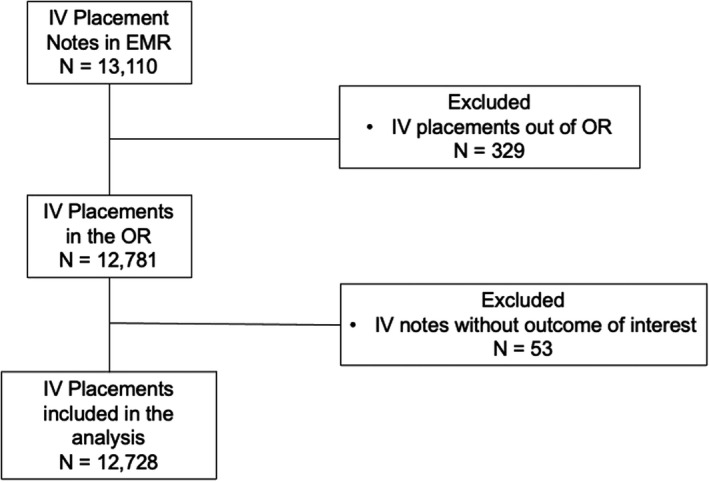
Results: 12 728 intravenous catheter insertions were analyzed. Multivariable analysis showed significantly higher odds of difficult vascular access with Black non-Hispanic race (1.43, 95% CI: 1.06-1.93, p = .018), younger age (0.93, 95% CI: 0.89-0.98, p = .005), overweight (1.41, 95% CI: 1.04-1.90, p = .025) and obese body mass index (1.56, 95% 95% CI: 1.12-2.17, p = .008), and American Society of Anesthesiologists physical status III (1.54, 95% CI:1.11-2.13, p = .01). The attending anesthesiologist compared to all other practitioners (certified registered nurse anesthetist: (0.41, 95% CI: 0.31-0.56, p < .001, registered nurse: 0.25, 95% CI: 0.13-0.48, p < .001, trainee: 0.21, 95% CI: 0.17-0.28, p-value <.001 with attending as reference variable) and ultrasound use (2.61, 95% CI: 1.85-3.69, p < .001) were associated with successful intravenous catheter placement.
Conclusions: Black non-Hispanic race/ethnicity, younger age, obese/overweight body mass index, American Society of Anesthesiologists physical status III, and ultrasound were all associated with pediatric difficult vascular access in the operating room.
Keywords: catheterization; catheters; child; healthcare disparities; institutional practice; interventional; logistic models; peripheral; retrospective studies; risk factors; ultrasonography.
© 2022 The Authors. Pediatric Anesthesia published by John Wiley & Sons Ltd.
Conflict of interest statement
None.
Figures
Comment in
-
"Mining large data on small veins to inform pediatric perioperative difficult intravenous access".Paediatr Anaesth. 2022 Jul;32(7):790-791. doi: 10.1111/pan.14472. Paediatr Anaesth. 2022. PMID: 35665569 No abstract available.
References
-
- Hall MJ, Schwartzman A, Zhang J, Liu X. Ambulatory surgery data from hospitals and ambulatory surgery centers: United States, 2010. Natl Health Stat Report. 2017;102:1‐15. - PubMed
-
- Cuper NJ, de Graaff JC, van Dijk AT, Verdaasdonk RM, van der Werff DB, Kalkman CJ. Predictive factors for difficult intravenous cannulation in pediatric patients at a tertiary pediatric hospital. Pediatr Anesth. 2012;22(3):223‐229. - PubMed
-
- Panebianco NL, Fredette JM, Szyld D, Sagalyn EB, Pines JM, Dean AJ. What you see (sonographically) is what you get: vein and patient characteristics associated with successful ultrasound‐guided peripheral intravenous placement in patients with difficult access. Acad Emerg Med. 2009;16(12):1298‐1303. - PubMed
-
- Reigart JR, Chamberlain KH, Eldridge D, et al. Peripheral intravenous access in pediatric inpatients. Clin Pediatr (Phila). 2012;51(5):468‐472. - PubMed
-
- Rauch D, Dowd D, Eldridge D, Mace S, Schears G, Yen K. Peripheral difficult venous access in children. Clin Pediatr (Phila). 2009;48(9):895‐901. - PubMed
MeSH terms
LinkOut - more resources
Full Text Sources
