. 2022 Apr;33(7-8):371-388.
doi: 10.1089/hum.2022.050.

Human and Insect Cell-Produced Recombinant Adeno-Associated Viruses Show Differences in Genome Heterogeneity

Affiliations

Human and Insect Cell-Produced Recombinant Adeno-Associated Viruses Show Differences in Genome Heterogeneity

Ngoc Tam Tran et al. Hum Gene Ther. 2022 Apr.

Abstract

In the past two decades, adeno-associated virus (AAV) vector manufacturing has made remarkable advancements to meet large-scale production demands for preclinical and clinical trials. In addition, AAV vectors have been extensively studied for their safety and efficacy. In particular, the presence of empty AAV capsids and particles containing "inaccurate" vector genomes in preparations has been a subject of concern. Several methods exist to separate empty capsids from full particles; but thus far, no single technique can produce vectors that are free of empty or partial (non-unit length) capsids. Unfortunately, the exact genome compositions of full, intermediate, and empty capsids remain largely unknown. In this work, we used AAV-genome population sequencing to explore the compositions of DNase-resistant, encapsidated vector genomes produced by two common production pipelines: plasmid transfection in human embryonic kidney cells (pTx/HEK293) and baculovirus expression vectors in Spodoptera frugiperda insect cells (rBV/Sf9). Intriguingly, our results show that vectors originating from the same construct design that were manufactured by the rBV/Sf9 system produced a higher degree of truncated and unresolved species than those generated by pTx/HEK293 production. We also demonstrate that empty particles purified by cesium chloride gradient ultracentrifugation are not truly empty but are instead packaged with genomes composed of a single truncated and/or unresolved inverted terminal repeat (ITR). Our data suggest that the frequency of these "mutated" ITRs correlates with the abundance of inaccurate genomes in all fractions. These surprising findings shed new light on vector efficacy, safety, and how clinical vectors should be quantified and evaluated.

Keywords: HEK293; Sf9; adeno-associated virus; gene therapy; vector heterogeneity.


Conflict of interest statement

G.G. is a scientific cofounder of Voyager Therapeutics and Aspa Therapeutics and holds equity in these companies. G.G. is an inventor on patents with potential royalties licensed to Voyager Therapeutics, Aspa Therapeutics, and other biopharmaceutical companies. The remaining authors declare no competing interests. M.P.-B. and E.A. are inventors of patents related to AAV gene therapy licensed to biopharma companies. K.W. is a full-time employee of Pacific Biosciences, a company commercializing SMRT sequencing technologies.

Figures
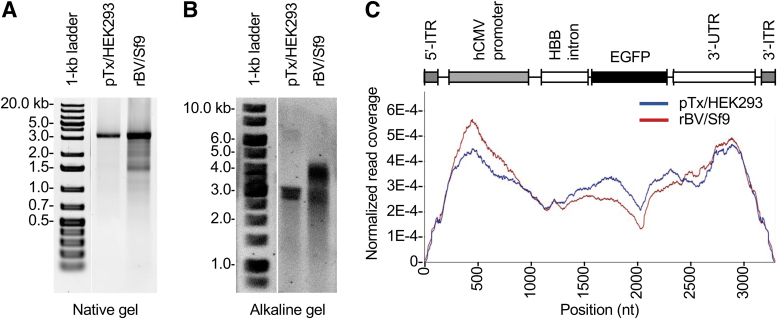
Figure 1.
Figure 1.
Encapsidated DNA evaluation of pTx/HEK293- and rBV/Sf9-produced AAV vectors. (A) Native agarose gel of rAAV DNA. The 3.3-kb band represents the full-length ITR-to-ITR vector genomes. Additional bands represent heterogeneous species. (B) Alkaline agarose gel of rAAV DNAs. (C) Profiling vector genomes by SSV-Seq. The reference genome is displayed above the individual coverage traces of the pTx/HEK293-produced vector (blue) and the rBV/Sf9-produced vector (red). Reads are normalized to sequencing read counts from a vector plasmid construct prepared by restriction enzyme digestion to liberate a double-strand fragment spanning from the 5′-ITR to the 3′-ITR. Coverage of the ITRs is reduced compared with the rest of the genome as a result of the ITRs strong secondary structure, differences in flip and flop configurations, and PCR bias across GC-rich sequences and homopolymers. ITR, inverted terminal repeat; PCR, polymerase chain reaction; rAAV, recombinant adeno-associated virus; rBV, recombinant baculovirus vector; SSV-Seq, single-stranded DNA virus sequencing.
Figure 2.
Figure 2.
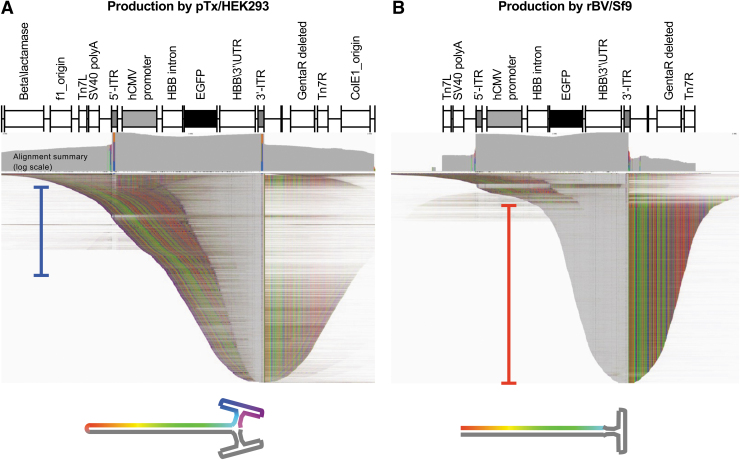
Production platform-related differences in vector genomes. (A) IGV display of pTx/HEK293-produced vector reads aligned to the trans plasmid reference. (B) rBV/HEK293-produced vector reads were aligned to a reference spanning from the left and right Tn7 elements. Alignment summaries are shown above in log scale. Reads are shown with 100-read down sampling with soft-clipped bases shown to highlight reads of unique length and composition. The portion of reads matching the reference are in gray, mismatches are shown as colored bases. Deletions appear as speckles in this squished display. Structures depicting truncated double-ITR species (blue-bracketed reads) and truncated single-ITR species (red-bracketed reads) are shown below each plot. IGV, Integrative Genomics Viewer.
Figure 3.
Figure 3.
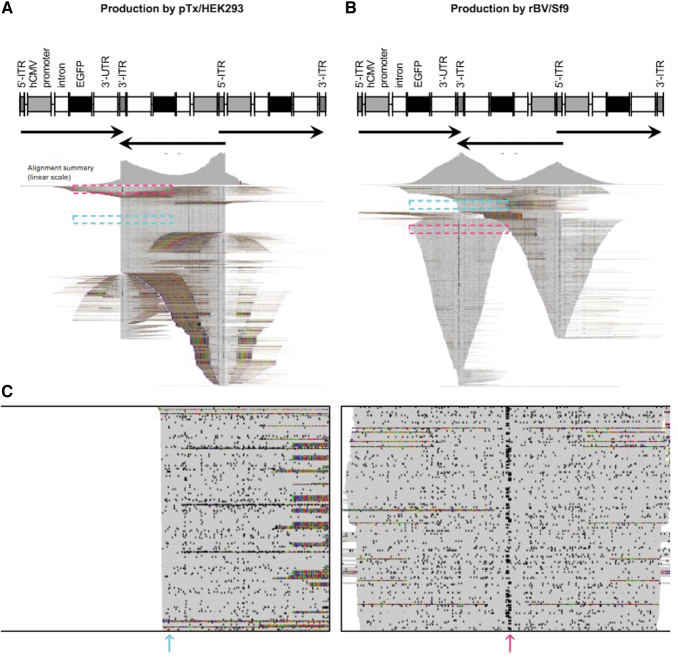
Vector reads aligned to an unresolved trimer reference reveal differential vector heterogeneity. (A, B) Displays of the pTx/HEK293-produced (A) and rBV/Sf9-produced (B) vector reads aligned to a reference that represents a predicted three-unit genome linked together by unresolved ITRs to capture species that have unresolved 5′-ITRs or 3′-ITRs. Alignment summaries are shown. Arrows indicate transgene direction. Dashed cyan and magenta boxes show populations of resolved and unresolved 3′-ITRs, respectively. (C) Zoom-in of cyan and magenta boxes from (B), respectively, representing reads with resolved (left) and unresolved 3-ITRs (right). Read matches (gray), mismatches (colored), and deletions (speckles) are shown in squished display. Cyan and magenta arrows show read regions with low and high degrees of deletions at the ITR, respectively.
Figure 4.
Figure 4.
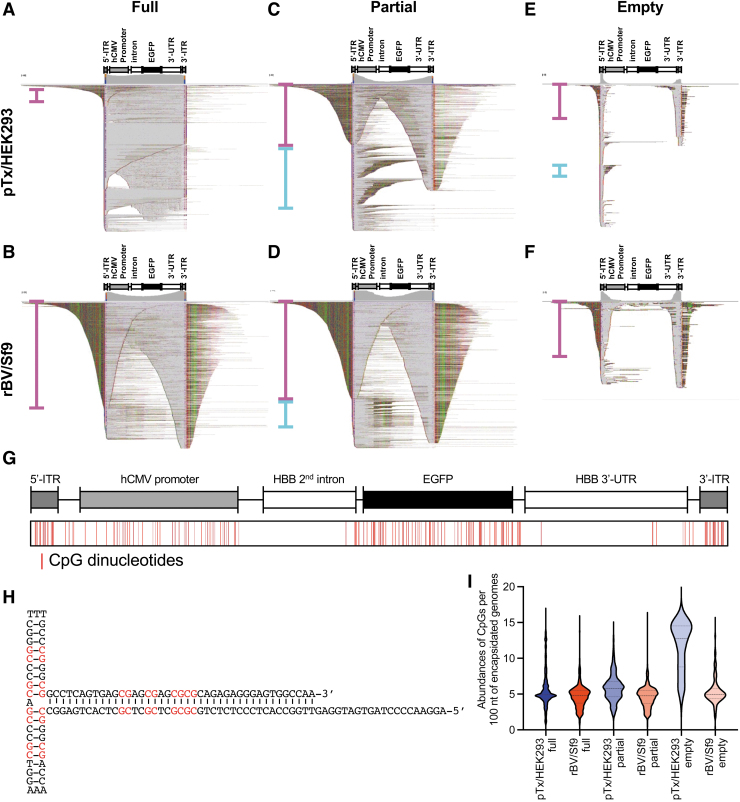
Differential vector heterogeneity between density gradient fractions. (A–F) Sequencing reads obtained from full (A, B), partial (C, D), and empty fractions (E, F) from pTx/HEK293-produced vectors (A, C, E) and rBV/Sf9-produced vectors (B, D, F). 5′-sorted alignments reveal variable abundances of single-ITR (magenta brackets) and double-ITR (cyan brackets) self-complementary genomes. (G) Diagram depicting the position of CpGs throughout the reference genome. (H) Structure of the AAV2 ITR highlighting the 16 CpGs (red). (I) Violin plot showing the abundances of CpGs per 100 nt of sequence among pTx/HEK293- (blue) and rBV/Sf9-produced (red) vector fractions. Dashed lines represent the data median, and dotted lines indicate upper and lower quartiles.
Figure 5.
Figure 5.
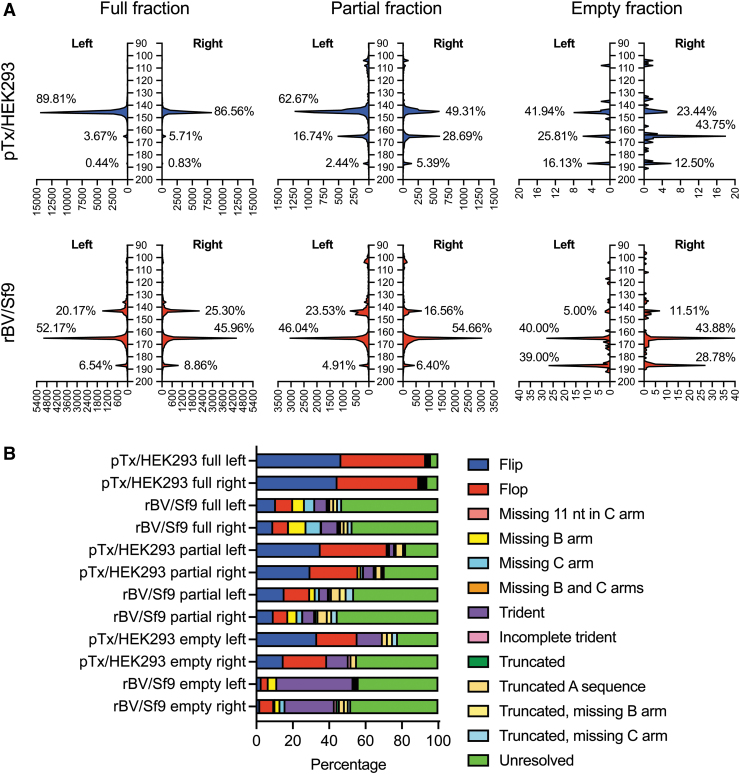
Differences in ITR heterogeneity between capsid fractions and production methods. (A) Distribution of ITR lengths among full, partial, and empty capsid fractions. Traces of left and right ITRs are shown for pTx/HEK293-produced vectors (top) and rBV/Sf9-produced vectors (bottom). The percentages of ITRs are calculated as the ITR counts within each peak over all counts integrated across sequences with lengths of 90–200 nt. (B) Thirteen ITR species were identified among all capsid fractions of the two production methods. Their abundances in samples are expressed as a percentage of all ITR counts properly categorized into the designated types.
Figure 6.
Figure 6.
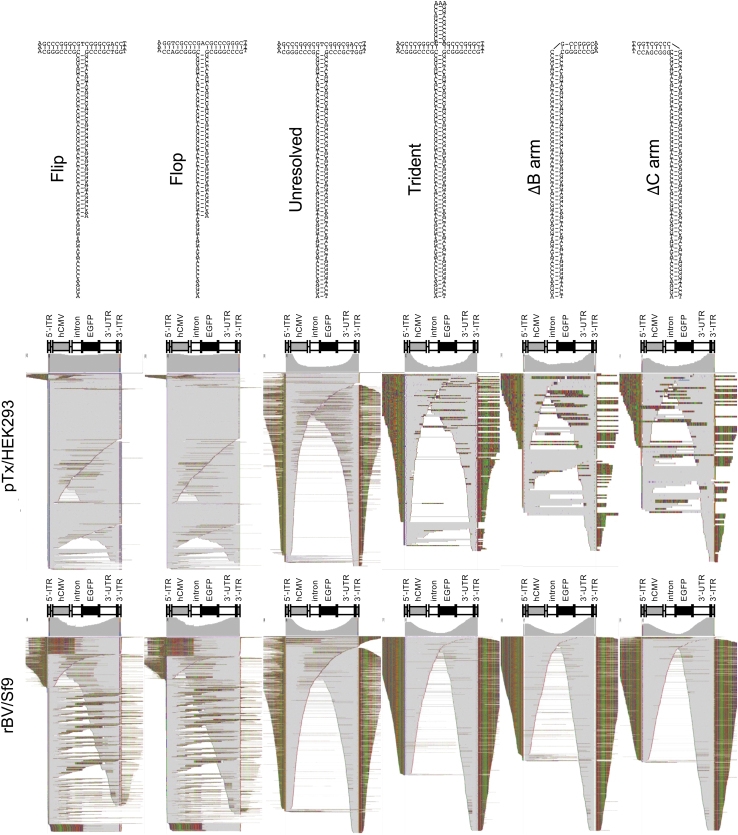
Differential genome heterogeneity among vectors that harbor different ITR species. Sequencing reads that harbor the five ITR species: flip, flop, unresolved, trident-shaped, B arm-deleted, or C arm-deleted configurations were extracted from the full capsid fractions of the pTx/HEK293-produced vectors (top) and rBV/Sf9-produced vectors (bottom). Reads were remapped to the vector genome reference. Aligned reads are displayed with soft-clipped bases shown. Alignment summary tracks are displayed above each plot. The portion of reads that perfectly align with the reference are in gray; mismatched bases are colored; deletions are shown as black dashes and appear as speckles throughout the squished display.

References

    1. Kuzmin DA, Shutova MV, Johnston NR, et al. . The clinical landscape for AAV gene therapies. Nat Rev Drug Discov 2021;20:173–174. - PubMed
    1. Keeler AM, Flotte TR. Recombinant adeno-associated virus gene therapy in light of luxturna (and zolgensma and glybera): where are we, and how did we get here? Annu Rev Virol 2019;6:601–621. - PMC - PubMed
    1. Rodrigues GA, Shalaev E, Karami TK, et al. . Pharmaceutical development of AAV-based gene therapy products for the eye. Pharm Res 2018;36:29. - PMC - PubMed
    1. Mendell JR, Al-Zaidy S, Shell R, et al. . Single-dose gene-replacement therapy for spinal muscular atrophy. N Engl J Med 2017;377:1713–1722. - PubMed
    1. Yla-Herttuala S. Endgame: glybera finally recommended for approval as the first gene therapy drug in the European Union. Mol Ther 2012;20:1831–1832. - PMC - PubMed

Publication types

LinkOut - more resources