


Integrating Behavioral Science and Design Thinking to Develop Mobile Health Interventions: Systematic Scoping Review
- PMID: 35293871
- PMCID: PMC8968622
- DOI: 10.2196/35799
Integrating Behavioral Science and Design Thinking to Develop Mobile Health Interventions: Systematic Scoping Review
Abstract
Background: Mobile health (mHealth) interventions are increasingly being designed to facilitate health-related behavior change. Integrating insights from behavioral science and design science can help support the development of more effective mHealth interventions. Behavioral Design (BD) and Design Thinking (DT) have emerged as best practice approaches in their respective fields. Until now, little work has been done to examine how BD and DT can be integrated throughout the mHealth design process.
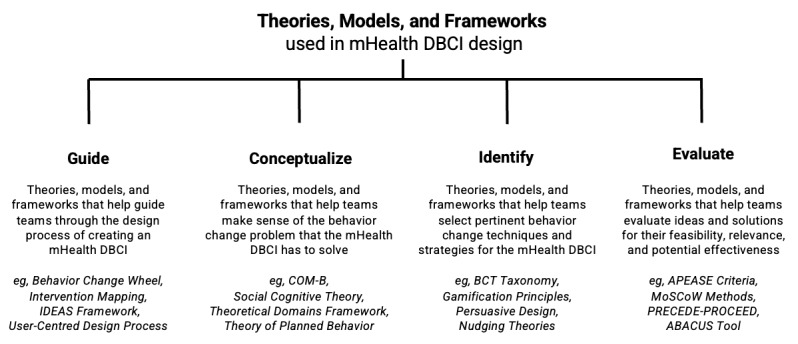
Objective: The aim of this scoping review was to map the evidence on how insights from BD and DT can be integrated to guide the design of mHealth interventions. The following questions were addressed: (1) what are the main characteristics of studies that integrate BD and DT during the mHealth design process? (2) what theories, models, and frameworks do design teams use during the mHealth design process? (3) what methods do design teams use to integrate BD and DT during the mHealth design process? and (4) what are key design challenges, implementation considerations, and future directions for integrating BD and DT during mHealth design?
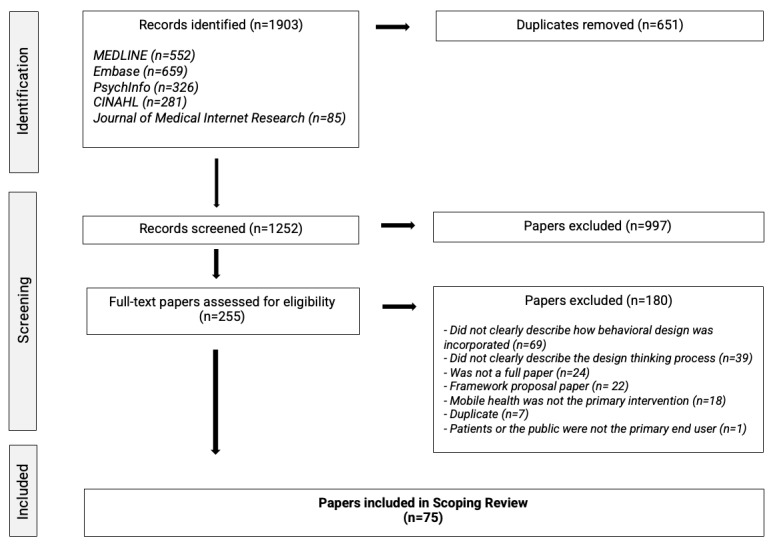
Methods: This review followed the Joanna Briggs Institute reviewer manual and PRISMA-ScR (Preferred Reporting Items for Systematic Reviews and Meta-Analyses Extension for Scoping Reviews) checklist. Studies were identified from MEDLINE, PsycINFO, Embase, CINAHL, and JMIR by using search terms related to mHealth, BD, and DT. Included studies had to clearly describe their mHealth design process and how behavior change theories, models, frameworks, or techniques were incorporated. Two independent reviewers screened the studies for inclusion and completed the data extraction. A descriptive analysis was conducted.
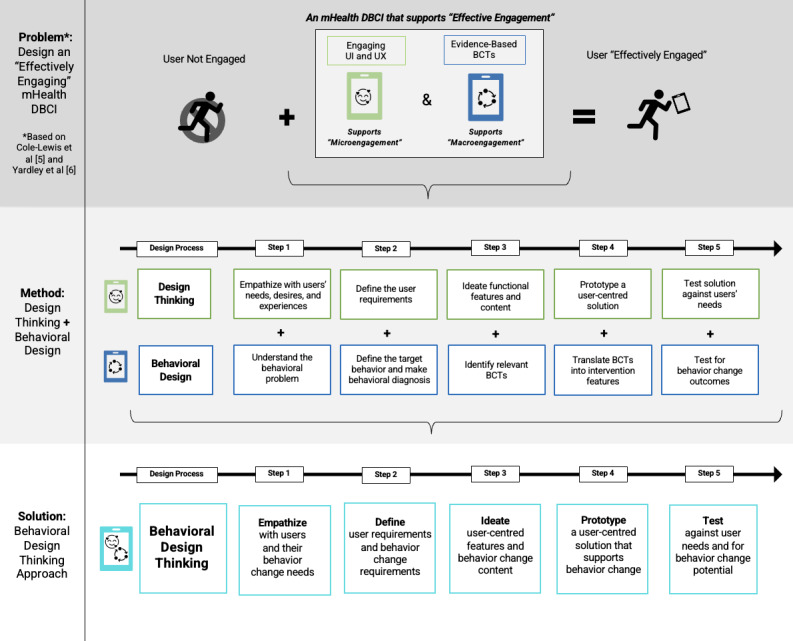
Results: A total of 75 papers met the inclusion criteria. All studies were published between 2012 and 2021. Studies integrated BD and DT in notable ways, which can be referred to as "Behavioral Design Thinking." Five steps were followed in Behavioral Design Thinking: (1) empathize with users and their behavior change needs, (2) define user and behavior change requirements, (3) ideate user-centered features and behavior change content, (4) prototype a user-centered solution that supports behavior change, and (5) test the solution against users' needs and for its behavior change potential. The key challenges experienced during mHealth design included meaningfully engaging patient and public partners in the design process, translating evidence-based behavior change techniques into actual mHealth features, and planning for how to integrate the mHealth intervention into existing clinical systems.
Conclusions: Best practices from BD and DT can be integrated throughout the mHealth design process to ensure that mHealth interventions are purposefully developed to effectively engage users. Although this scoping review clarified how insights from BD and DT can be integrated during mHealth design, future research is needed to identify the most effective design approaches.
Keywords: behavior change; design thinking; digital health; health behavior; mobile application; mobile health; mobile phone; product design; scoping review; systems design; telemedicine; user-centered design.
©Paula Voorheis, Albert Zhao, Kerry Kuluski, Quynh Pham, Ted Scott, Peter Sztur, Nityan Khanna, Mohamed Ibrahim, Jeremy Petch. Originally published in JMIR mHealth and uHealth (https://mhealth.jmir.org), 16.03.2022.
Conflict of interest statement
Conflicts of Interest: None declared.
Figures
References
-
- Murray Elizabeth, Hekler Eric B, Andersson Gerhard, Collins Linda M, Doherty Aiden, Hollis Chris, Rivera Daniel E, West Robert, Wyatt Jeremy C. Evaluating Digital Health Interventions: Key Questions and Approaches. Am J Prev Med. 2016 Nov;51(5):843–851. doi: 10.1016/j.amepre.2016.06.008. http://europepmc.org/abstract/MED/27745684 S0749-3797(16)30229-X - DOI - PMC - PubMed
-
- Perski O, Blandford A, West R, Michie S. Conceptualising engagement with digital behaviour change interventions: a systematic review using principles from critical interpretive synthesis. Transl Behav Med. 2017 Jun;7(2):254–267. doi: 10.1007/s13142-016-0453-1. http://europepmc.org/abstract/MED/27966189 10.1007/s13142-016-0453-1 - DOI - PMC - PubMed
-
- Marcolino MS, Oliveira JAQ, D'Agostino M, Ribeiro AL, Alkmim MBM, Novillo-Ortiz D. The Impact of mHealth Interventions: Systematic Review of Systematic Reviews. JMIR Mhealth Uhealth. 2018 Jan 17;6(1):e23. doi: 10.2196/mhealth.8873. https://mhealth.jmir.org/2018/1/e23/ v6i1e23 - DOI - PMC - PubMed
-
- Kay M, Santos J, Takane M. Global Observatory for eHealth Series, vol 3. Geneva, Switzerland: World Health Organization; 2011. [2021-05-15]. mHealth: new horizons for health through mobile technologies based on the findings of the second global survey on eHealth. http://www.who.int/goe/publications/goe_mhealth_web.pdf .
-
- Cole-Lewis H, Ezeanochie N, Turgiss J. Understanding Health Behavior Technology Engagement: Pathway to Measuring Digital Behavior Change Interventions. JMIR Form Res. 2019 Oct 10;3(4):e14052. doi: 10.2196/14052. https://formative.jmir.org/2019/4/e14052/ v3i4e14052 - DOI - PMC - PubMed
Publication types
MeSH terms
LinkOut - more resources
Full Text Sources
Medical
Miscellaneous
