


Assessment of the Readability of Web-Based Patient Education Material From Major Canadian Pediatric Associations: Cross-sectional Study
- PMID: 35293875
- PMCID: PMC8968558
- DOI: 10.2196/31820
Assessment of the Readability of Web-Based Patient Education Material From Major Canadian Pediatric Associations: Cross-sectional Study
Abstract
Background: Web-based patient education materials (PEMs) are frequently written above the recommended reading level in North America. Poor PEM readability limits the accessibility of medical information for individuals with average literacy levels or lower. Pediatric hospital and association websites have not only been shown to be a preferred source of information among caregivers but have also become a necessity during the COVID-19 pandemic. The readability of Canadian pediatric association websites has not yet been assessed.
Objective: The aim of this study is to determine if the content of PEMs from Canadian pediatric associations is written at a reading level that the majority of Canadians can understand.
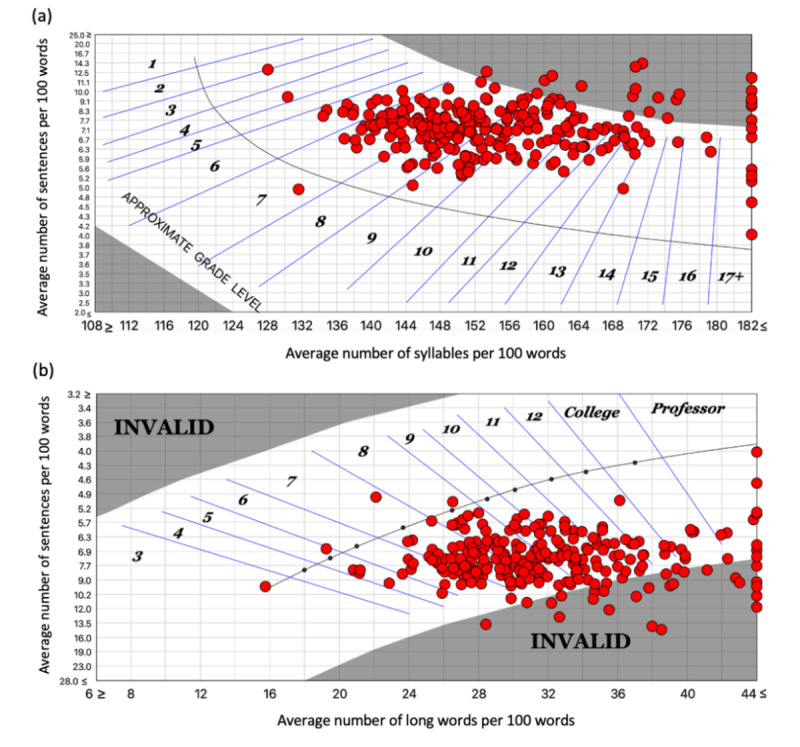
Methods: A total of 258 PEMs were extracted from 10 Canadian pediatric associations and evaluated for their reading level using 10 validated readability scales. The PEMs underwent a difficult word analysis and comparisons between PEMs from different associations were conducted.
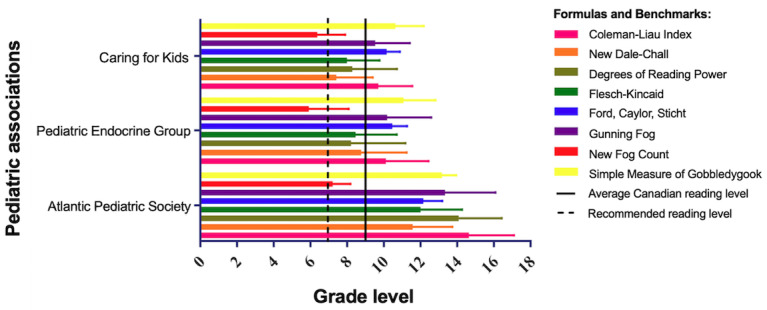
Results: Web-based PEMs were identified from 3 pediatric association websites, where the reading level (calculated as a grade level) was found to be an average of 8.8 (SD 1.8) for the Caring for Kids website, 9.5 (SD 2.2) for the Pediatric Endocrine Group website, and 13.1 (SD 2.1) for the Atlantic Pediatric Society website. The difficult word analysis identified that 19.9% (SD 6.6%) of words were unfamiliar, with 13.3% (SD 5.3%) and 31.9% (SD 6.1%) of words being considered complex (≥3 syllables) and long (≥6 letters), respectively.
Conclusions: The web-based PEMs were found to be written above the recommended seventh-grade reading level for Canadians. Consideration should be made to create PEMs at an appropriate reading level for both patients and their caregivers to encourage health literacy and ultimately promote preventative health behaviors and improve child health outcomes.
Keywords: accessibility; health literacy; online health information; patient education; pediatrics.
©Alice Man, Courtney van Ballegooie. Originally published in JMIR Pediatrics and Parenting (https://pediatrics.jmir.org), 16.03.2022.
Conflict of interest statement
Conflicts of Interest: None declared.
Figures
References
-
- Rothrock S, Rothrock A, Swetland S, Pagane M, Isaak S, Romney J, Chavez V, Chavez S. Quality, trustworthiness, readability, and accuracy of medical information regarding common pediatric emergency medicine-related complaints on the web. J Emerg Med. 2019 Oct;57(4):469–477. doi: 10.1016/j.jemermed.2019.06.043. https://linkinghub.elsevier.com/retrieve/pii/S0736-4679(19)30560-8 S0736-4679(19)30560-8 - DOI - PubMed
-
- Cocco AM, Zordan R, Taylor DM, Weiland TJ, Dilley SJ, Kant J, Dombagolla M, Hendarto A, Lai F, Hutton J. Dr Google in the ED: searching for online health information by adult emergency department patients. Med J Aust. 2018 Oct 15;209(8):342–347. doi: 10.5694/mja17.00889.10.5694/mja17.00889 - DOI - PubMed
-
- Diaz JA, Griffith RA, Ng JJ, Reinert SE, Friedmann PD, Moulton AW. Patients' use of the internet for medical information. J Gen Intern Med. 2002 Mar;17(3):180–5. doi: 10.1046/j.1525-1497.2002.10603.x. https://onlinelibrary.wiley.com/resolve/openurl?genre=article&sid=nlm:pu... jgi10603 - DOI - PMC - PubMed
-
- Farrell TW, Francis L, Brown T, Ferrante LE, Widera E, Rhodes R, Rosen T, Hwang U, Witt LJ, Thothala N, Liu SW, Vitale CA, Braun UK, Stephens C, Saliba D. Rationing limited healthcare resources in the COVID-19 era and beyond: ethical considerations regarding older adults. J Am Geriatr Soc. 2020 Jun;68(6):1143–1149. doi: 10.1111/jgs.16539. http://europepmc.org/abstract/MED/32374466 - DOI - PMC - PubMed
LinkOut - more resources
Full Text Sources
Research Materials
