


Novel volumetric capnography indices measure ventilation inhomogeneity in cystic fibrosis
- PMID: 35295235
- PMCID: PMC8918935
- DOI: 10.1183/23120541.00440-2021
Novel volumetric capnography indices measure ventilation inhomogeneity in cystic fibrosis
Abstract
Background: Volumetric capnography (VCap) is a simpler alternative to multiple-breath washout (MBW) to detect ventilation inhomogeneity in patients with cystic fibrosis (CF). However, its diagnostic performance is influenced by breathing dynamics. We introduce two novel VCap indices, the capnographic inhomogeneity indices (CIIs), that may overcome this limitation and explore their diagnostic characteristics in a cohort of CF patients.
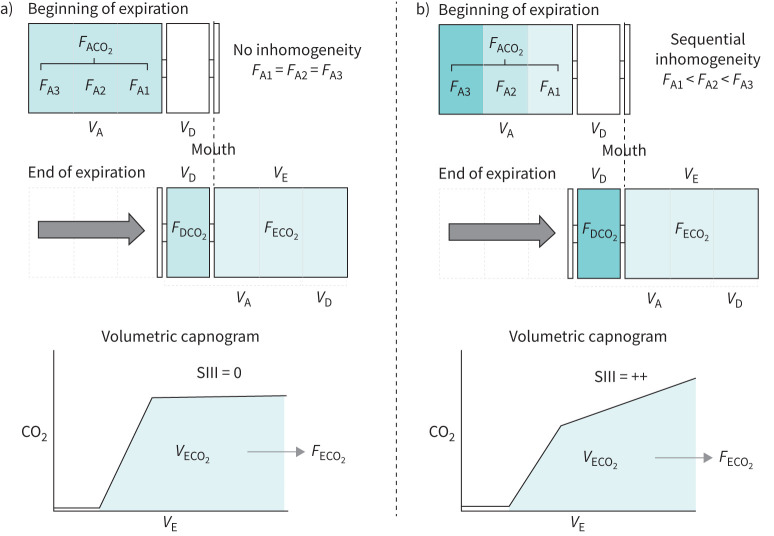
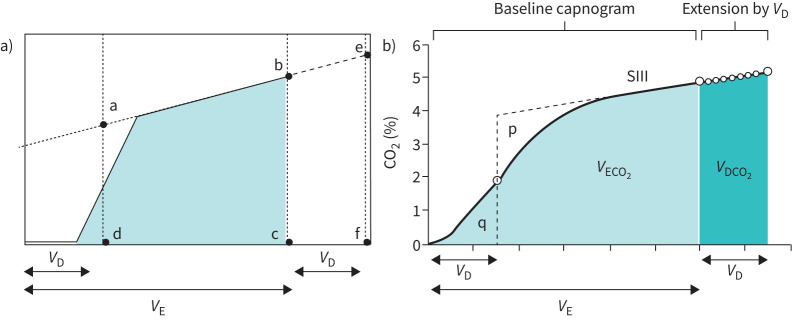
Methods: We analysed 320 N2-MBW trials from 50 CF patients and 65 controls (age 4-18 years) and calculated classical VCap indices, such as slope III (SIII) and the capnographic index (KPIv). We introduced novel CIIs based on a theoretical lung model and assessed their diagnostic performance compared to classical VCap indices and the lung clearance index (LCI).
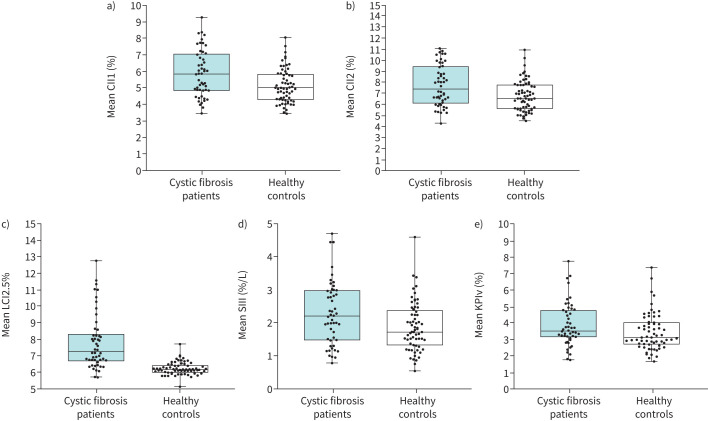
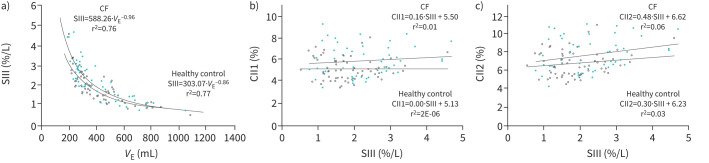
Results: Both CIIs were significantly higher in CF patients compared with controls (mean±sd CII1 5.9±1.4% versus 5.1±1.0%, p=0.002; CII2 7.7±1.8% versus 6.8±1.4%, p=0.002) and presented strong correlation with LCI (CII1 r2=0.47 and CII2 r2=0.44 in CF patients). Classical VCap indices showed inferior discriminative ability (SIII 2.3±1.0%/L versus 1.9±0.7%/L, p=0.013; KPIv 3.9±1.3% versus 3.5±1.2%, p=0.071), while the correlation with LCI was weak (SIII r2=0.03; KPIv r2=0.08 in CF patients). CIIs showed lower intra-subject inter-trial variability, calculated as coefficient of variation for three and relative difference for two trials, than classical VCap indices, but higher than LCI (CII1 11.1±8.2% and CII2 11.0±8.0% versus SIII 16.3±13.5%; KPIv 15.9±12.8%; LCI 5.9%±4.2%).
Conclusion: CIIs detect ventilation inhomogeneity better than classical VCap indices and correlate well with LCI. However, further studies on their diagnostic performance and clinical utility are required.
Copyright ©The authors 2022.
Conflict of interest statement
Conflicts of interest: S. Fouzas has nothing to disclose. Conflicts of interest: A-C. Kentgens repots no other conflicts of interest. Conflicts of interest: O. Lagiou has nothing to disclose. Conflicts of interest: B.S. Frauchiger has nothing to disclose. Conflicts of interest: F. Wyler has nothing to disclose. Conflicts of interest: I. Theodorakopoulos has nothing to disclose. Conflicts of interest: S. Yammine repots no other conflicts of interest. Conflicts of interest: P. Latzin reports grants from Vertex and Vifor paid to his institution, personal fees and honoraria paid to his institution from Vertex, Vifor and OM Pharma, fees for participation on a data safety monitoring or advisory board from Santhera (DMC), and personal fees paid to his institution from Polyphor, Vertex, OM pharma and Vifor, all outside the submitted work. Support statement: The work was supported by Swiss National Science Foundation Grants (Yammine 179905 and Latzin 182719). A-C. Kentgens is a recipient of the Swiss Government Excellence Scholarship from The Swiss Confederation. Funding information for this article has been deposited with the Crossref Funder Registry.
Figures
References
LinkOut - more resources
Full Text Sources