


Combined Bioremediation of Bensulfuron-Methyl Contaminated Soils With Arbuscular Mycorrhizal Fungus and Hansschlegelia zhihuaiae S113
- PMID: 35295293
- PMCID: PMC8918986
- DOI: 10.3389/fmicb.2022.843525
Combined Bioremediation of Bensulfuron-Methyl Contaminated Soils With Arbuscular Mycorrhizal Fungus and Hansschlegelia zhihuaiae S113
Abstract
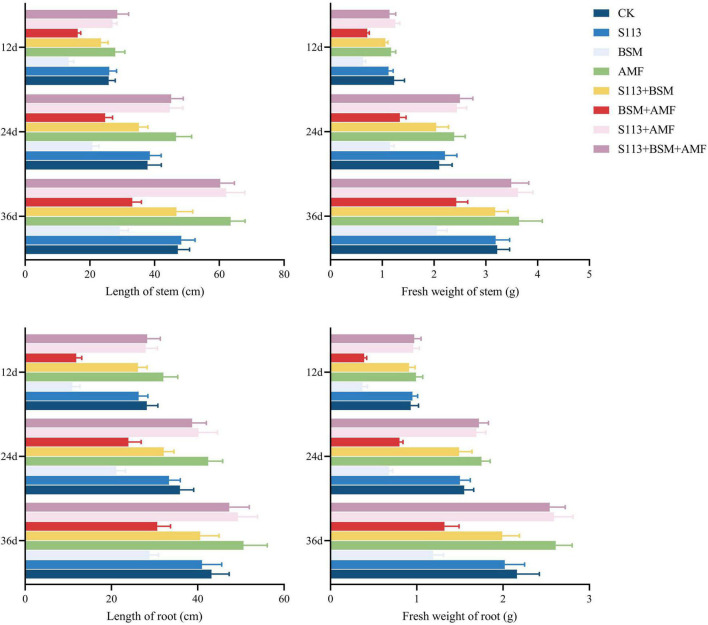
Over the past decades, because of large-scale bensulfuron-methyl (BSM) application, environmental residues of BSM have massively increased, causing severe toxicity in rotation-sensitive crops. The removal of BSM from the environment has become essential. In this study, the combined bioremediation of the arbuscular mycorrhizal fungi (AMF) Rhizophagus intraradices and BSM-degrading strain Hansschlegelia zhihuaiae S113 of BSM-polluted soil was investigated. BSM degradation by S113 in the maize rhizosphere could better promote AMF infection in the roots of maize, achieving an infection rate of 86.70% on the 36th day in the AMF + S113 + BSM group. Similarly, AMF enhanced the colonization and survival of S113 in maize rhizosphere, contributing 4.65 × 10⁵ cells/g soil on the 15th day and 3.78 × 10⁴ cells/g soil on the 20th day to a population of colonized-S113 (based possibly on the strong root system established by promoting plant-growth AMF). Both S113 and AMF coexisted in rhizosphere soil. The BSM-degrading strain S113 could completely remove BSM at 3 mg/kg from the maize rhizosphere soil within 12 days. AMF also promoted the growth of maize seedlings. When planted in BSM-contaminated soil, maize roots had a fresh weight of 2.59 ± 0.26 g in group S113 + AMF, 2.54 ± 0.20 g in group S113 + AMF + BSM, 2.02 ± 0.16 g in group S113 + BSM, and 2.61 ± 0.25 g in the AMF group, all of which exceeded weights of the control group on the 36th day except for the S113 + BSM group. Additionally, high-throughput sequencing results indicated that simultaneous inoculation with AMF and strain S113 of BSM-polluted maize root-soil almost left the indigenous bacterial community diversity and richness in maize rhizosphere soil unaltered. This represents a major advantage of bioremediation approaches resulting from the existing vital interactions among local microorganisms and plants in the soil. These findings may provide theoretical guidance for utilizing novel joint-bioremediation technologies, and constitute an important contribution to environmental pollution bioremediation while simultaneously ensuring crop safety and yield.
Keywords: 16s sequencing; Hansschlegelia zhihuaiae S113; arbuscular mycorrhizal fungi; bensulfuron-methyl; combined bioremediation.
Copyright © 2022 Qian, Zhao, Zhou, Zhao, Mutter and Huang.
Conflict of interest statement
The authors declare that the research was conducted in the absence of any commercial or financial relationships that could be construed as a potential conflict of interest.
Figures




References
-
- Baum C., El-Tohamy W., Gruda N. (2015). Increasing the productivity and product quality of vegetable crops using arbuscular mycorrhizal fungi: A review. Sci. Hortic. Amsterdam 187 131–141. 10.1016/j.scienta.2015.03.002 - DOI
-
- Biermann B., Linderman R. G. (1981). Quantifying vesicular-arbuscular mycorrhizae: a proposed method towards standardization. New Phytol. 87 63–67. 10.1111/j.1469-8137.1981.tb01690.x - DOI
-
- Bowles T. M., Barrios-Masias F. H., Carlisle E. A., Cavagnaro T. R., Jackson L. E. (2016). Effects of arbuscular mycorrhizae on tomato yield, nutrient uptake, water relations, and soil carbon dynamics under deficit irrigation in field conditions. Sci. Total Environ. 56 1223–1234. 10.1016/j.scitotenv.2016.05.178 - DOI - PubMed
LinkOut - more resources
Full Text Sources
Miscellaneous
