


Heat Stress: Effects on Rumen Microbes and Host Physiology, and Strategies to Alleviate the Negative Impacts on Lactating Dairy Cows
- PMID: 35295316
- PMCID: PMC8919045
- DOI: 10.3389/fmicb.2022.804562
Heat Stress: Effects on Rumen Microbes and Host Physiology, and Strategies to Alleviate the Negative Impacts on Lactating Dairy Cows
Abstract
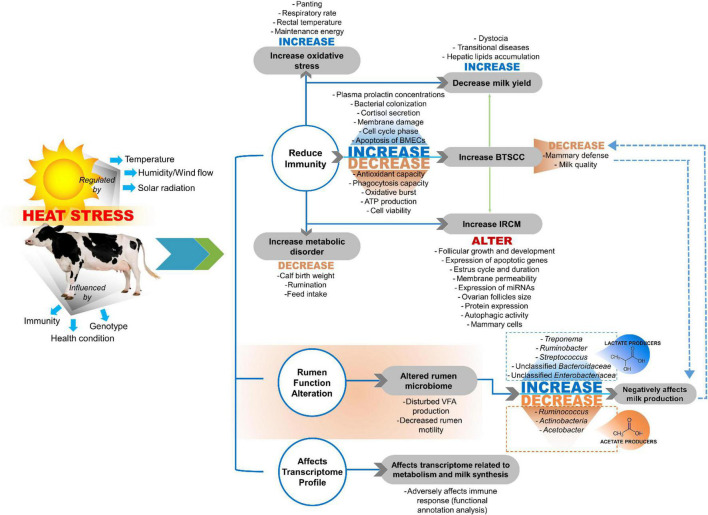
Heat stress (HS) in dairy cows causes considerable losses in the dairy industry worldwide due to reduced animal performance, increased cases of metabolic disorders, altered rumen microbiome, and other health problems. Cows subjected to HS showed decreased ruminal pH and acetate concentration and an increased concentration of ruminal lactate. Heat-stressed cows have an increased abundance of lactate-producing bacteria such as Streptococcus and unclassified Enterobacteriaceae, and soluble carbohydrate utilizers such as Ruminobacter, Treponema, and unclassified Bacteroidaceae. Cellulolytic bacteria, especially Fibrobacteres, increase during HS due to a high heat resistance. Actinobacteria and Acetobacter, both acetate-producing bacteria, decreased under HS conditions. Rumen fermentation functions, blood parameters, and metabolites are also affected by the physiological responses of the animal during HS. Isoleucine, methionine, myo-inositol, lactate, tryptophan, tyrosine, 1,5-anhydro-D-sorbitol, 3-phenylpropionic acid, urea, and valine decreased under these conditions. These responses affect feed consumption and production efficiency in milk yield, growth rate, and reproduction. At the cellular level, activation of heat shock transcription factor (HSF) (located throughout the nucleus and the cytoplasm) and increased expression of heat shock proteins (HSPs) are the usual responses to cope with homeostasis. HSP70 is the most abundant HSP family responsible for the environmental stress response, while HSF1 is essential for increasing cell temperature. The expression of bovine lymphocyte antigen and histocompatibility complex class II (DRB3) is downregulated during HS, while HSP90 beta I and HSP70 1A are upregulated. HS increases the expression of the cytosolic arginine sensor for mTORC1 subunits 1 and 2, phosphorylation of mammalian target of rapamycin and decreases the phosphorylation of Janus kinase-2 (a signal transducer and activator of transcription factor-5). These changes in physiology, metabolism, and microbiomes in heat-stressed dairy cows require urgent alleviation strategies. Establishing control measures to combat HS can be facilitated by elucidating mechanisms, including proper HS assessment, access to cooling facilities, special feeding and care, efficient water systems, and supplementation with vitamins, minerals, plant extracts, and probiotics. Understanding the relationship between HS and the rumen microbiome could contribute to the development of manipulation strategies to alleviate the influence of HS. This review comprehensively elaborates on the impact of HS in dairy cows and introduces different alleviation strategies to minimize HS.
Keywords: alleviation strategies; dairy cows; gut microbiome; heat stress; metabolism; physiology.
Copyright © 2022 Kim, Ramos, Valencia, Cho and Lee.
Conflict of interest statement
The authors declare that the research was conducted in the absence of any commercial or financial relationships that could be construed as a potential conflict of interest.
Figures
References
-
- Abdel-Samee A. M. (1987). The Role of Cortisol in Improving Productivity of Heat-Stressed Farm Animals with Different Techniques. Ph.D. Thesis. Zagazig: Zagazig University.
Publication types
LinkOut - more resources
Full Text Sources
