. 2022 Mar 16;23(1):212.
doi: 10.1186/s12864-022-08305-1.

Evolution of the recombination regulator PRDM9 in minke whales

Affiliations

Evolution of the recombination regulator PRDM9 in minke whales

Elena Damm et al. BMC Genomics. .

Abstract

Background: PRDM9 is a key regulator of meiotic recombination in most metazoans, responsible for reshuffling parental genomes. During meiosis, the PRDM9 protein recognizes and binds specific target motifs via its array of C2H2 zinc-fingers encoded by a rapidly evolving minisatellite. The gene coding for PRDM9 is the only speciation gene identified in vertebrates to date and shows high variation, particularly in the DNA-recognizing positions of the zinc-finger array, within and between species. Across all vertebrate genomes studied for PRDM9 evolution, only one genome lacks variability between repeat types - that of the North Pacific minke whale. This study aims to understand the evolution and diversity of Prdm9 in minke whales, which display the most unusual genome reference allele of Prdm9 so far discovered in mammals.

Results: Minke whales possess all the features characteristic of PRDM9-directed recombination, including complete KRAB, SSXRD and SET domains and a rapidly evolving array of C2H2-type-Zincfingers (ZnF) with evidence of rapid evolution, particularly at DNA-recognizing positions that evolve under positive diversifying selection. Seventeen novel PRDM9 variants were identified within the Antarctic minke whale species, plus a single distinct PRDM9 variant in Common minke whales - shared across North Atlantic and North Pacific minke whale subspecies boundaries.

Conclusion: The PRDM9 ZnF array evolves rapidly, in minke whales, with at least one DNA-recognizing position under positive selection. Extensive PRDM9 diversity is observed, particularly in the Antarctic in minke whales. Common minke whales shared a specific Prdm9 allele across subspecies boundaries, suggesting incomplete speciation by the mechanisms associated with PRDM9 hybrid sterility.

Keywords: Balaenoptera acutorostrata; Balaenoptera bonaerensis; Meiotic recombination regulation; Microsatellite loci; Minke whales; PRDM9; Postzygotic reproductive isolation; mtDNA.


Conflict of interest statement

No competing interests

Figures

Fig. 1
Fig. 1
Diversity in the Cys2His2-ZnF domain in minke whales. A Prdm9 gene annotation in Balaenoptera acutorostrata scammoni genome reference, with primer site annotations and predicted PRDM9 protein from nucleotide translation (B) Representative PCR products of DNAs from individuals from AN IV (294,271), AN V (1653), NP (K8030) and NA (MN2), showing variation in the number of minisatellite repeats units (number of ZnFs in brackets) (C) Stylized structure of ZnF binding to DNA, with nucleotide-specificity conferred by amino-acids in positions − 1, + 2, + 3, and + 6 of alpha-helices. D PRDM9 ZnF arrays identified in minke whales, named with broad-scale sampling location, Northern Hemisphere (NH) and Southern Hemisphere (SH) and the total number of ZnFs in the ZnFs domain. E Types of PRDM9 ZnFs in minke whales. Three-letter codes were generated using the IUPAC nomenclature of amino-acids involved in DNA binding. All variable amino acids are colored, and asterisks label ZnFs also present in genome references of Balaenoptera acutorostrata scammoni (*Ba) or Balaenoptera bonaerensis (*Bb), see also Additional File 6
Fig. 2
Fig. 2
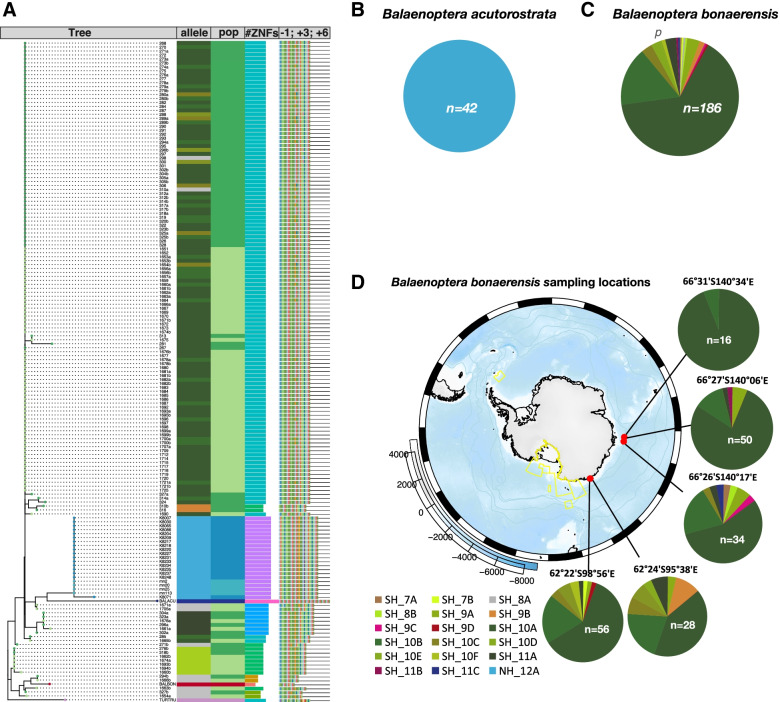
Prdm9 Phylogenetic analyses and allele frequencies at different geographical scales. A PRDM9 phylogenetic analyses excluding hypervariable sites across all geographical regions, including several outgroups, from left to right Tree: Nucleotide Phylogeny of PRDM9 alleles allele: PRDM9 coding minisatellite allele colored as the translated variant from Fig. 1 pop: assigned population of individuals (dark blue): North Pacific, (light blue) North Atlantic, (light green) Antarctic Area IV, (dark green) Antarctic Area V, as well as Genome Reference alleles: (blue) Balaenoptera acutorostrata scammoni, (red) Balaenoptera bonaerensis and outgroups (pink) Tursiops Truncatus. # ZnFs: number of ZnFs − 1, + 3, + 6: Color coded Hypervariable positions of all repeats. B allelic diversity in Common minke whales (C) allelic diversity in Antarctic minke whales (D) fine-scale diversity by Sampling locations of Antarctic minke whales on a map of the Southern Ocean (yellow delineations show protected areas)
Fig. 3
Fig. 3
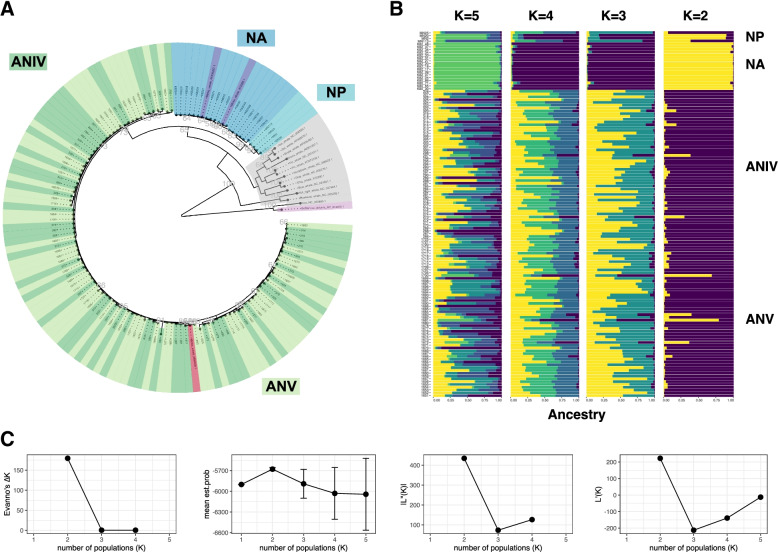
Population structure of minke whales (NP, light blue) North Pacific, (NA, dark blue) North Atlantic (ANIV, dark green) Antarctic Area IV, (ANV, light green) Antarctic Area V (A) Phylogeny of minke whale mitochondrial D-loop region, containing the hypervariable segments (HVS). B Population STRUCTURE analyses of minisatellites without a priori location information. C The magnitude of ∆K as a function of K, mean of the estimated probability of the data and its standard deviation (mean ± SD over 50 replicates), and Log probability of data L(K) as a function of K
Fig. 4
Fig. 4
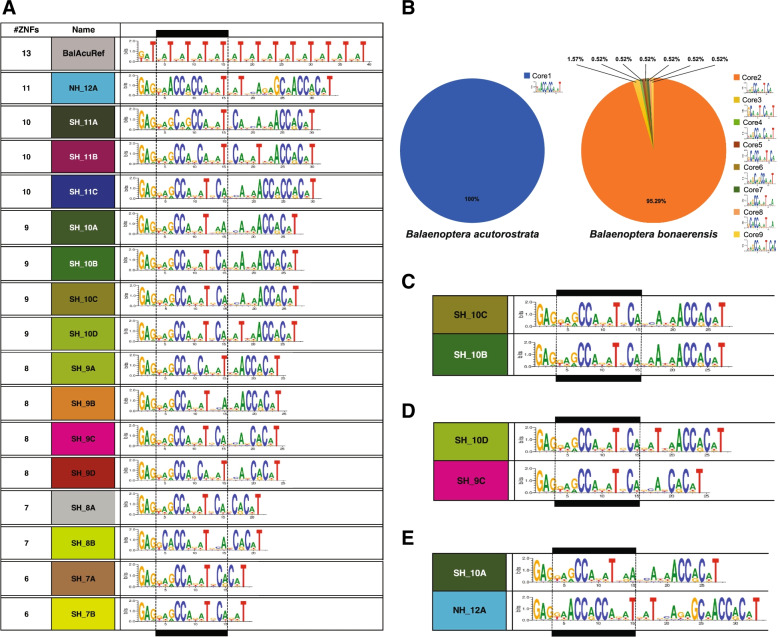
PRDM9 motif binding predictions (A) Array binding predictions with ZnFs#3-#6 “core motif” boxed (B) Pie chart of the population frequency of “core motifs” across all individuals (C) Identical “core motif” combinations are predicted to result in fully symmetric binding and efficient DSB formation [3, 4] (D) variants with somewhat dissimilar motifs, are predicted to result in some degree of asymmetry. In humans, a similar degree of motif-match still allowed DSBs necessary for successful recombination [3, 4, 29] (E) hypothetical combination of the most common variant of minke whale species of two hemispheres, generating a putative interspecies hybrid combination. Asymmetric positioning of recombination initiation sites would be predicted, which is implicated in F1-hybrid male sterility in mammals [30]

References

    1. Imai Y, Baudat F, Taillepierre M, Stanzione M, Toth A, de Massy B. The PRDM9 KRAB domain is required for meiosis and involved in protein interactions. Chromosoma. 2017;126(6):681–695. - PMC - PubMed
    1. Parvanov ED, Tian H, Billings T, Saxl RL, Spruce C, Aithal R, Krejci L, Paigen K, Petkov PM. PRDM9 interactions with other proteins provide a link between recombination hotspots and the chromosomal axis in meiosis. Mol Biol Cell. 2017;28(3):488–499. - PMC - PubMed
    1. Berg IL, Neumann R, Lam KW, Sarbajna S, Odenthal-Hesse L, May CA, Jeffreys AJ. PRDM9 variation strongly influences recombination hot-spot activity and meiotic instability in humans. Nat Genet. 2010;42(10):859–863. - PMC - PubMed
    1. Berg IL, Neumann R, Sarbajna S, Odenthal-Hesse L, Butler NJ, Jeffreys AJ. Variants of the protein PRDM9 differentially regulate a set of human meiotic recombination hotspots highly active in African populations. Proc Natl Acad Sci U S A. 2011;108(30):12378–12383. - PMC - PubMed
    1. Kono H, Tamura M, Osada N, Suzuki H, Abe K, Moriwaki K, Ohta K, Shiroishi T. Prdm9 polymorphism unveils mouse evolutionary tracks. DNA Res. 2014;21(3):315–326. - PMC - PubMed

Substances

LinkOut - more resources