


An mHealth Intervention to Reduce the Packing of Discretionary Foods in Children's Lunch Boxes in Early Childhood Education and Care Services: Cluster Randomized Controlled Trial
- PMID: 35297768
- PMCID: PMC8972115
- DOI: 10.2196/27760
An mHealth Intervention to Reduce the Packing of Discretionary Foods in Children's Lunch Boxes in Early Childhood Education and Care Services: Cluster Randomized Controlled Trial
Abstract
Background: Interventions in early childhood education and care (ECEC) services have the potential to improve children's diet at the population level.
Objective: This study aims to test the efficacy of a mobile health intervention in ECEC services to reduce parent packing of foods high in saturated fat, sugar, and sodium (discretionary foods) in children's (aged 3-6 years) lunch boxes.
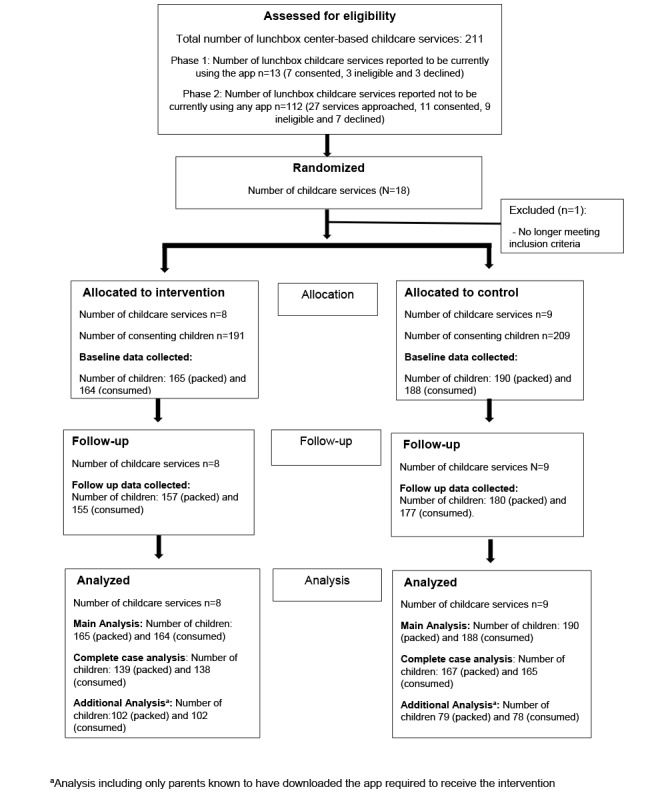
Methods: A cluster randomized controlled trial was undertaken with 355 parent and child dyads recruited by phone and in person from 17 ECEC services (8 [47%] intervention and 9 [53%] control services). Parents in the intervention group received a 10-week fully automated program targeting barriers to packing healthy lunch boxes delivered via an existing service communication app. The program included weekly push notifications, within-app messages, and links to further resources, including websites and videos. The control group did not receive any intervention. The primary outcomes were kilojoules from discretionary foods and associated nutrients (saturated fat, free sugars, and sodium) packed in children's lunch boxes. Secondary outcomes included consumption of kilojoules from discretionary foods and related nutrients and the packing and consumption of serves of discretionary foods and core food groups. Photography and weights of foods in children's lunch boxes were recorded by trained researchers before and after the trial to assess primary and secondary outcomes. Outcome assessors were blinded to service allocation. Feasibility, appropriateness, and acceptability were assessed via an ECEC service manager survey and a parent web-based survey. Use of the app was assessed via app analytics.
Results: Data on packed lunch box contents were collected for 88.8% (355/400) of consenting children at baseline and 84.3% (337/400) of children after the intervention. There was no significant difference between groups in kilojoule from discretionary foods packed (77.84 kJ, 95% CI -163.49 to 319.18; P=.53) or the other primary or secondary outcomes. The per-protocol analysis, including only data from children of parents who downloaded the app, also did not find any statistically significant change in primary (-1.98 kJ, 95% CI -343.87 to 339.90; P=.86) or secondary outcomes. Approximately 61.8% (102/165) of parents in the intervention group downloaded the app, and the mean service viewing rate of weekly within-app messages was 26% (SD 14.9). Parents who responded to the survey and participating services agreed that it was appropriate to receive lunch box information via the app (40/50, 80% and 6/8, 75%, respectively).
Conclusions: The intervention was unable to demonstrate an impact on kilojoules or associated nutrients from discretionary foods packed in children's lunch boxes. Low app downloads and program message views indicate a need to explore how to improve factors related to implementation before further testing similar mobile health interventions in this setting.
Trial registration: Australian New Zealand Clinical Trials Registry ACTRN12618000133235; https://www.anzctr.org.au/Trial/Registration/TrialReview.aspx?id=374379.
Keywords: child; mHealth; nutrition; parents; preschool.
©Nicole Pearson, Meghan Finch, Rachel Sutherland, Melanie Kingsland, Luke Wolfenden, Taya Wedesweiler, Vanessa Herrmann, Sze Lin Yoong. Originally published in the Journal of Medical Internet Research (https://www.jmir.org), 17.03.2022.
Conflict of interest statement
Conflicts of Interest: None declared.
Figures
Similar articles
-
A Multicomponent mHealth-Based Intervention (SWAP IT) to Decrease the Consumption of Discretionary Foods Packed in School Lunchboxes: Type I Effectiveness-Implementation Hybrid Cluster Randomized Controlled Trial.J Med Internet Res. 2021 Jun 24;23(6):e25256. doi: 10.2196/25256. J Med Internet Res. 2021. PMID: 34185013 Free PMC article. Clinical Trial.
-
Cluster randomised controlled trial of an m-health intervention in centre-based childcare services to reduce the packing of discretionary foods in children's lunchboxes: study protocol for the 'SWAP IT Childcare' trial.BMJ Open. 2019 Jun 1;9(5):e026829. doi: 10.1136/bmjopen-2018-026829. BMJ Open. 2019. PMID: 31154306 Free PMC article.
-
Protocol for an effectiveness- implementation hybrid trial to assess the effectiveness and cost-effectiveness of an m-health intervention to decrease the consumption of discretionary foods packed in school lunchboxes: the 'SWAP IT' trial.BMC Public Health. 2019 Nov 12;19(1):1510. doi: 10.1186/s12889-019-7725-x. BMC Public Health. 2019. PMID: 31718597 Free PMC article. Clinical Trial.
-
The effectiveness of lunchbox interventions on improving the foods and beverages packed and consumed by children at centre-based care or school: a systematic review and meta-analysis.Int J Behav Nutr Phys Act. 2019 Apr 29;16(1):38. doi: 10.1186/s12966-019-0798-1. Int J Behav Nutr Phys Act. 2019. PMID: 31036038 Free PMC article.
-
A systematic evaluation of digital nutrition promotion websites and apps for supporting parents to influence children's nutrition.Int J Behav Nutr Phys Act. 2020 Feb 10;17(1):17. doi: 10.1186/s12966-020-0915-1. Int J Behav Nutr Phys Act. 2020. PMID: 32041640 Free PMC article.
Cited by
-
Healthy eating interventions delivered in early childhood education and care settings for improving the diet of children aged six months to six years.Cochrane Database Syst Rev. 2023 Aug 22;8(8):CD013862. doi: 10.1002/14651858.CD013862.pub3. Cochrane Database Syst Rev. 2023. PMID: 37606067 Free PMC article.
-
The impact of the Change4Life Food Scanner app on children's diets and parental psychological outcomes: a randomised pilot and feasibility study.BMC Public Health. 2025 Jul 2;25(1):2215. doi: 10.1186/s12889-025-23400-0. BMC Public Health. 2025. PMID: 40604685 Free PMC article. Clinical Trial.
-
Healthy eating interventions delivered in early childhood education and care settings for improving the diet of children aged six months to six years.Cochrane Database Syst Rev. 2023 Jun 12;6(6):CD013862. doi: 10.1002/14651858.CD013862.pub2. Cochrane Database Syst Rev. 2023. Update in: Cochrane Database Syst Rev. 2023 Aug 22;8:CD013862. doi: 10.1002/14651858.CD013862.pub3. PMID: 37306513 Free PMC article. Updated. Review.
-
Assessing the scalability of healthy eating interventions within the early childhood education and care setting: secondary analysis of a Cochrane systematic review.Public Health Nutr. 2023 Dec;26(12):3211-3229. doi: 10.1017/S1368980023002550. Epub 2023 Nov 22. Public Health Nutr. 2023. PMID: 37990443 Free PMC article.
-
How to integrate and leverage digital health modalities for health promotion in early childhood education: Opportunities to improve intervention access and engagement.Transl Behav Med. 2025 Jan 16;15(1):ibaf006. doi: 10.1093/tbm/ibaf006. Transl Behav Med. 2025. PMID: 40052536
References
-
- World Health Organization . Report of a Joint WHO/FAO Expert Consultation. Geneva: World Health Organisation; 2003. Diet, nutrition and the prevention of chronic disease: report of a joint WHO/FAO expert consultation.
-
- GBD 2017 Diet Collaborators Health effects of dietary risks in 195 countries, 1990-2017: a systematic analysis for the Global Burden of Disease Study 2017. Lancet. 2019 May 11;393(10184):1958–72. doi: 10.1016/S0140-6736(19)30041-8. https://linkinghub.elsevier.com/retrieve/pii/S0140-6736(19)30041-8 S0140-6736(19)30041-8 - DOI - PMC - PubMed
-
- Drewnowski A, Rehm CD. Consumption of added sugars among US children and adults by food purchase location and food source. Am J Clin Nutr. 2014 Sep;100(3):901–7. doi: 10.3945/ajcn.114.089458. http://europepmc.org/abstract/MED/25030785 ajcn.114.089458 - DOI - PMC - PubMed
-
- National diet and nutrition survey: results from years 5-6 (combined) of the rolling programme (2012/13 and 2013/14) Public Health England. 2012. [2019-05-01]. https://www.gov.uk/government/statistics/ndns-results-from-years-5-and-6... .
-
- Australian Institute of Health and Welfare . Nutrition Across the Life Stages. Cat. no. PHE 227. Canberra: AIHW; 2018.
Publication types
MeSH terms
Associated data
LinkOut - more resources
Full Text Sources
Medical
