


Embedding Physical Activity Within Community Home Support Services for Older Adults in Ireland - A Qualitative Study of Barriers and Enablers
- PMID: 35299723
- PMCID: PMC8922314
- DOI: 10.2147/CIA.S351431
Embedding Physical Activity Within Community Home Support Services for Older Adults in Ireland - A Qualitative Study of Barriers and Enablers
Abstract
Introduction: In Ireland, over 55,000 older adults are supported in their community by formal home support, amounting to an estimated 23 million care hours annually. There is a growing need to move beyond care, to more proactive approaches to maintain physical function. In a feasibility study, we delivered the "Care to Move" (CTM) program through existing home support services. This qualitative study aimed to explore the experience and perceptions of Health Care Assistants (HCAs), who were trained in and delivered the CTM program.
Methods: We conducted semi-structured telephone interviews with 22 HCAs [mean age 49.0 ± 10.7 years and female 21/22] involved in the delivery of the program with older adults [n = 35, mean age 82.8 (7.8) years]. Interview transcripts were coded and analyzed thematically to capture barriers and enablers to program delivery.
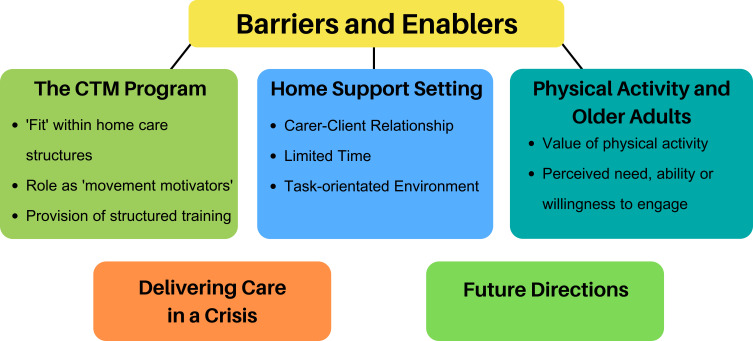
Results: Barriers and enablers were identified under three themes i) the CTM approach ii) the home support setting, iii) older adults and physical activity, with iv) delivering care in a crisis and v) future directions further identified. Overall, there was a positive perception of the program's focus on "movement prompts and motivators", the "fit" within home support services, and the training provided. Practical challenges of limited time and the task-orientated nature of home support were reported as recurring barriers for CTM. Many HCAs commented on the value and perceived positive benefits of the program for their clients. Though negative perceptions of older adults' motivation or ability to engage with physical activity were noted. Risk, such as injury or pain, was identified but was not a dominant theme.
Conclusion: Our findings suggest that embedding physical activity initiatives within home support services could be feasible. Restructuring of services, engaging HCAs, and moving beyond traditional "task-oriented" care models to more personalised proactive approaches may facilitate this initiative and support aging in place.
Keywords: aging; aging in place; frailty; integrated care; physical activity.
© 2022 Swan et al.
Conflict of interest statement
Bex Townley and Dawn A. Skelton are Directors of Later Life Training Ltd, a not-for-profit company delivering training in exercise delivery with older people, including the Care to Move program. BT and DAS had no role in the design of the interview questions, in conducting the interviews or in the analysis of the qualitative data. BT and DAS had no role in the design of the interview questions (designed by FH, LS, MOS), in conducting the interviews (conducted by FH, LS) or in the analysis of the qualitative data (conducted by LS, MOS, AW). DAS and BT report personal fees from Later Life Training Ltd, during the conduct of the study; personal fees from Later Life Training Ltd, outside the submitted work. Debbie Rooney is CEO of North Dublin Home Care and Lisa Murphy is the Service and Quality Manager at North Dublin Home Care. North Dublin Homecare provide a PhD funding bursary for author LS and had no role in the design of the study; in the collection, analyses, or interpretation of data; in the writing of the manuscript, or in the decision to publish the results. The aforementioned authors report no other potential conflicts of interest in this work. All other authors report no conflicts of interest in this work.
Figures

References
-
- United Nations. World population ageing report 2015; 2015.
-
- Health Service Executive. National service plan 2021; 2021. Available from: https://www.hse.ie/eng/services/publications/serviceplans/national-servi.... Accessed February 23, 2022.
MeSH terms
LinkOut - more resources
Full Text Sources
Medical
