. 2022 Jun;13(3):1442-1459.
doi: 10.1002/jcsm.12954. Epub 2022 Mar 17.

Mapping ongoing nutrition intervention trials in muscle, sarcopenia, and cachexia: a scoping review of future research

Affiliations

Mapping ongoing nutrition intervention trials in muscle, sarcopenia, and cachexia: a scoping review of future research

Camila E Orsso et al. J Cachexia Sarcopenia Muscle. 2022 Jun.

Abstract

Muscle loss alone, or in the context of sarcopenia or cachexia, is a prevalent condition and a predictor of negative outcomes in aging and disease. As adequate nutrition is essential for muscle maintenance, a growing number of studies has been conducted to explore the role of specific nutrients on muscle mass or function. Nonetheless, more research is needed to guide evidence-based recommendations. This scoping review aimed to compile and document ongoing clinical trials investigating nutrition interventions as a strategy to prevent or treat low muscle mass or function (strength and physical performance), sarcopenia, or cachexia. ClinicalTrials.gov and the WHO International Clinical Trials Registry Platform were searched up to 21 April 2021 for planned and ongoing trials. Randomized controlled trials with ≥20 participants per arm were included based on intent to explore the effects of nutrition interventions on muscle-related outcomes (i.e. muscle mass or strength, physical performance, or muscle synthesis rate) in both clinical and non-clinical conditions (i.e. aging). Two reviewers independently screened records for eligibility, and a descriptive synthesis of trials characteristics was conducted. A total of 113 trials were included in the review. Most trials (69.0%) enroll adults with clinical conditions, such as cancer (19.5%), obesity and metabolic diseases (16.8%), and musculoskeletal diseases (10.7%). The effects of nutrition interventions on age-related muscle loss are explored in 31% of trials. Although nutrition interventions of varied types were identified, food supplements alone (48.7%) or combined with dietary advice (11.5%) are most frequently reported. Protein (17.7%), amino acids (10.6%), and β-hydroxy-β-methylbutyrate (HMB, 6.2%) are the top three food supplements' nutrients under investigation. Primary outcome of most trials (54.9%) consists of measures of muscle mass alone or in combination with muscle strength and/or performance (as either primary or secondary outcomes). Muscle strength and physical performance are primary outcomes of 38% and 31.9% of the trials, respectively. These measurements were obtained using a variety of techniques. Only a few trials evaluate muscle synthesis rate either as a primary or secondary outcome (5.3%). Several nutrition studies focusing on muscle, sarcopenia, and cachexia are underway and can inform future research in this area. Although many trials have similar type of interventions, methodological heterogeneity may challenge study comparisons, and future meta-analyses aiming to provide evidence-based recommendations. Upcoming research in this area may benefit from guidelines for the assessment of therapeutic effects of nutrition interventions.

Keywords: Cachexia; Clinical trials; Dietary intervention; Muscle; Nutrition intervention; Sarcopenia.


Conflict of interest statement

C.E.O. has received honoraria from Abbott Nutrition outside the scope of the submitted work. C.M.P. has received honoraria and/or paid consultancy from Abbott Nutrition, Nutricia, Nestlé Health Science, Fresenius Kabi, Pfizer, and Helsinn. A.L. has received honoraria and/or paid consultancy from Abbott, Baxter, BBraun, Fresenius Kabi, Nestlé Health Science, Nutricia, and Smartfish; and research grant from Fresenius Kabi. The other authors declare that they have no known conflicts of interest.

Figures
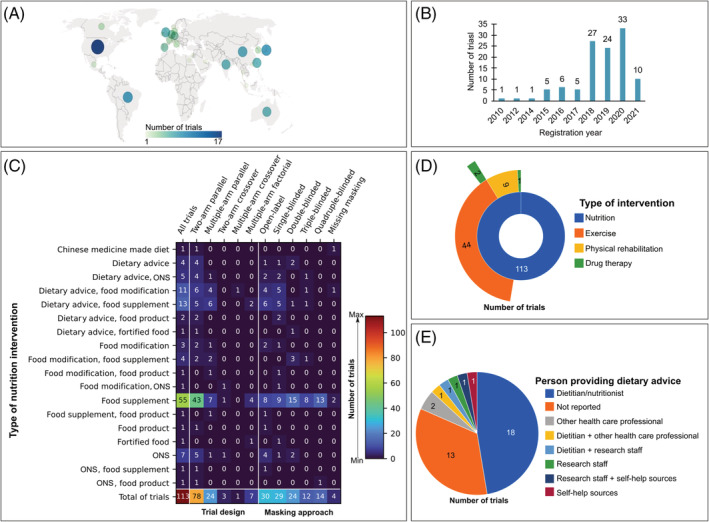
Figure 1
Figure 1
Graphical summary of the overall characteristics of ongoing randomized controlled trials investigating the effects of nutrition interventions on muscle mass or function, sarcopenia, or cachexia (N = 113). Numbers are absolute counts. (A) Illustration showing the distribution of trials according to country of registration. As depicted above, the USA is the leading country in the number of registered trials (15.0% of all trials); Brazil (8.0%) and Japan (8.0%) appears as the second leading countries. (B) Bar graph reporting number of trials per year of registration. (C) Heat map illustrating number of trials stratified by type of nutrition intervention, study design, and masking approaches. Colours within the heat map range from dark blue (least frequency) to dark red (most frequency); total numbers of trials can be found in the bottom row. (D) Sunburst chart showing the distribution of trials (in absolute counts) in which nutrition interventions (inner ring) are combined with one (middle ring) or ≥2 co‐interventions (outer rings; multimodal interventions). (E) Pie chart depicting how dietary advice is provided in 38 trials. Numbers placed inside of each piece of rings (in D) or pies (in E) correspond to the number of trials being studied. ONS, oral nutritional supplement.
Figure 2
Figure 2
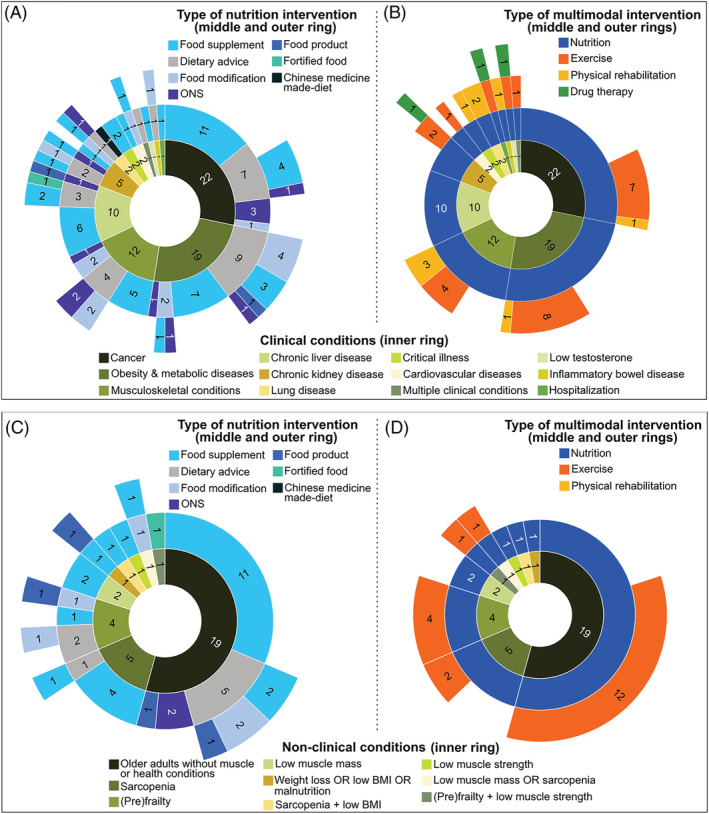
Sunburst charts depicting the types of nutrition and multimodal interventions under investigation in ongoing randomized clinical trials in (A, B) patients with clinical conditions (i.e. acute or chronic diseases; 78 out of 113 trials) and (C, D) older adults with non‐clinical conditions (with or without muscle‐related conditions; 35 out of 113 trials). While the inner rings represent categories of clinical and non‐clinical conditions, middle and outer rings describe the types of nutrition and multimodal interventions that relates to each condition. Numbers placed inside of each piece of rings correspond to the number of trials being studied in absolute counts. As an example of interpretation, in (A) of the 22 trials including patients with cancer, 11 provide patients with food supplements alone, 7 prescribe dietary advice (concurrent with food supplement in 4 trials or with ONS in 1 trial), 3 trials provide ONS alone, and 1 trial prescribe food modification alone. BMI, body mass index; ONS, oral nutritional supplement.
Figure 3
Figure 3
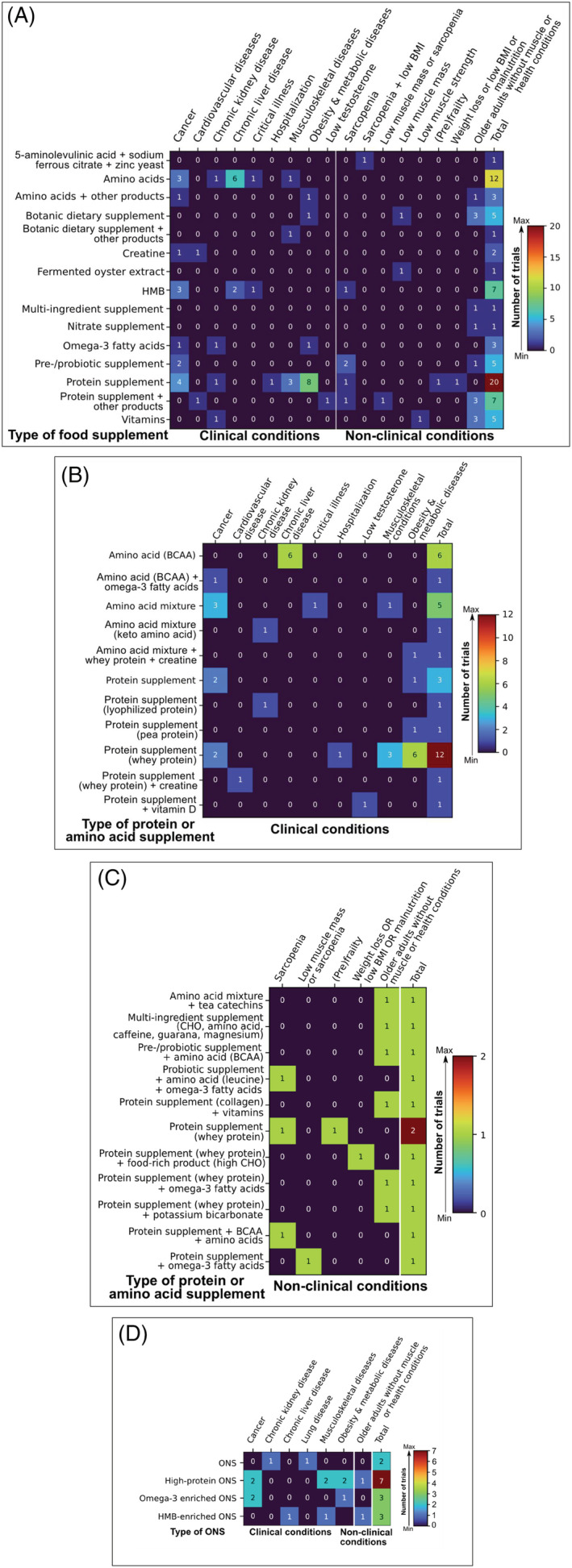
Heat map showing the distribution of ongoing randomized clinical trials studying the effects of food supplements (n = 74) and oral nutritional supplements (n = 15) on muscle mass or function, sarcopenia, or cachexia out of 113 trials included in this scoping review. (A) Types of food supplements under investigation in clinical (i.e. acute or chronic diseases; 49 out of 78 trials) and non‐clinical conditions (i.e. aging with or without muscle conditions; 25 out of 35 trials). (B) Composition of protein and amino acids supplements in clinical conditions. (C) Composition of protein and amino acids supplements in non‐clinical conditions. (D) Type of oral nutritional supplement in clinical and non‐clinical conditions. Colours within the heat map range from dark blue (least frequency) to dark red (most frequency). Value in each cell is absolute count, and the last column of each chart depicts total counts. Note that some clinical and non‐clinical conditions were omitted from the figure as they do not report nutrition interventions with food supplements or oral nutritional supplements. BCAA, branched‐chain amino acids; BMI, body mass index; Ca, calcium; CHO, carbohydrate; HMB, β‐hydroxy‐β‐methylbutyrate; ONS, oral nutritional supplements.
Figure 4
Figure 4
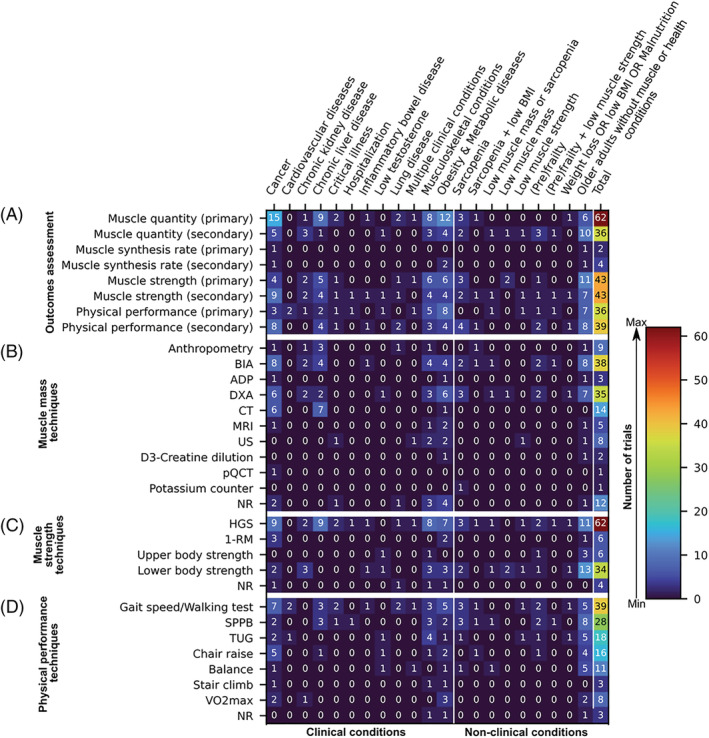
Heat map displaying outcome measures (y‐axis) of 113 ongoing randomized clinical trials studying the effects of nutrition interventions on muscle mass or function, sarcopenia, or cachexia. Trials are grouped by clinical and non‐clinical conditions (x‐axis). (A) Categories of muscle‐related outcomes (i.e. muscle quantity, muscle synthesis rate, muscle strength, and physical performance) stratified by types of outcomes (i.e. primary vs. secondary). (B) Anthropometric and body composition techniques being used to estimate outcomes related to muscle mass quantity. (C) Techniques being employed to evaluate muscle strength. (D) Methods commonly used to assess physical performance; note that different tests to evaluate gait speed and chair raise were grouped together for concision. Colours within the heat map range from dark blue (least frequency of trials) to dark red (most frequency of trials). Value in each cell is absolute count, and the last column of each figure panel depicts total counts. Note that some trials reported one or more concurrent primary or secondary outcomes. 1‐RM, one‐repetition maximum; ADP, air‐displacement plethysmography; BIA, bioelectrical impedance analysis; BMI, body mass index; CT, computed tomography; DXA, dual‐energy x‐ray absorptiometry; HGS, handgrip strength; MRI, magnetic resonance imaging; NR, not reported; pQCT, peripheral quantitative computed tomography; SPPB, Short Physical Performance Battery; TUG, timed up and go; US, ultrasound.
Figure 5
Figure 5
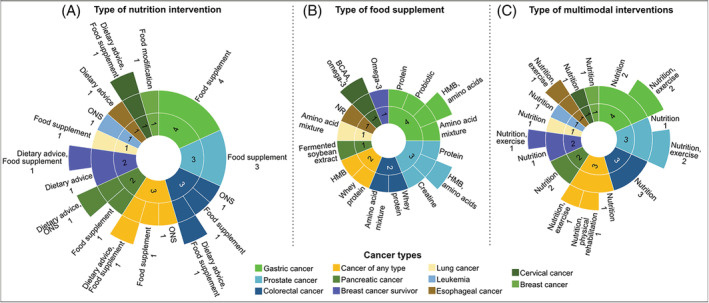
Sunburst charts illustrating the characteristics of interventions and distribution of trials across cancer types (inner rings, n = 22). Labels are placed outside of rings to indicate the number of trials and types of (A) nutrition interventions, (B) food supplements, and (C) multimodal interventions. Values are absolute counts. Nutrition interventions are given before cancer surgery in four trials, after cancer surgery in two trials, and both pre‐ and postoperatively in two trials. Patients included in eight trials are undergoing chemotherapy or radiotherapy while receiving the nutrition intervention. All patients with prostate cancer are receiving androgen deprivation therapy. One trial includes patients who are undergoing either curative or palliative cancer treatment, although therapy type was not specified. BCAA, branched‐chain amino acids; NR, not reported; ONS, oral nutritional supplement.
Figure 6
Figure 6
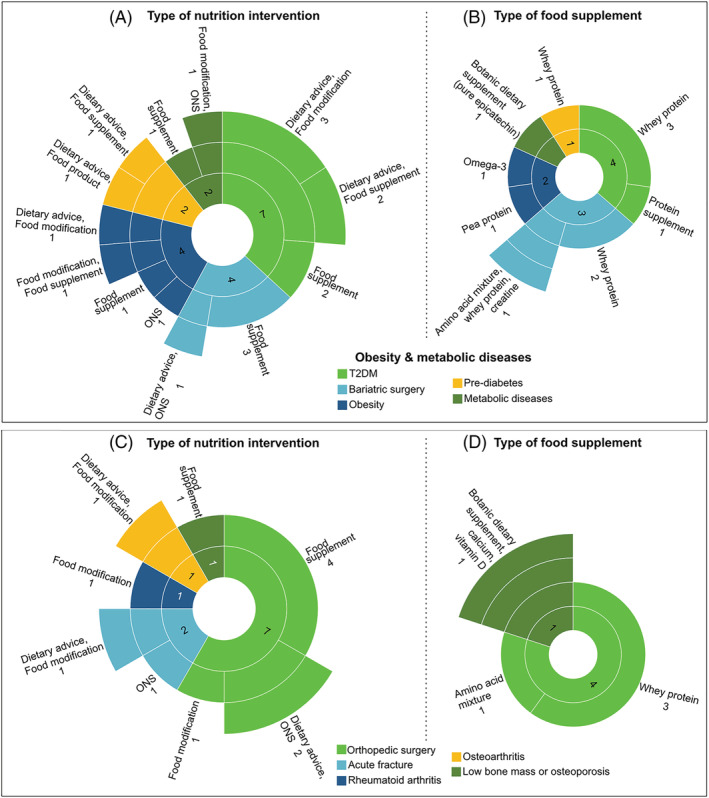
Sunburst charts showing characteristics of interventions and distribution of trials across patients with obesity and metabolic diseases (A, B; n = 19 trials) as well as musculoskeletal conditions (C, D; n = 12). While the inner rings represent classes of conditions, middle and outer rings describe the types of nutrition interventions (A, C) and food supplements (B, D) that relates to each condition. Labels are placed outside of rings to describe these information and number of trials (in absolute counts). Numbers placed inside of each innermost piece of rings correspond to the total number of trials being studied in each condition. HMB, β‐hydroxy‐β‐methylbutyrate; ONS, oral nutritional supplement; T2DM, type 2 diabetes mellitus.
Figure 7
Figure 7
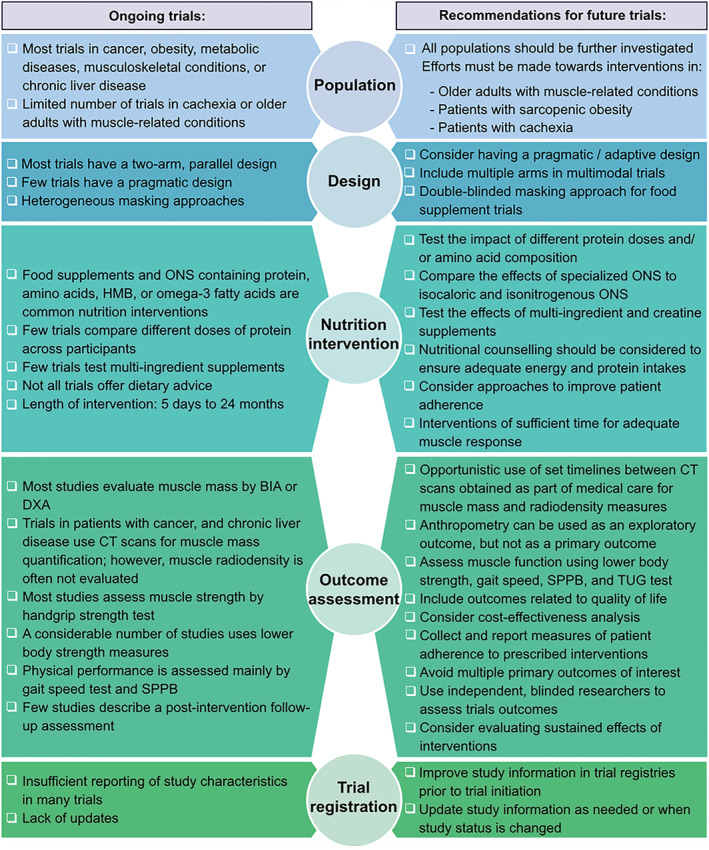
Recommendations for future trials investigating nutrition or multimodal interventions to prevent or treat low muscle mass or function, sarcopenia, or cachexia. BIA, bioelectrical impedance analysis; CT, computed tomography; DXA, dual‐energy X‐ray absorptiometry; ONS, oral nutritional supplement; SPPB, Short Physical Performance Battery; TUG, timed up and go.

References

    1. Bauer J, Morley JE, Schols AMWJ, Ferrucci L, Cruz‐Jentoft AJ, Dent E, et al. Sarcopenia: A time for action. An SCWD position paper. J Cachexia Sarcopenia Muscle 2019;10:956–961. - PMC - PubMed
    1. Cruz‐Jentoft AJ, Bahat G, Bauer J, Boirie Y, Bruyère O, Cederholm T, et al. Sarcopenia: Revised European consensus on definition and diagnosis. Age Ageing 2019;48:16–31. - PMC - PubMed
    1. Mayhew AJ, Amog K, Phillips S, Parise G, McNicholas PD, De Souza RJ, et al. The prevalence of sarcopenia in community‐dwelling older adults, an exploration of differences between studies and within definitions: a systematic review and meta‐analyses. Age Ageing 2019;48:48–56. - PubMed
    1. Ligthart‐Melis GC, Luiking YC, Kakourou A, Cederholm T, Maier AB, de van der Schueren MAE. Frailty, sarcopenia, and malnutrition frequently (Co‐)occur in hospitalized older adults: a systematic review and meta‐analysis. J Am Med Dir Assoc 2020;21:1216–1228. - PubMed
    1. Benz E, Trajanoska K, Lahousse L, Schoufour JD, Terzikhan N, De Roos E, et al. Sarcopenia in COPD: a systematic review and meta‐analysis. Eur Respir Rev 2019;28:1–13. - PMC - PubMed

Publication types

Grants and funding