


The association between skeletal muscle measures and chemotherapy-induced toxicity in non-small cell lung cancer patients
- PMID: 35301821
- PMCID: PMC9178405
- DOI: 10.1002/jcsm.12967
The association between skeletal muscle measures and chemotherapy-induced toxicity in non-small cell lung cancer patients
Abstract
Background: Chemotherapy-induced toxicities frequently occur in non-small cell lung cancer (NSCLC) patients treated with platinum-based chemotherapy. Low skeletal muscle mass (SMM) has been associated with a higher incidence of toxicities for several types of cancers and cytostatics. The aim of this study was to evaluate the association between skeletal muscle measures and chemotherapy-induced toxicity in a large cohort of NSCLC patients.
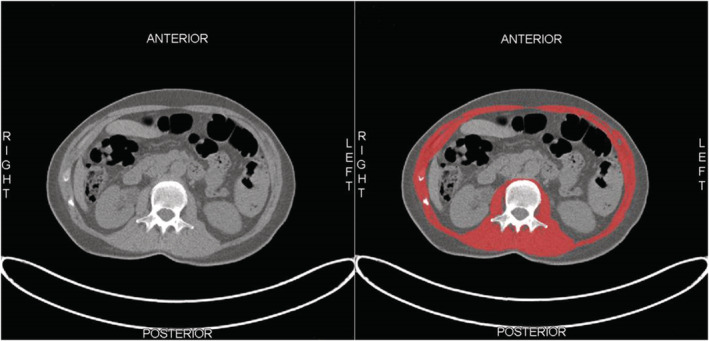
Methods: A multicentre prospective follow-up study (PGxLUNG, NTR number NL5373610015) in NSCLC patients was conducted. Included were patients diagnosed with NSCLC (stage II-IV) treated with first-line platinum-based (cisplatin or carboplatin) chemotherapy of whom pretreatment imaging was available. Skeletal muscle area (SMA) segmentation was performed on abdominal imaging at the level of the third lumbar vertebra (L3). SMA at the level of L3 was corrected for squared height (m2 ) to yield the lumbar skeletal muscle mass index (LSMI). Skeletal muscle density (SMD) was calculated as the mean Hounsfield Unit (HU) of the segmented SMA. SMM and SMD were categorized as low, intermediate, and high, based on LSMI and mean HU tertiles, respectively. Chemotherapy-induced toxicity was scored using CTCAE v4.03 and categorized into haematological (anaemia, leukocytopenia, neutropenia, and thrombocytopenia), non-haematological (nephrotoxicity, neurotoxicity, and esophagitis), and dose-limiting toxicity (DLT) (treatment switch, delay, de-escalation, discontinuation, or hospitalization). The relationship between SMM, SMD, and toxicities was assessed with logistic regression modelling taking into account potential confounders like gender and body mass index (BMI).
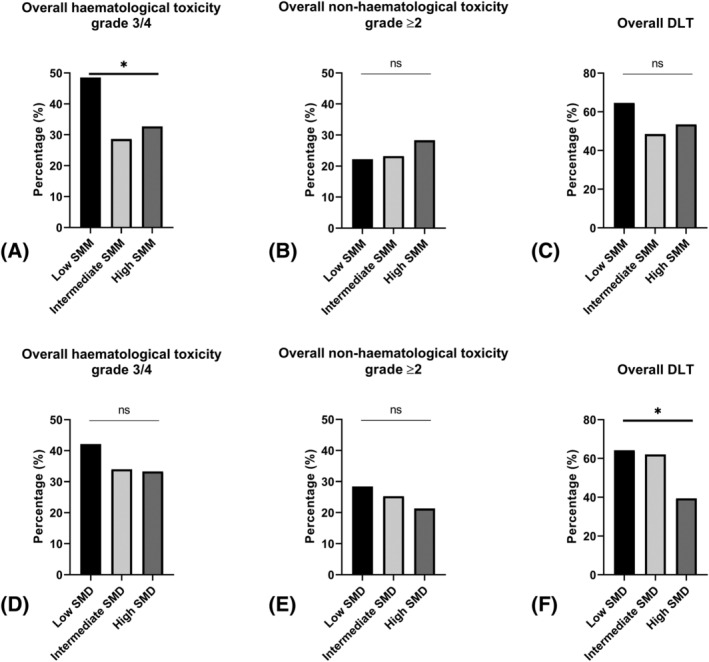
Results: In total, 297 patients (male n = 167, median age 64 years) were included. Haematological toxicity grade 3/4 was experienced in 36.6% (n = 108) of the patients, 24.6% (n = 73) experienced any non-haematological toxicity grade ≥2, and 55.6% (n = 165) any DLT. Multivariate logistic regression analysis showed that low SMM (ORadj 2.41, 95% CI 1.31-4.45, P = 0.005) and age at diagnosis >65 years (ORadj 1.76, 95% CI 1.07-2.90, P = 0.025) were statistically significantly associated with overall haematological toxicity grade 3/4. No statistically significant associations were found between low SMM or low SMD and non-haematological toxicities. Low SMM (ORadj 2.23, 95% CI 1.23-4.04, P = 0.008) and high SMD (ORadj 0.41, 95% CI 0.23-0.74, P = 0.003) were statistically significantly associated with a higher respectively lower risk of DLT.
Conclusions: Non-small cell lung cancer patients with pretreatment low SMM are at significant higher risk for haematological toxicities grade 3/4 and DLT. NSCLC patients with high SMD are at significant lower risk for DLT. Further studies should be aimed to investigate whether platinum dosing based on skeletal muscle measurements and/or improvement of pretreatment SMM/SMD could reduce the risk of toxicity without compromising efficacy.
Keywords: Body composition; Chemotherapy-induced toxicity; Non-small cell lung cancer; Platinum-based chemotherapy; Skeletal muscle mass.
© 2022 The Authors. Journal of Cachexia, Sarcopenia and Muscle published by John Wiley & Sons Ltd on behalf of Society on Sarcopenia, Cachexia and Wasting Disorders.
Conflict of interest statement
The authors have nothing to declare. The authors of this manuscript certify that they comply with the ethical guidelines for authorship and publishing in the
Figures
References
-
- Bray F, Ferlay J, Soerjomataram I, Siegel RL, Torre LA, Jemal A. Global cancer statistics 2018: GLOBOCAN estimates of incidence and mortality worldwide for 36 cancers in 185 countries. CA Cancer J Clin 2018;68:394–424. - PubMed
-
- Spira A, Ettinger DS. Multidisciplinary management of lung cancer. Wood AJJ, ed. N Engl J Med 2004;350:379–392. - PubMed
-
- Deng HY, Zha P, Hou L, Huang KL. Does sarcopenia have any impact on survival of patients with surgically treated non‐small‐cell lung cancer? Interact Cardiovasc Thorac Surg 2019;29:144–147. - PubMed
-
- Kawaguchi Y, Hanaoka J, Ohshio Y, Okamoto K, Kaku R, Hayashi K, et al. Sarcopenia predicts poor postoperative outcome in elderly patients with lung cancer. Gen Thorac Cardiovasc Surg 2019;67:949–954. - PubMed
Publication types
MeSH terms
Substances
Grants and funding
LinkOut - more resources
Full Text Sources
Medical
