


Ab initio studies of magnetism and topology in solid Pd-rich [Formula: see text]-PdSi alloys
- PMID: 35302061
- PMCID: PMC8931064
- DOI: 10.1038/s41598-022-08656-5
Ab initio studies of magnetism and topology in solid Pd-rich [Formula: see text]-PdSi alloys
Abstract
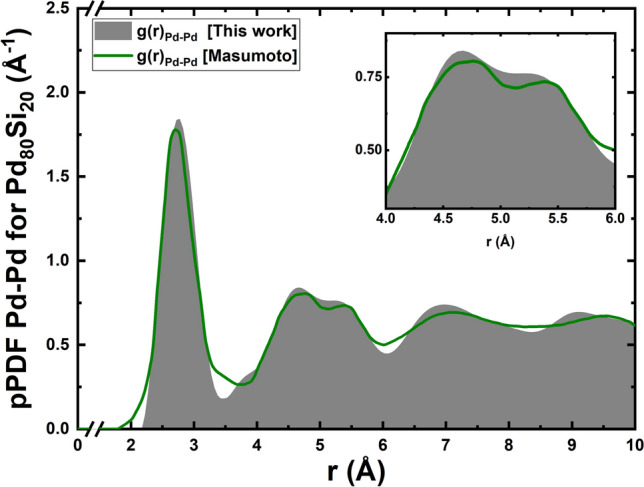
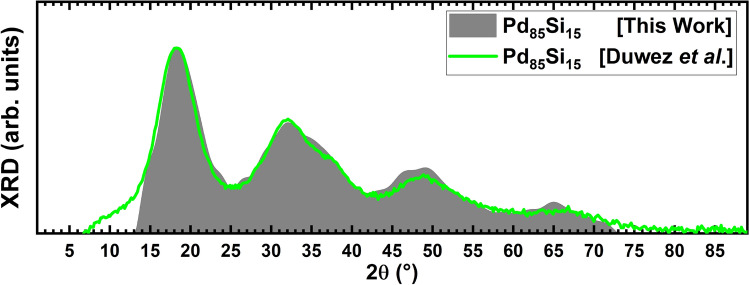
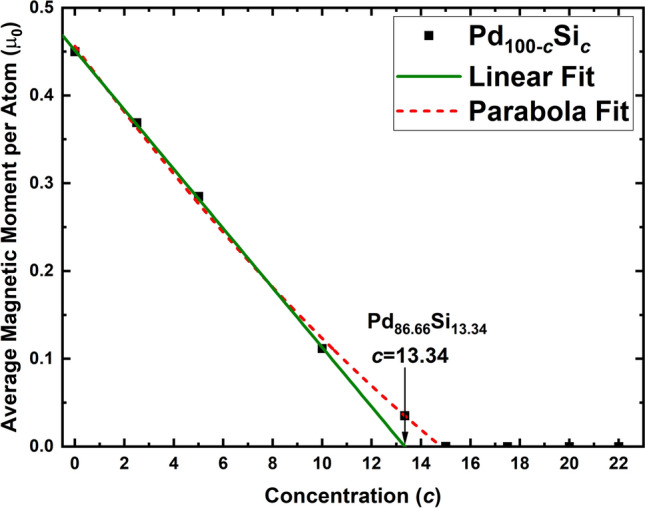
In 1965 Duwez et al. reported having generated an amorphous, stable phase of palladium-silicon in the region 15 to 23 atomic percent, at.%, silicon. These pioneering efforts have led to the development of solid materials that are now known as Bulk Metallic Glasses, BMG. In 2019 Rodríguez et al. discovered, computationally, that bulk amorphous Pd becomes magnetic, and so does porous/amorphous Pd. Puzzled by these results, the study of several solid binary systems in the Pd-rich zone was undertaken; in particular, the study of the glassy metallic alloy a-Pd[Formula: see text]Si[Formula: see text], for [Formula: see text], (c in at.%) to see what their topology is, what their electronic properties are and to inquire about their magnetism. In this work it is shown that this metallic glass is in fact magnetic in the region [Formula: see text]. Collaterally [Formula: see text] and [Formula: see text] magnetization curves are shown where the net magnetic moment is presented. The topology and the position of the first few peaks of the pair distribution functions, which agrees well with experiment, are also discussed. The BMGs produced experimentally so far are limited in size, but despite this limitation, recent industrial efforts have developed some useful devices that may revolutionize technology.
© 2022. The Author(s).
Conflict of interest statement
The authors declare no competing interests.
Figures




References
-
- Klement W, Willens RH, Duwez POL. Non-crystalline structure in solidified gold-silicon alloys. Nature. 1960;187:869–870. doi: 10.1038/187869b0. - DOI
-
- Duwez P, Willens RH, Crewdson RC. Amorphous phase in palladium—silicon alloys. J. Appl. Phys. 1965;36:2267–2269. doi: 10.1063/1.1714461. - DOI
-
- Duwez, P. Metallic glasses-historical background, in Glassy Metals I. Topics in Applied Physics, Ch. 2, 19–23 (Springer, 1981).
-
- Suryanarayana C, Inoue A. Bulk Metallic Glasses. 2. Taylor and Francis Group, CRC Press; 2018.
-
- Amorphology Inc., Spin-off of NASA that produces devices based on BMG. https://www.amorphology.com (2021).
LinkOut - more resources
Full Text Sources
