


Risk of Peritoneal Carcinomatosis After Risk-Reducing Salpingo-Oophorectomy: A Systematic Review and Individual Patient Data Meta-Analysis
- PMID: 35302882
- PMCID: PMC9851686
- DOI: 10.1200/JCO.21.02016
Risk of Peritoneal Carcinomatosis After Risk-Reducing Salpingo-Oophorectomy: A Systematic Review and Individual Patient Data Meta-Analysis
Abstract
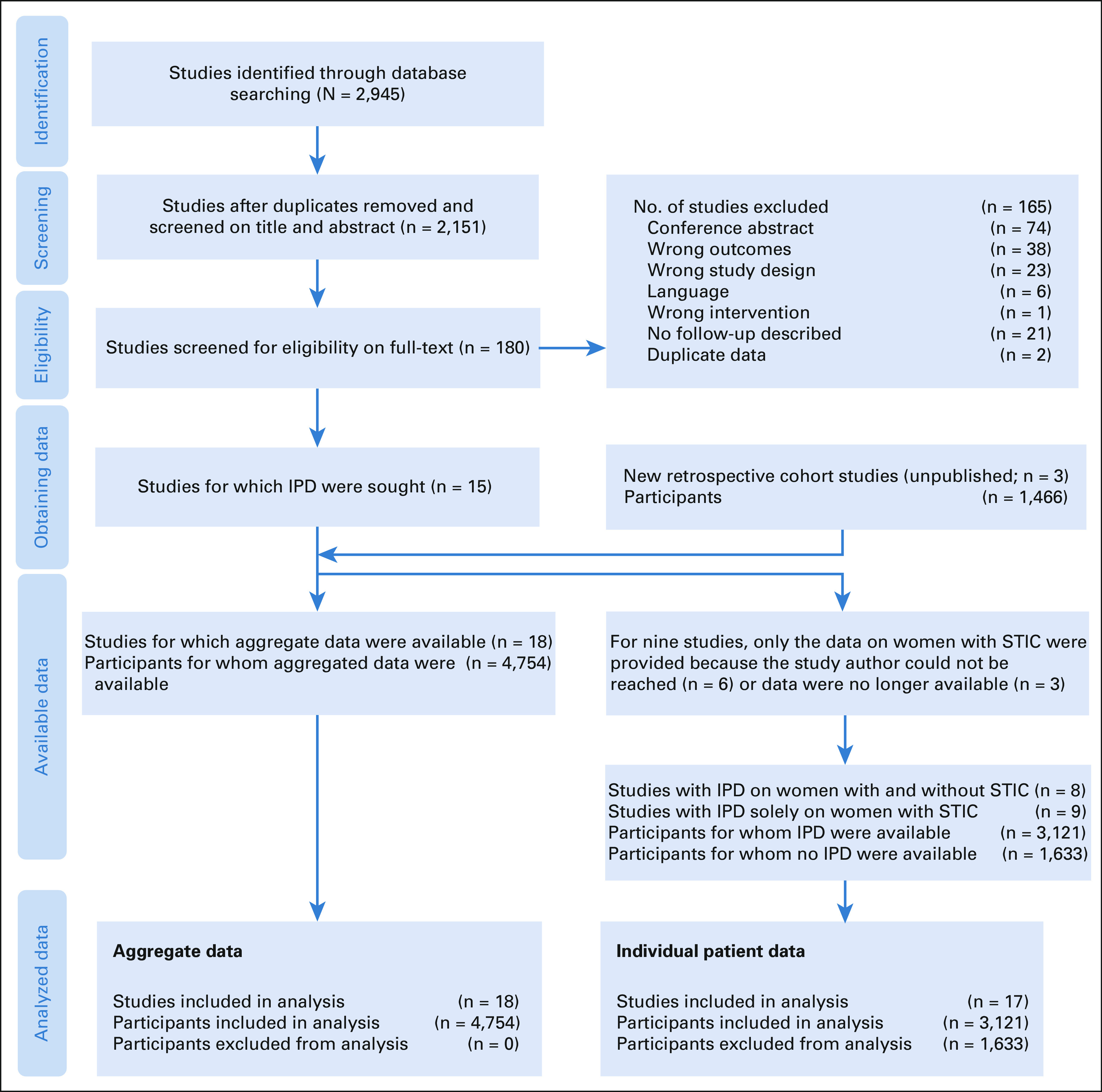
Purpose: After risk-reducing salpingo-oophorectomy (RRSO), BRCA1/2 pathogenic variant (PV) carriers have a residual risk to develop peritoneal carcinomatosis (PC). The etiology of PC is not yet clarified, but may be related to serous tubal intraepithelial carcinoma (STIC), the postulated origin for high-grade serous cancer. In this systematic review and individual patient data meta-analysis, we investigate the risk of PC in women with and without STIC at RRSO.
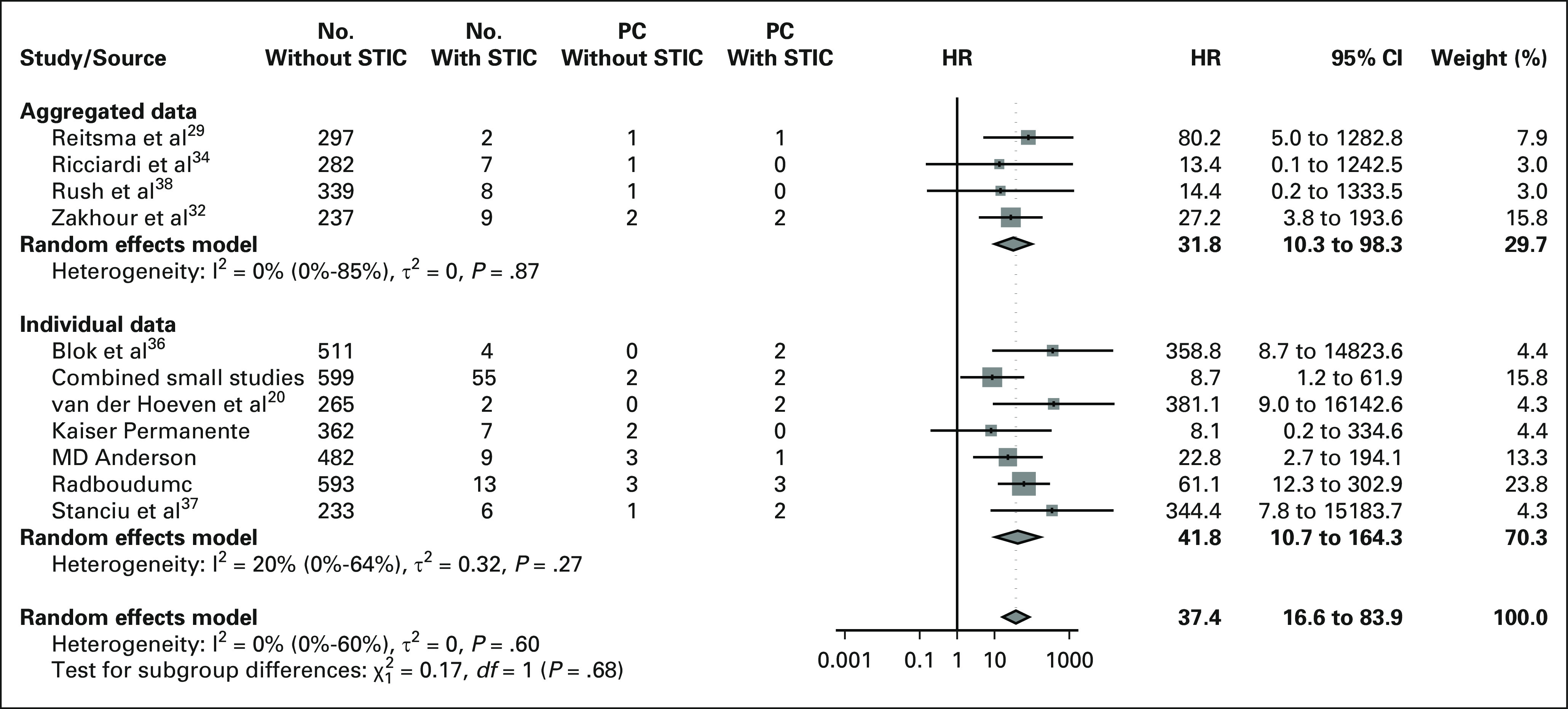
Methods: Unpublished data from three centers were supplemented by studies identified in a systematic review of EMBASE, MEDLINE, and the Cochrane library describing women with a BRCA-PV with and without STIC at RRSO until September 2020. Primary outcome was the hazard ratio for the risk of PC between BRCA-PV carriers with and without STIC at RRSO, and the corresponding 5- and 10-year risks. Primary analysis was based on a one-stage Cox proportional-hazards regression with a frailty term for study.
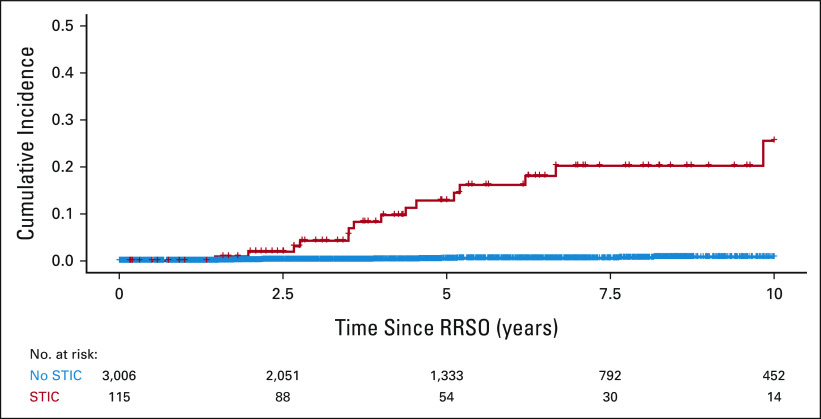
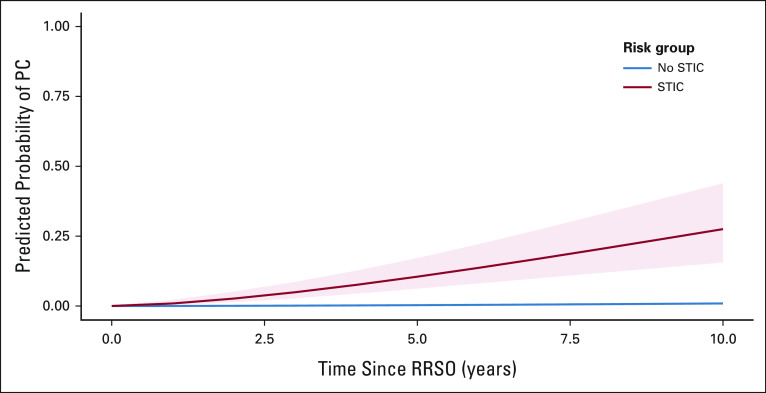
Results: From 17 studies, individual patient data were available for 3,121 women, of whom 115 had a STIC at RRSO. The estimated hazard ratio to develop PC during follow-up in women with STIC was 33.9 (95% CI, 15.6 to 73.9), P < .001) compared with women without STIC. For women with STIC, the five- and ten-year risks to develop PC were 10.5% (95% CI, 6.2 to 17.2) and 27.5% (95% CI, 15.6 to 43.9), respectively, whereas the corresponding risks were 0.3% (95% CI, 0.2 to 0.6) and 0.9% (95% CI, 0.6 to 1.4) for women without STIC at RRSO.
Conclusion: BRCA-PV carriers with STIC at RRSO have a strongly increased risk to develop PC which increases over time, although current data are limited by small numbers of events.
Conflict of interest statement
Figures
Comment in
-
Risk of Peritoneal Cancer After Risk-Reducing Bilateral Salpingo-Oophorectomy for Women With Germline BRCA Pathogenic Variants: A Cause for Concern or Potentially Avoidable?J Clin Oncol. 2022 Jun 10;40(17):1850-1852. doi: 10.1200/JCO.22.00325. Epub 2022 Mar 25. J Clin Oncol. 2022. PMID: 35333598 No abstract available.
-
Considerations for the Risk of Peritoneal Carcinomatosis After Risk-Reducing Salpingo-Oophorectomy.J Clin Oncol. 2022 Nov 10;40(32):3783. doi: 10.1200/JCO.22.00726. Epub 2022 Jul 12. J Clin Oncol. 2022. PMID: 35820079 No abstract available.
References
-
- Siegel RL, Miller KD, Jemal A: Cancer statistics, 2019. CA Cancer J Clin 69:7-34, 2019 - PubMed
-
- Kuchenbaecker KB, Hopper JL, Barnes DR, et al. : Risks of breast, ovarian, and contralateral breast cancer for BRCA1 and BRCA2 mutation carriers. Jama 317:2402-2416, 2017 - PubMed
-
- Lu KH: Screening for ovarian cancer in asymptomatic women. JAMA 319:557-558, 2018 - PubMed
-
- Buys SS, Partridge E, Black A, et al. : Effect of screening on ovarian cancer mortality: The Prostate, Lung, Colorectal and Ovarian (PLCO) cancer screening randomized controlled trial. JAMA 305:2295-2303, 2011 - PubMed
Publication types
MeSH terms
Grants and funding
LinkOut - more resources
Full Text Sources
Other Literature Sources
Medical
Miscellaneous
