


Nitrites and nitrates from food additives and natural sources and cancer risk: results from the NutriNet-Santé cohort
- PMID: 35303088
- PMCID: PMC9365633
- DOI: 10.1093/ije/dyac046
Nitrites and nitrates from food additives and natural sources and cancer risk: results from the NutriNet-Santé cohort
Abstract
Background: Nitrates and nitrites occur naturally in water and soil. They are also used as food additives (preservatives) in processed meats. They could play a role in the carcinogenicity of processed meat. The objective was to investigate the relationship between nitrate and nitrite intakes (natural food, water and food additive sources) and cancer risk in a large prospective cohort with detailed dietary assessment.
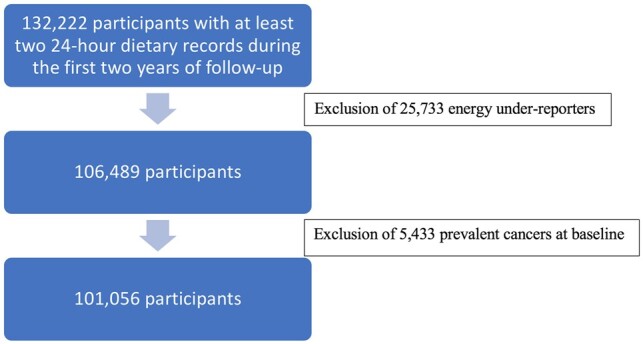
Methods: Overall, 101 056 adults from the French NutriNet-Santé cohort (2009-ongoing, median follow-up 6.7 years) were included. Nitrites/nitrates exposure was evaluated using repeated 24-h dietary records, linked to a comprehensive composition database and accounting for commercial names/brands of industrial products. Associations with cancer risk were assessed using multi-adjusted Cox hazard models.
Results: In total, 3311 incident cancer cases were diagnosed. Compared with non-consumers, high consumers of food additive nitrates had higher breast cancer risk [hazard ratio (HR) = 1.24 (95% CI 1.03-1.48), P = 0.02], more specifically for potassium nitrate. High consumers of food additive nitrites had higher prostate cancer risk [HR = 1.58 (1.14-2.18), P = 0.008], specifically for sodium nitrite. Although similar HRs were observed for colorectal cancer for additive nitrites [HR = 1.22 (0.85-1.75)] and nitrates [HR = 1.26 (0.90-1.76)], no association was detected, maybe due to limited statistical power for this cancer location. No association was observed for natural sources.
Conclusion: Food additive nitrates and nitrites were positively associated with breast and prostate cancer risks, respectively. Although these results need confirmation in other large-scale prospective studies, they provide new insights in a context of lively debate around the ban of these additives from the food industry.
Keywords: Nitrites; cancer risk; food additives; nitrates; prospective cohort.
© The Author(s) 2022. Published by Oxford University Press on behalf of the International Epidemiological Association.
Figures
References
-
- International Agency for Research on Cancer (IARC). Ingested nitrate and nitrite, and cyanobacterial peptide toxins. 2010. https://publications.iarc.fr/Book-And-Report-Series/Iarc-Monographs-On-T... (10 March 2021, date last accessed).
-
- Open Food Facts. https://world.openfoodfacts.org/discover (22 October 2020, date last accessed).
-
- International Agency for Research on Cancer (IARC). IARC Monographs on the Evaluation of Carcinogenesis Risks to Humans Some N-Nitroso Compounds. Lyon: International Agency for Research on Cancer, 1998.
-
- Duncan C, Dougall H, Johnston P. et al. Chemical generation of nitric oxide in the mouth from the enterosalivary circulation of dietary nitrate. Nat Med 1995;1:546–51. - PubMed
Publication types
MeSH terms
Substances
Grants and funding
LinkOut - more resources
Full Text Sources
Medical
