


Cytokine adsorption in patients with acute-on-chronic liver failure (CYTOHEP)-a single center, open-label, three-arm, randomized, controlled intervention trial
- PMID: 35303938
- PMCID: PMC8931566
- DOI: 10.1186/s13063-022-06139-6
Cytokine adsorption in patients with acute-on-chronic liver failure (CYTOHEP)-a single center, open-label, three-arm, randomized, controlled intervention trial
Erratum in
-
Correction: Cytokine adsorption in patients with acute-on-chronic liver failure (CYTOHEP)-a single center, open-label, three-arm, randomized, controlled intervention trial.Trials. 2022 Apr 15;23(1):319. doi: 10.1186/s13063-022-06267-z. Trials. 2022. PMID: 35428345 Free PMC article. No abstract available.
Abstract
Background: Liver cirrhosis is a major healthcare problem and the mortality rate is high. During recent years, systemic inflammation has been recognized as a major driver of hepatic decompensation and progression of liver cirrhosis to acute-on-chronic liver failure (ACLF). The aim of the CYTOHEP study is to assess the impact of extracorporeal hemoadsorption with the CytoSorb adsorber on serum bilirubin concentrations, humoral inflammation parameters, liver function parameters, and patient survival in patients with ACLF and acute kidney injury (AKI).
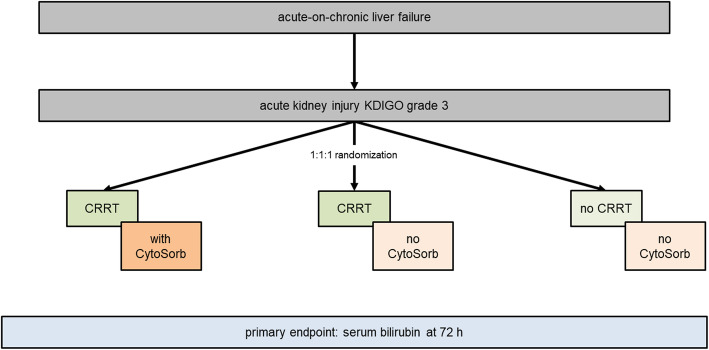
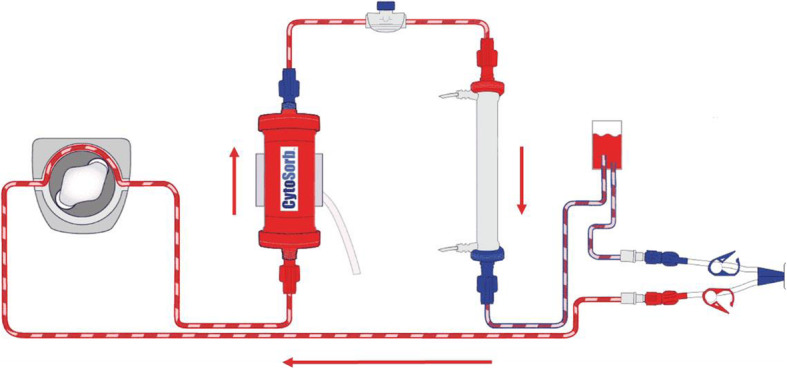
Methods: The CYTOHEP study is a prospective, single-center, open-label, three-arm, randomized, controlled intervention trial. Patients with ACLF and AKI stage 3 according to Kidney Disease: Improving Global Outcome (KDIGO) criteria will be randomized into three groups to be treated with (1) continuous renal replacement therapy (CRRT) and CytoSorb, (2) CRRT without CytoSorb, and (3) without both, CRRT and CytoSorb. In the hemoadsorption group, CytoSorb will be used for 72 h. The other groups receive standard of care with early or late initiation of CRRT, respectively. Primary endpoint of the study is serum bilirubin concentration after 72 h, important secondary endpoints are 30-day survival and a panel of inflammatory parameters.
Discussion: The CYTOHEP study is designed to evaluate the benefit of extracorporeal hemoadsorption in patients with ACLF. The results of this study will help to better understand the potential role of hemoadsorption for the treatment of ACLF and its impact on bilirubin levels, inflammatory parameters, and survival.
Trial registration: ClinicalTrials.gov NCT05019352. Registered on August 24, 2021. Deutsches Register Klinischer Studien (DRKS) DRKS00026082.
Keywords: Acute-on-chronic liver failure; CytoSorb; Extracorporeal hemoadsorption; Liver cirrhosis; Randomized controlled trial.
© 2022. The Author(s).
Conflict of interest statement
ASu received speakers’ honoraria from CytoSorbents, the manufacturer of the CytoSorb device. ASu also received an unrestricted research grant from CytoSorbents. DB received speakers’ honoraria from Bayer Healthcare and the Falk Foundation. Further, he receives consulting honoraria from Bayer Healthcare, Boston Scientific, and Shionogi. EP received consulting honoraria from Novartis Pharma.
Figures

References
-
- Chan AW, Tetzlaff JM, Gotzsche PC, Altman DG, Mann H, Berlin JA, Dickersin K, Hrobjartsson A, Schulz KF, Parulekar WR, Krleza-Jeric K, Laupacis A, Moher D. SPIRIT 2013 explanation and elaboration: guidance for protocols of clinical trials. Bmj. 2013;346(jan08 15):e7586. doi: 10.1136/bmj.e7586. - DOI - PMC - PubMed
-
- Arroyo V, Angeli P, Moreau R, Jalan R, Clària J, Trebicka J, Fernández J, Gustot T, Caraceni P, Bernardi M, Investigators from the EASL-CLIF Consortium, Grifols Chair and European Foundation for the Study of Chronic Liver Failure (EF-Clif) The systemic inflammation hypothesis: Towards a new paradigm of acute decompensation and multiorgan failure in cirrhosis. J Hepatol. 2021;74(3):670–685. doi: 10.1016/j.jhep.2020.11.048. - DOI - PubMed
Publication types
MeSH terms
Substances
Associated data
LinkOut - more resources
Full Text Sources
Medical
