


Cost-effectiveness analysis on COVID-19 surveillance strategy of large-scale sports competition
- PMID: 35303953
- PMCID: PMC8931792
- DOI: 10.1186/s40249-022-00955-3
Cost-effectiveness analysis on COVID-19 surveillance strategy of large-scale sports competition
Abstract
Background: Nucleic acid test (NAT) could effectively control the spread of COVID-19 caused by large-scale sports competitions. However, quantitative analysis on the appropriate frequency of NAT is scarce, and the cost-effectiveness and necessity of high-frequency NAT remain to be fully explored and validated. This study aims to optimize the COVID-19 surveillance strategies through cost-effectiveness analysis for the Tokyo 2020 Olympic Games and the upcoming Beijing 2022 Olympic Winter Games.
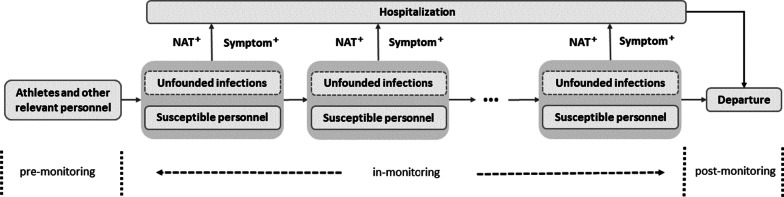
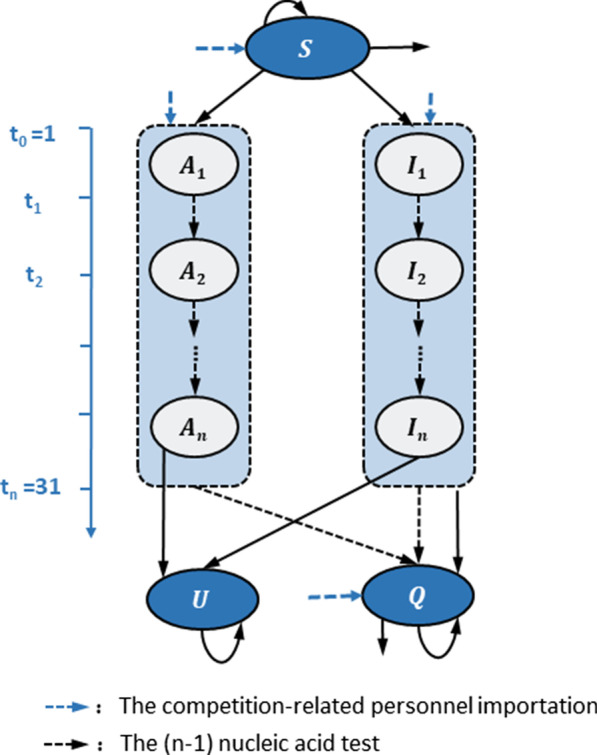
Methods: A total of 18 scenarios were designed regarding the NAT frequency, symptom monitoring, and strengthening close-contact control. An agent-based stochastic dynamic model was used to compare the cost-effectiveness of different NAT scenarios and optimize the surveillance strategies. The dynamics of the proposed model included the arrival and departure of agents, transmission of the disease according to Poisson processes, and quarantine of agents based on regular NATs and symptom onset. Accumulative infections, cost, and incremental cost-effectiveness ratio (ICER) were simulated in the frame of the model. ICER was used to compare the cost-effectiveness of different scenarios. Univariate sensitivity analysis was performed to test the robustness of the results.
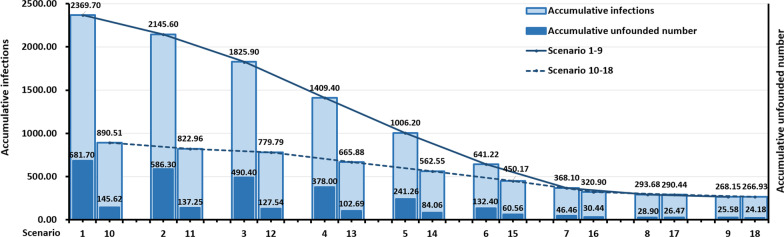
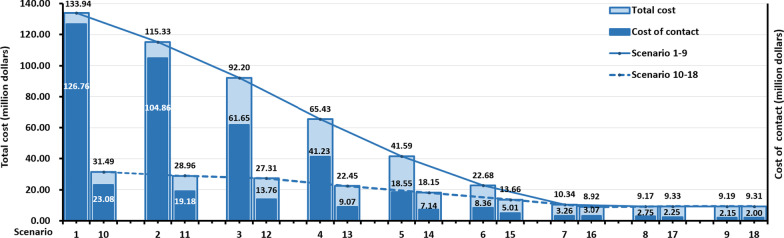
Results: In Scenario 16, where the competition-related personnel (CRP) received NAT daily and national sports delegation (NSD) with quarantined infections accepted an additional NAT daily, accumulative infection was 320.90 (90 initial infections), the total cost was (United States Dollar) USD 8 920 000, and the cost of detecting out each infection was USD 27 800. Scenario 16 would reduce the total cost by USD 22 570 000 (avoid 569.61 infections), USD 1 420 000 (avoid 47.2 infections) compared with Scenario 10 (weekly NAT, strengthened close contact control) and Scenario 7 (daily NAT, no strengthened close contact control), respectively. Sensitivity analysis showed that the result was most sensitive to the change in basic reproductive number.
Conclusions: High-frequency NATs such as bidaily, daily, and twice a day were cost-effective. NAT daily for CRP with strengthening close-contact control could be prioritized in defense against COVID-19 at large-scale sports competitions. This study could assist policymakers by assessing the cost-effectiveness of NAT scenarios and provide the host country with an optimal COVID-19 surveillance strategy.
Keywords: COVID-19; Cost-effectiveness; Nucleic acid test; Sports competition; Stochastic dynamic model; Surveillance.
© 2022. The Author(s).
Conflict of interest statement
The authors declare that they have no competing interests.
Figures
References
-
- Xiaotang Z. The spread effect of large scale international sports competition events on social developement. J Guangzhou Sport Univ. 2007;01:26–28.
-
- CCTV News Client. 4 new people involved in the Tokyo Paralympics test positive for the new crown virus. 2021. http://m.news.cctv.com/2021/09/05/ARTIzDtdEPlXcwiKerIwDjx9210905.shtml. Accessed 15 Nov 2021.
-
- General Office of National Health Commission of the People’s Republic of China, Office of National Administration of Traditional Chinese Medicine. Diagnosis and treatment of corona virus disease-19 (8th trial edition). 2021. http://www.gov.cn/zhengce/zhengceku/2021-04/15/content_5599795.htm?_zbs_.... Accessed 1 Nov 2021.
MeSH terms
Grants and funding
LinkOut - more resources
Full Text Sources
Medical
Research Materials
Miscellaneous
