


A late Middle Pleistocene Middle Stone Age sequence identified at Wadi Lazalim in southern Tunisia
- PMID: 35304482
- PMCID: PMC8933421
- DOI: 10.1038/s41598-022-07816-x
A late Middle Pleistocene Middle Stone Age sequence identified at Wadi Lazalim in southern Tunisia
Abstract
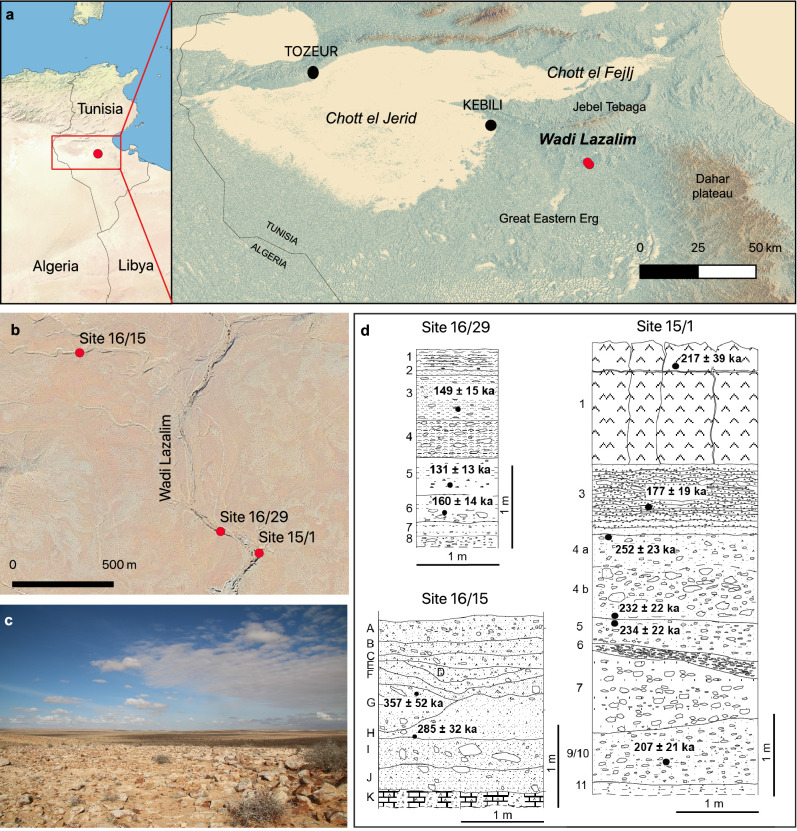
The late Middle Pleistocene, starting at around 300 ka, witnessed large-scale biological and cultural dynamics in hominin evolution across Africa including the onset of the Middle Stone Age that is closely associated with the evolution of our species-Homo sapiens. However, archaeological and geochronological data of its earliest appearance are scarce. Here we report on the late Middle Pleistocene sequence of Wadi Lazalim, in the Sahara of Southern Tunisia, which has yielded evidence for human occupations bracketed between ca. 300-130 ka. Wadi Lazalim contributes valuable information on the spread of early MSA technocomplexes across North Africa, that likely were an expression of large-scale diffusion processes.
© 2022. The Author(s).
Conflict of interest statement
The authors declare no competing interests.
Figures

References
-
- McDougall I, Brown FH, Fleagle JG. Stratigraphic placement and age of modern humans from Kibish, Ethiopia. Nature. 2005;433:733–736. - PubMed
-
- Van Peer, P. in Africa from MIS 6–2: Population Dynamics and Paleoenvironments (eds C. Sacha Jones & A. Brian Stewart) 147–159 (Springer, 2016).
-
- Hublin J-J, et al. New fossils from Jebel Irhoud, Morocco and the pan-African origin of Homo sapiens. Nature. 2017;546:289. - PubMed
-
- Richter D, et al. The age of the hominin fossils from Jebel Irhoud, Morocco, and the origins of the Middle Stone Age. Nature. 2017;546:293. - PubMed
