


Borderline personality disorder: associations with psychiatric disorders, somatic illnesses, trauma, and adverse behaviors
- PMID: 35304564
- PMCID: PMC9135625
- DOI: 10.1038/s41380-022-01503-z
Borderline personality disorder: associations with psychiatric disorders, somatic illnesses, trauma, and adverse behaviors
Abstract
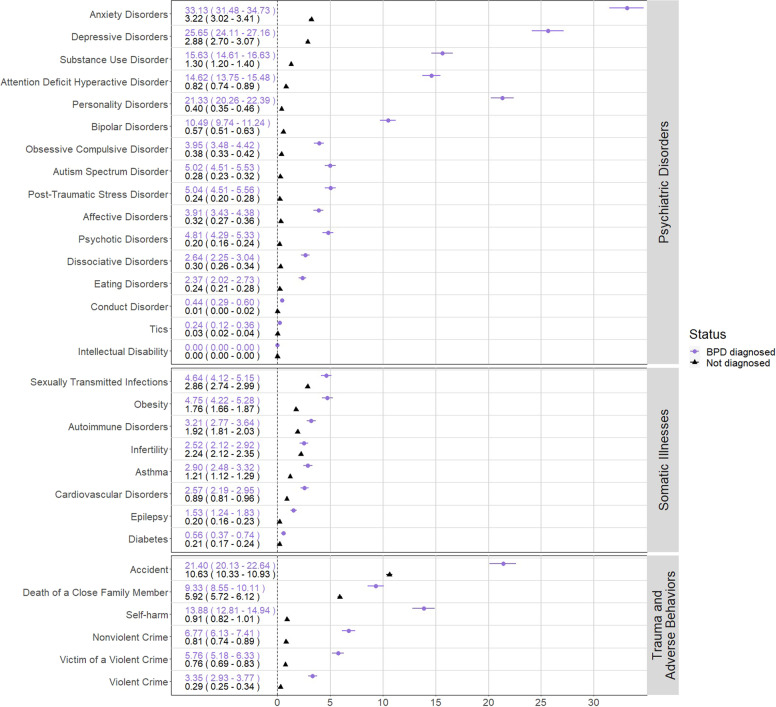
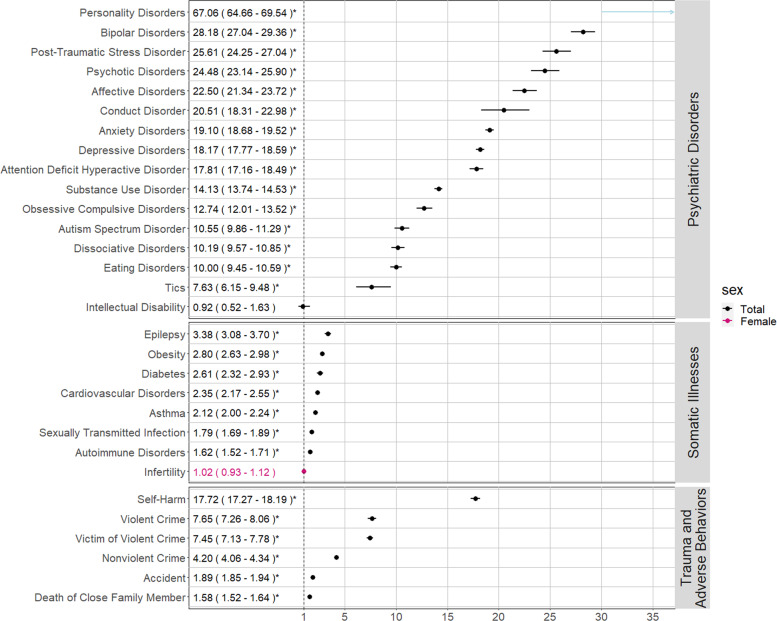
In one of the largest, most comprehensive studies on borderline personality disorder (BPD) to date, this article places into context associations between this diagnosis and (1) 16 different psychiatric disorders, (2) eight somatic illnesses, and (3) six trauma and adverse behaviors, e.g., violent crime victimization and self-harm. Second, it examines the sex differences in individuals with BPD and their siblings. A total of 1,969,839 Swedish individuals were identified from national registers. Cumulative incidence with 95% confidence intervals (CI) was evaluated after 5 years of follow-up from BPD diagnosis and compared with a matched cohort. Associations were estimated as hazard ratios (HR) with 95% CIs from Cox regression. 12,175 individuals were diagnosed with BPD (85.3% female). Individuals diagnosed with BPD had higher cumulative incidences and HRs for nearly all analyzed indicators, especially psychiatric disorders. Anxiety disorders were most common (cumulative incidence 95% CI 33.13% [31.48-34.73]). Other notable findings from Cox regressions include psychotic disorders (HR 95% CI 24.48 [23.14-25.90]), epilepsy (3.38 [3.08-3.70]), violent crime victimization (7.65 [7.25-8.06]), and self-harm (17.72 [17.27-18.19]). HRs in males and females with BPD had overlapping CIs for nearly all indicators. This indicates that a BPD diagnosis is a marker of vulnerability for negative events and poor physical and mental health similarly for both males and females. Having a sibling with BPD was associated with an increased risk for psychiatric disorders, trauma, and adverse behaviors but not somatic disorders. Clinical implications include the need for increased support for patients with BPD navigating the health care system.
© 2022. The Author(s).
Conflict of interest statement
Larsson reports: Evolan (speaker); Shire (speaker, grant recipient); Takeda (speaker, grant recipient) all outside the submitted work. Tate, Sahlin, Liu, Lu, Lundström, Lichtenstein, Kuja-Halkola report no financial relationships with commercial interests.
Figures
References
-
- Gunderson JG, Herpertz SC, Skodol AE, Torgersen S, Zanarini MC. Borderline personality disorder. Nat Rev Dis Prim. 2018;4:1–20.. - PubMed
-
- APA. Diagnostic and statistical manual of mental disorders (DSM-5®). American Psychiatric Association Publication; 2013.
-
- Frankenburg FR, Zanarini MC. The association between borderline personality disorder and chronic medical illnesses, poor health-related lifestyle choices, and costly forms of health care utilization. J Clin Psychiatry. 2004. - PubMed
-
- Arola R, Antila H, Riipinen P, Hakko H, Riala K, Kantojärvi L. Borderline personality disorder associates with violent criminality in women: a population based follow-up study of adolescent psychiatric inpatients in Northern Finland. Forensic Sci Int. 2016;266:389–95. doi: 10.1016/j.forsciint.2016.06.028. - DOI - PubMed
Publication types
MeSH terms
Grants and funding
LinkOut - more resources
Full Text Sources
