


Cerebellar morphometric and spectroscopic biomarkers for Machado-Joseph Disease
- PMID: 35305685
- PMCID: PMC8933766
- DOI: 10.1186/s40478-022-01329-4
Cerebellar morphometric and spectroscopic biomarkers for Machado-Joseph Disease
Abstract
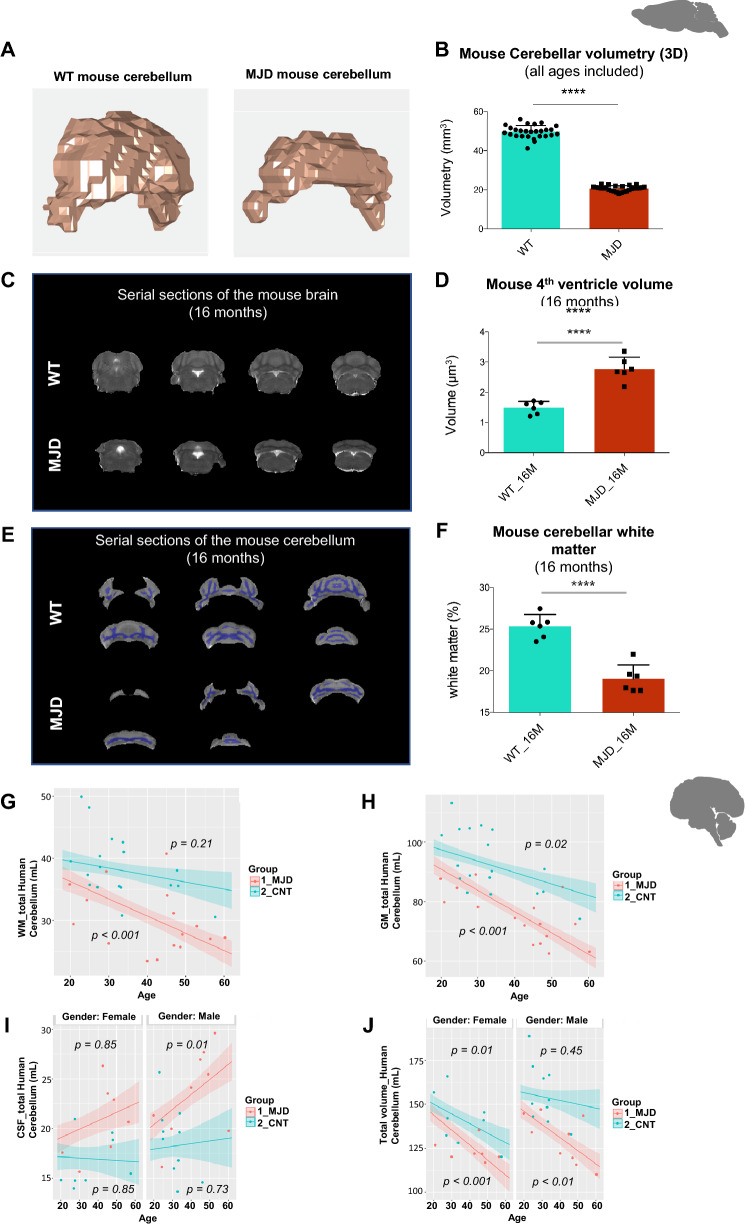
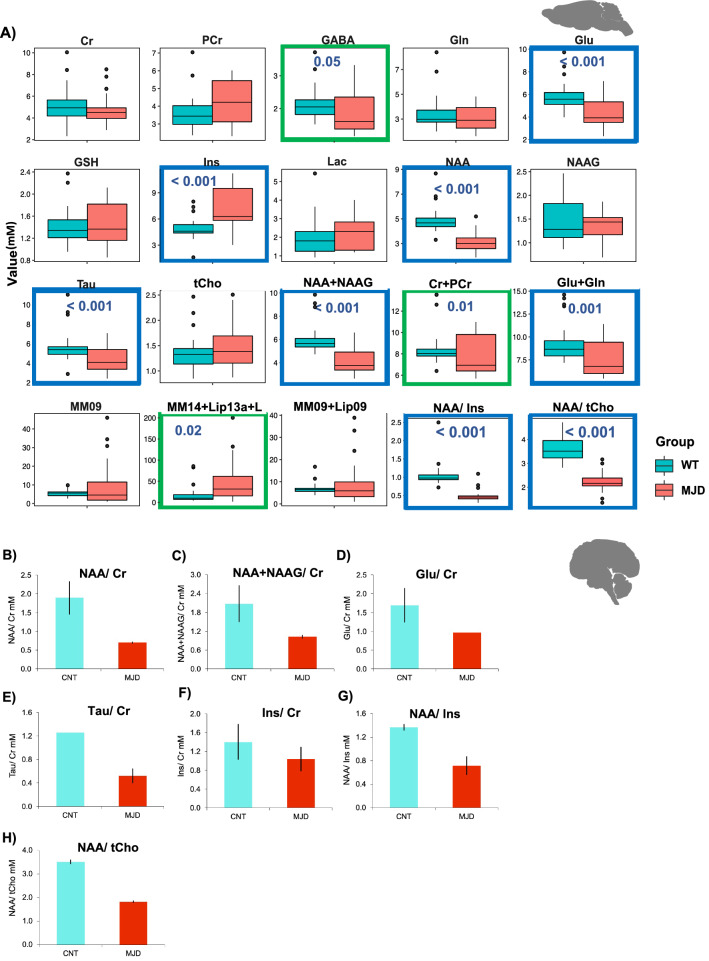
Machado-Joseph disease (MJD) or Spinocerebellar ataxia type 3 (SCA3) is the most common form of dominant SCA worldwide. Magnetic Resonance Imaging (MRI) and Proton Magnetic Resonance Spectroscopy (1H-MRS) provide promising non-invasive diagnostic and follow-up tools, also serving to evaluate therapies efficacy. However, pre-clinical studies showing relationship between MRI-MRS based biomarkers and functional performance are missing, which hampers an efficient clinical translation of therapeutics. This study assessed motor behaviour, neurochemical profiles, and morphometry of the cerebellum of MJD transgenic mice and patients aiming at establishing magnetic-resonance-based biomarkers. 1H-MRS and structural MRI measurements of MJD transgenic mice were performed with a 9.4 Tesla scanner, correlated with motor performance on rotarod and compared with data collected from human patients. We found decreased cerebellar white and grey matter and enlargement of the fourth ventricle in both MJD mice and human patients as compared to controls. N-acetylaspartate (NAA), NAA + N-acetylaspartylglutamate (NAA + NAAG), Glutamate, and Taurine, were significantly decreased in MJD mouse cerebellum regardless of age, whereas myo-Inositol (Ins) was increased at early time-points. Lower neurochemical ratios levels (NAA/Ins and NAA/total Choline), previously correlated with worse clinical status in SCAs, were also observed in MJD mice cerebella. NAA, NAA + NAAG, Glutamate, and Taurine were also positively correlated with MJD mice motor performance. Importantly, these 1H-MRS results were largely analogous to those found for MJD in human studies and in our pilot data in human patients. We have established a magnetic resonance-based biomarker approach to monitor novel therapies in preclinical studies and human clinical trials.
Keywords: Machado-Joseph disease (MJD); Magnetic resonance imaging (MRI); Motor performance; Proton magnetic resonance spectroscopy (1H-MRS) biomarkers; Spinocerebellar ataxia type 3 (SCA3).
© 2022. The Author(s).
Conflict of interest statement
The authors have declared that no conflict of interest exists.
Figures


References
-
- Kawaguchi Y, Okamoto T, Taniwaki M, Aizawa M, Inoue M, Katayama S, et al. CAG expansions in a novel gene for Machado-Joseph disease at chromosome 14q32.1. Nat Genet. 1994;8:221–228. - PubMed
-
- Paulson HL, Perez MK, Trottier Y, Trojanowski JQ, Subramony SH, Das SS, et al. Intranuclear inclusions of expanded polyglutamine protein in spinocerebellar ataxia type 3. Neuron. 1997;19:333–344. - PubMed
-
- Koeppen AH. Polyglutamine disorders. Adv Exp Med Biol. 2018;1049:233–241. - PubMed
-
- Murata Y, Yamaguchi S, Kawakami H, Imon Y, Maruyama H, Sakai T, et al. Characteristic magnetic resonance imaging findings in Machado-Joseph disease. Arch Neurol-chicago. 1998;55:33–37. - PubMed
-
- Schulz JB, Borkert J, Wolf S, Schmitz-Hübsch T, Rakowicz M, Mariotti C, et al. Visualization, quantification and correlation of brain atrophy with clinical symptoms in spinocerebellar ataxia types 1, 3 and 6. Neuroimage. 2010;49:158–168. - PubMed
Publication types
MeSH terms
Substances
LinkOut - more resources
Full Text Sources
