


Advances in Preclinical PET
- PMID: 35307164
- PMCID: PMC9038721
- DOI: 10.1053/j.semnuclmed.2022.02.002
Advances in Preclinical PET
Abstract
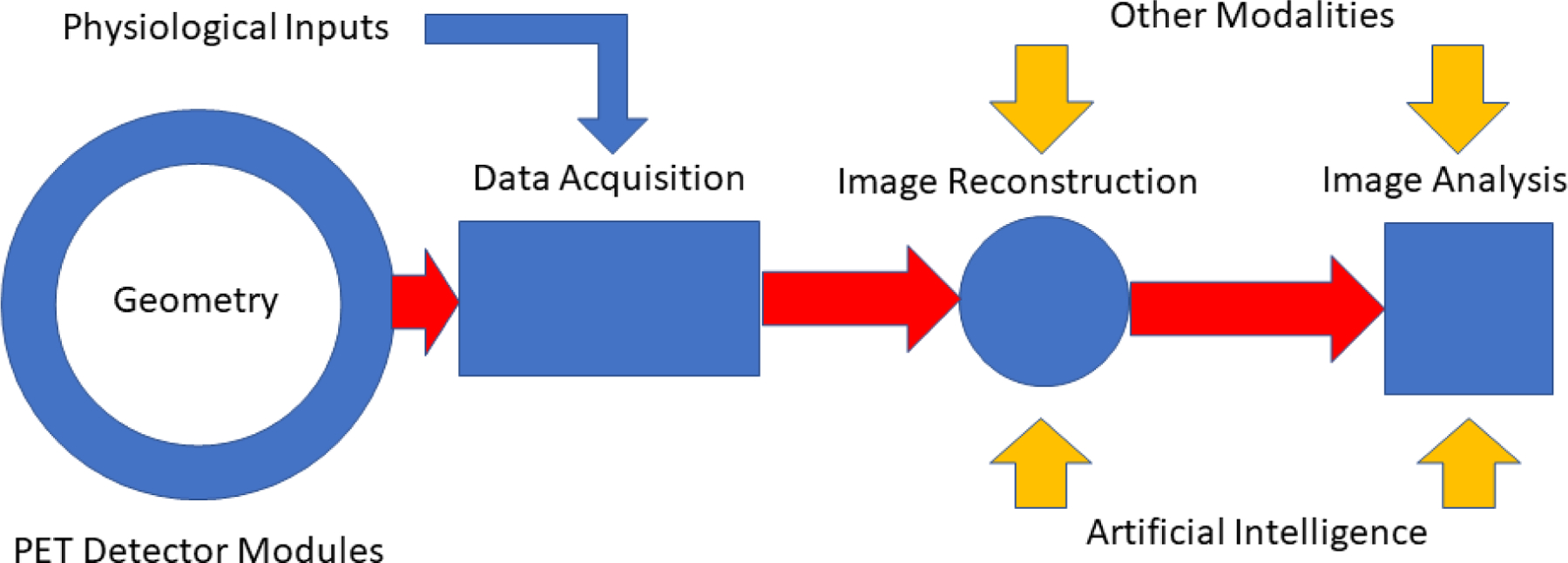
The classical intent of PET imaging is to obtain the most accurate estimate of the amount of positron-emitting radiotracer in the smallest possible volume element located anywhere in the imaging subject at any time using the least amount of radioactivity. Reaching this goal, however, is confounded by an enormous array of interlinked technical issues that limit imaging system performance. As a result, advances in PET, human or animal, are the result of cumulative innovations across each of the component elements of PET, from data acquisition to image analysis. In the report that follows, we trace several of these advances across the imaging process with a focus on small animal PET.
Published by Elsevier Inc.
Conflict of interest statement
Declaration of interests The authors declare that they have no known competing financial interests or personal relationships that could have appeared to influence the work reported in this paper
Figures

References
-
- Amirrashedi M, Zaidi H, Ay MR. Advances in preclinical PET instrumentation. PET clinics. 2020;15(4):403–426. - PubMed
-
- Miyaoka RS, Lehnert AL. Small animal PET: a review of what we have done and where we are going. Physics in Medicine & Biology. 2020;65(24):24TR04. - PubMed
-
- Levin CS, Hoffman EJ. Calculation of positron range and its effect on the fundamental limit of positron emission tomography system spatial resolution. Physics in Medicine & Biology. 1999;44(3):781. - PubMed
Publication types
MeSH terms
Grants and funding
LinkOut - more resources
Full Text Sources
Research Materials
