. 2022 Aug;6(8):702-710.
doi: 10.1016/j.oret.2022.03.011. Epub 2022 Mar 18.

The Current State of Genetic Testing Platforms for Inherited Retinal Diseases

Affiliations

The Current State of Genetic Testing Platforms for Inherited Retinal Diseases

Debarshi Mustafi et al. Ophthalmol Retina. 2022 Aug.

Abstract

Purpose: To evaluate genetic testing platforms used to aid in the diagnosis of inherited retinal degenerations (IRDs).

Design: Evaluation of diagnostic tests and technologies.

Subjects: Targeted genetic panel testing for IRDs.

Methods: Data collected regarding targeted genetic panel testing for IRDs offered by different laboratories were investigated for the inclusion of coding and noncoding variants in disease genes. Both large IRD panels and smaller, more focused, disease-specific panels were included in the analysis.

Main outcome measures: Number of disease genes tested as well as the commonality and uniqueness across testing platforms in both coding and noncoding variants of disease.

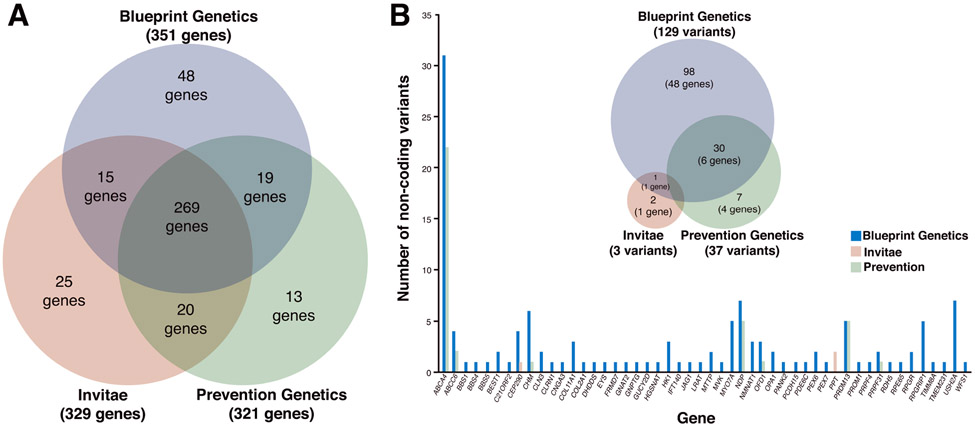
Results: Across the 3 IRD panel tests investigated, 409 unique genes are represented, of which 269 genes are tested by all 3 panels. The top 20 genes known to cause over 70% of all IRDs are represented in the 269 common genes tested by all 3 panels. In addition, 138 noncoding variants in 50 unique genes are assayed across the 3 platforms. Focused, disease-specific panels exhibit significant variability across the 5 testing platforms that were studied.

Conclusions: Ordering genetic testing for IRDs is not straightforward, as evidenced by the multitude of panels available to providers. It is important that there is coverage of both coding and noncoding regions in IRD genes to offer diagnoses in these patients. This paper details the diversity of testing platforms currently available to clinicians and provides a thorough explanation of the genes tested in the different IRD panels. In a time of increased importance of the clinical genetic testing of patients with IRDs, knowledge of the proper test to order is paramount.

Keywords: Genetic counseling; Genetic testing; Genome sequencing; Inherited retinal disease; Retinal dystrophy.


Conflict of interest statement

Conflict of Interest: No conflicting relationship exists for any author.

Figures

Figure 1.
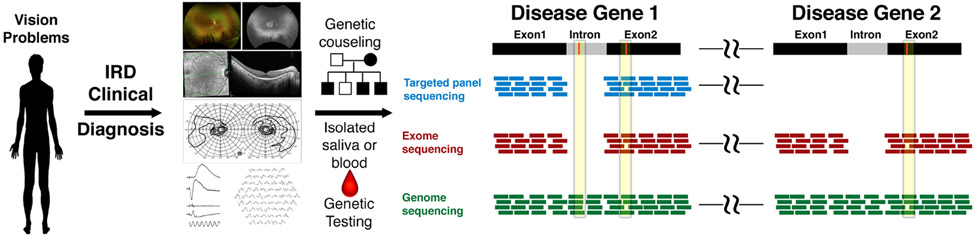
Figure 1.. Genetic testing paradigm for patients with IRDs.
This schematic highlights the process of genetic testing patients with suspected IRDs. The process starts with careful clinical diagnosis by the clinician. Once a diagnosis of IRD is suspected, the patient should be referred for genetic counseling for detailed family history and genogram construction as well as for discussion of the implications of genetic testing. Isolated blood or saliva can then be taken for genetic testing. The type of genetic testing will determine the coverage and identification of pathogenic genetic variants. In targeted gene panel sequencing, or panel testing, reads map to exons of targeted genes. In this example, the pathogenic variant (red) in exon 2 of disease gene 1 would be identified, but not the intronic variant in disease gene 1. Since the targets are pre-set, exonic variants in a distant (denoted by spacers) disease gene 2 would not be captured with this test. In exome sequencing, reads map to exons of all genes so both exonic variants would be detected, but not the intronic variant. Genome sequencing, which has reads encompassing the entire region, would be expected to identify both intronic and exonic variants in both disease genes.
Figure 2.
Figure 2.. Examination of genes included in retinal dystrophy panels offered by Blueprint Genetics, Invitae and Prevention Genetics.
(A) Of the 409 unique coding regions of genes assayed across the three different retinal dystrophy panels, there are 269 genes in common including the top 20 genes known to cause over 70% of IRDs. In the Blueprint Genetics Retinal Dystrophy panel, there are 48 unique genes of which 37 are mitochondrial genes. Prevention genetics has 13 unique genes with some indicated in rare forms of RP associated with structural variants. Invitae’s panel has 25 unique genes with a subset of those implicated in oculocutaneous albinism. (B) Of the 138 non-coding variants assayed across all platforms, 98 (across 49 genes) are unique to Blueprint, 2 are unique to Invitae in the gene PPT, whereas 7 (across 4 genes) are unique to Prevention Genetics, reflected in the proportionate Venn diagram. There is 1 variant in common between Blueprint Genetics and Invitae in the gene CEP290 and Blueprint and Prevention Genetics have 30 non-coding variants in common across 6 genes. The plot shows the number of non-coding variants in the targeted genes, with ABCA4 having the most variants.
Figure 3.
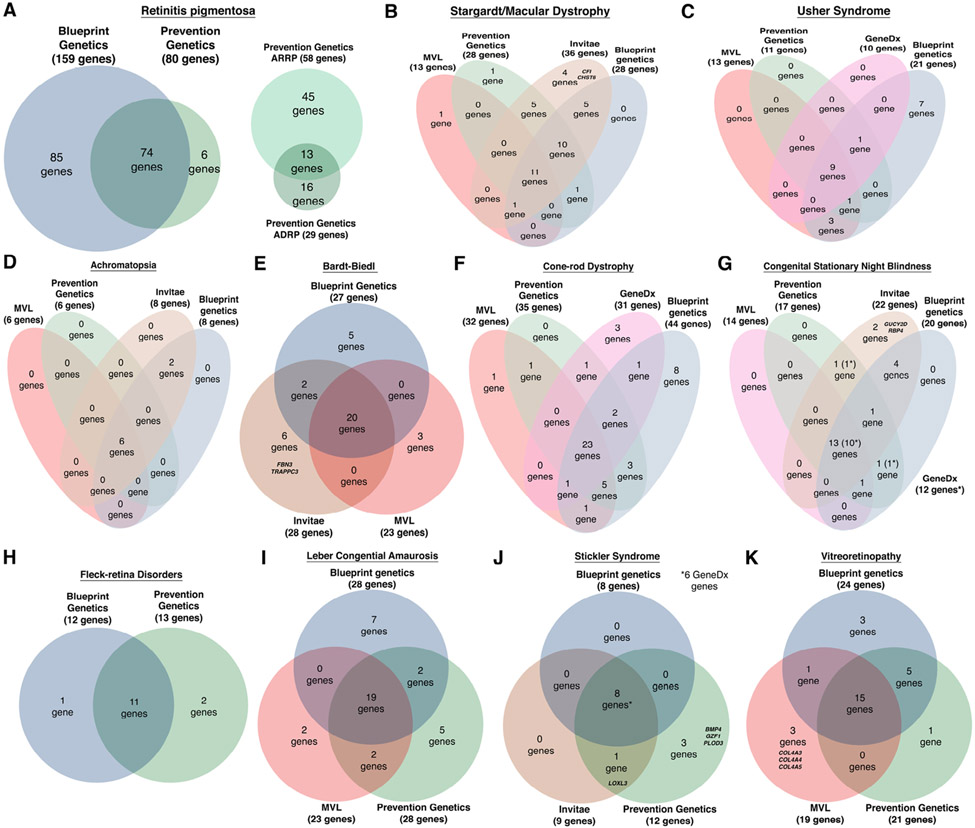
Figure 3.. Not all retinal disease panels are created equal.
A survey of different retinal disease panels highlight the differences that exist between the different platforms surveyed (Blueprint Genetics, GeneDx, Invitae, MVL, and Prevention Genetics). In the most prevalent IRD, retinitis pigmentosa (A), the larger Blueprint Genetics panel, as indicated by the proportionate Venn diagram, encompasses the majority of retinitis pigmentosa genes. There are panels specific to different inheritance patterns that exist with Prevention Genetics, but the overarching disease specific panels include these genes. Survey of focused panels for more common IRDs of (B) Stargardt and (C) Usher syndrome illustrate some specific platforms may be better suited for each disease. In Stargardt disease Invitae is the most comprehensive whereas for Usher Syndrome the Blueprint Genetics platform is most inclusive of disease genes. Other panels available for (D) Achromatopsia, (E) Bardt-Biedl, (F) Cone-rod dystrophy, (G) Congenital stationary night blindness (the 12 GeneDx genes are marked by asteriks in parenthesis in the diagram) , (H) Fleck-retina disorders, (I) Leber's congenital amaurosis, (J) Stickler syndrome, and (K) Vitreoretinopathy are shown. Interestingly, Invitae and Prevention Genetics disease specific panels included genes that were not in their larger retinal dystrophy panels. These 8 genes are listed by symbol in their respective disease specific diagram ((E) Bardt-Biedl, (B) Stargardt/Macular Dystrophy, (J) Stickler syndrome). The only other genes unique to these panels were the 3 collagen genes listed from MVL in the (K) Vitreoretinopathy panel.

References

    1. Stone EM. Genetic testing for inherited eye disease. Arch Ophthalmol. 2007;125:205–212. - PubMed
    1. Bessant DA, Ali RR, Bhattacharya SS. Molecular genetics and prospects for therapy of the inherited retinal dystrophies. Curr Opin Genet Dev. 2001;11:307–316. - PubMed
    1. Berger W, Kloeckener-Gruissem B, Neidhardt J. The molecular basis of human retinal and vitreoretinal diseases. Prog Retin Eye Res. 2010;29:335–315. - PubMed
    1. Solebo AL, Teoh L, Rahi J. Epidemiology of blindness in children. Arch Dis Child. 2017;102:853–851. - PubMed
    1. Hamblion EL, Moore AT, Rahi JS, British Childhood Onset Hereditary Retinal Disorders Network. Incidence and patterns of detection and management of childhood-onset hereditary retinal disorders in the UK. Br J Ophthalmol. 2012;96:360–365. - PubMed

Publication types