


National, regional, and provincial disease burden attributed to Streptococcus pneumoniae and Haemophilus influenzae type b in children in China: Modelled estimates for 2010-17
- PMID: 35308577
- PMCID: PMC8928075
- DOI: 10.1016/j.lanwpc.2022.100430
National, regional, and provincial disease burden attributed to Streptococcus pneumoniae and Haemophilus influenzae type b in children in China: Modelled estimates for 2010-17
Abstract
Background: Vaccination against Streptococcus pneumoniae (pneumococcus) and Haemophilus influenzae type b (Hib) is not included in China's national immunization programme. To inform China's immunization polices, we estimated annual national, regional, and provincial childhood mortality and morbidity attributable to pneumococcus and Hib in 2010-17.
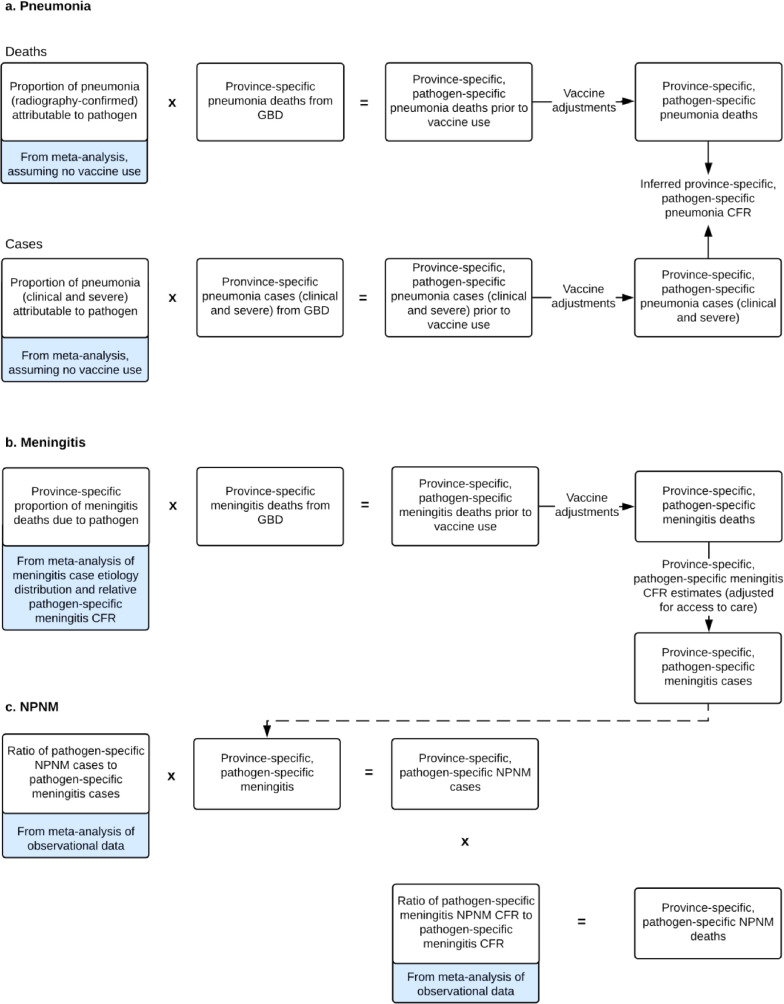
Methods: We estimated proportions of pneumonia and meningitis deaths and cases attributable to pneumococcus and Hib using evidence from vaccine clinical trials and surveillance studies of bacterial meningitis and pathogen-specific case fatality ratios (CFR). Then we applied the proportions to model provincial-level pneumonia cases and deaths, meningitis deaths and meningitis CFR in children aged 1-59 months, accounting for vaccine coverage. Non-pneumonia, non-meningitis (NPNM) invasive disease cases were derived by applying NPNM meningitis ratios to meningitis estimates.
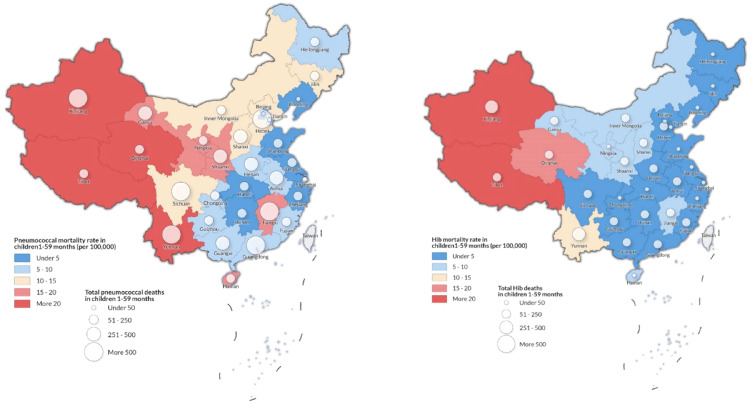
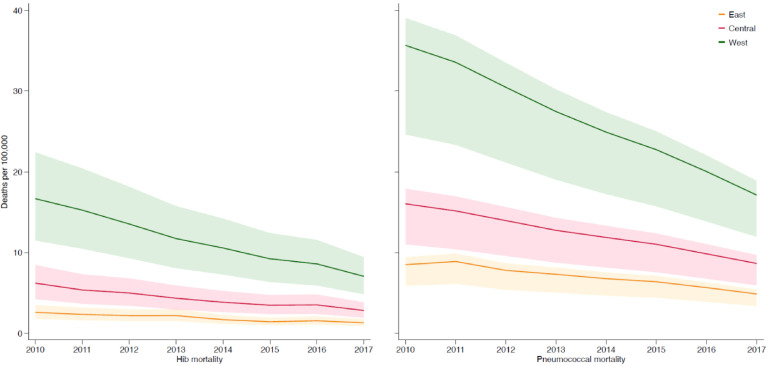
Findings: In 2010-17, annual pneumococcal deaths fell by 49% from 15 600 (uncertainty range: 10 800-17 300) to 8 000 (5 500-8 900), and Hib deaths fell by 56% from 6 500 (4 500-8 800) to 2 900 (2 000-3 900). Severe pneumococcal and Hib cases decreased by 16% to 218 200 (161 500-252 200) in 2017 and 29% to 49 900 (29 000-99 100). Estimated 2017 national three-dose coverage in private market was 1·3% for PCV and 33·4% for Hib vaccine among children aged 1-59 months. Provinces in the west region had the highest disease burden.
Interpretation: Childhood mortality and morbidity attributable to pneumococcal and Hib has decreased in China, but still substantially varied by region and province. Higher vaccine coverage could further reduce disease burden.
Funding: Bill & Melinda Gates Foundation.
Keywords: China; Haemophilus influenzae type b; Immunization; Streptococcus pneumoniae.
© 2022 The Author(s).
Conflict of interest statement
HF reports grants from the Bill & Melinda Gates Foundation and Sanofi Pasteur. BW reports grants from the Bill & Melinda Gates Foundation. MDK reports grants from the Bill & Melinda Gates Foundation, Pfizer and Gavi Alliance, and personal fees from Merck. CG reports grants from the Bill & Melinda Gates Foundation and Pfizer, and personal fees from Merck. All other authors declare no competing interests.
Figures
References
-
- Murphy T.V., White K.E., Pastor P., et al. Declining incidence of Haemophilus influenzae type b disease since introduction of vaccination. JAMA. 1993;269(2):246–248. - PubMed
-
- Adegbola R.A., Secka O., Lahai G., et al. Elimination of Haemophilus influenzae type b (Hib) disease from the Gambia after the introduction of routine immunisation with a Hib conjugate vaccine: a prospective study. Lancet. 2005;366(9480):144–150. - PubMed
-
- Hammitt L.L., Crane R.J., Karani A., et al. Effect of Haemophilus influenzae type b vaccination without a booster dose on invasive H influenzae type b disease, nasopharyngeal carriage, and population immunity in Kilifi, Kenya: a 15-year regional surveillance study. Lancet Glob Health. 2016;4(3):e185–ee94. - PMC - PubMed
LinkOut - more resources
Full Text Sources
