


Smoking Attributable Risk in Multiple Sclerosis
- PMID: 35309300
- PMCID: PMC8927036
- DOI: 10.3389/fimmu.2022.840158
Smoking Attributable Risk in Multiple Sclerosis
Abstract
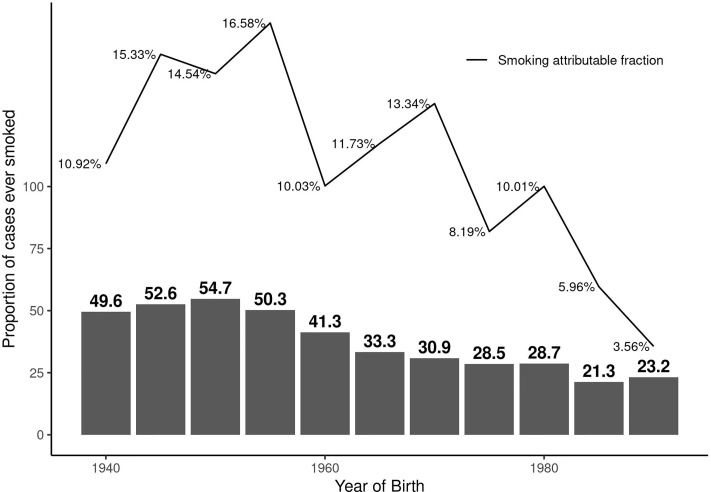
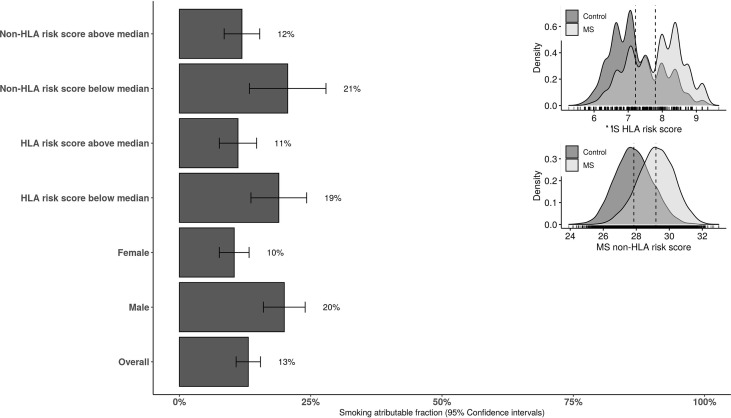
Tobacco smoke is an important modifiable environmental risk factor for multiple sclerosis (MS) risk. The population attributable fraction (AF) of MS due to smoking can be used to assess the contribution of smoking to the risk of MS development. We conducted a matched case-control study, including individuals with MS and population-based controls. Overall, sex- and genetic risk score-stratified AF due to smoking were calculated by fitting logistic regression models. We included 9,419 individuals with MS and 9,419 population-based matched controls. At the time of MS onset 44.1% of persons with MS and 35.9% of controls ever regularly smoked of which 38.1% and 29.2% were still smoking. The overall AF was 13.1% (95%CI: 10.7 to 15.4). The AF was 10.6% (95%CI: 7.4 to 13.7) in females and 19.1% (95%CI: 13.1 to 25.1) in males. The AF was 0.6% (95%CI: 0.0 to 2) in ex-smokers. In those having human leucocyte antigen (HLA) and non-HLA risk scores above the median levels of controls, the AF was 11.4% (95%CI: 6.8 to 15.9) and 12% (95%CI: 7.7 to 16.3), respectively. The AF was 17.6% (95%CI: 10.2 to 24.9) and 18.6% (95%CI: 5.5 to 31.6) in those with HLA and non-HLA risk scores below the median levels in controls, respectively. We noticed a decline in AF in recent birth cohorts. This study indicates that at least 13% of cases of MS could be prevented through the avoidance of tobacco smoking. Considering the prevalence of MS, this represents a very large group of people in absolute number.
Keywords: attributable fraction; multiple sclerosis; risk factor; smoking; tobacco.
Copyright © 2022 Manouchehrinia, Huang, Hillert, Alfredsson, Olsson, Kockum and Constantinescu.
Conflict of interest statement
The authors declare that the research was conducted in the absence of any commercial or financial relationships that could be construed as a potential conflict of interest.
Figures
References
Publication types
MeSH terms
LinkOut - more resources
Full Text Sources
Medical
Research Materials
