


Training, psychometric status, biological markers and neuromuscular fatigue in soccer
- PMID: 35309535
- PMCID: PMC8919895
- DOI: 10.5114/biolsport.2022.104065
Training, psychometric status, biological markers and neuromuscular fatigue in soccer
Abstract
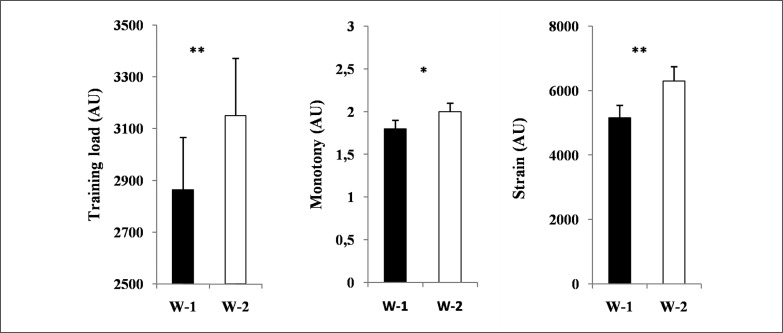
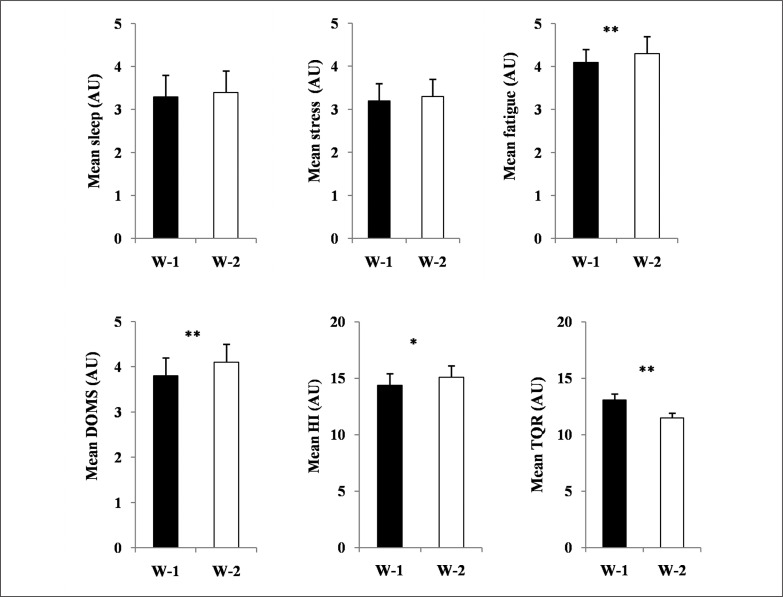
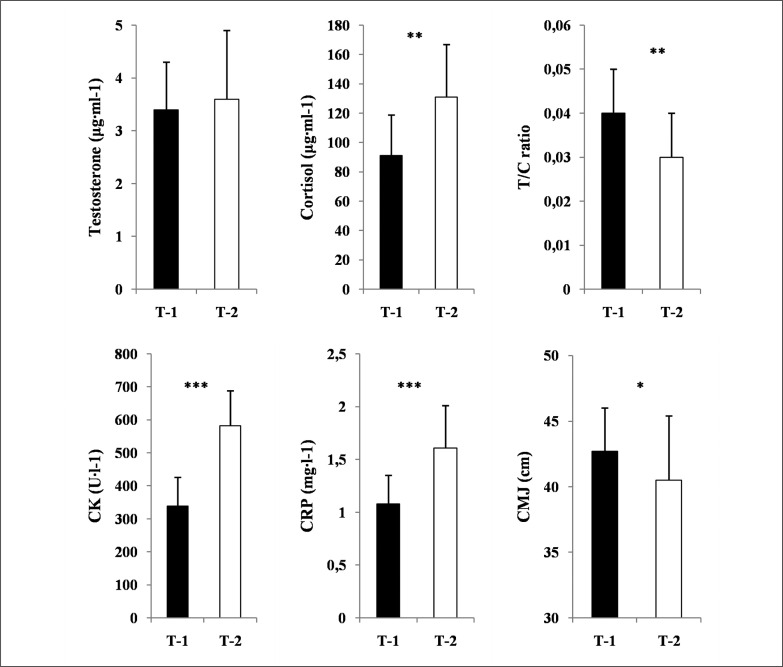
The study examined the relationship between psychometric status, neuromuscular, and biochemical markers of fatigue in response to an intensified training (IT) period in soccer. Fifteen professional soccer players volunteered to participate in the study (mean ± SD: age: 25 ± 1 years; body height: 179 ± 7 cm, body mass: 73.7 ± 16.2 kg, experience: 13.2 ± 3 years). Training load, monotony, strain, Hooper index and total quality recovery (TQR) were determined for each training session during a 2-week of IT. Counter-movement jump (CMJ) and biochemical responses [testosterone, cortisol, testosterone-to-cortisol ratio (T/C ratio), creatine kinase, and C-reactive protein] were collected before and after IT. Results showed that IT induced significant increases in cortisol, creatine kinase and C-reactive protein and significant decreases in T/C ratio and CMJ performance from before to after IT (p < 0.01, p < 0.001, p < 0.001, p < 0.01, p < 0.05, respectively). However, testosterone did not differ from before to after IT (p > 0.05). Training loads were positively correlated with Hooper index (p < 0.05) and negatively correlated with total quality recovery (p < 0.05). Hooper index was positively correlated with cortisol (p < 0.05), T/C ratio (p < 0.01), and creatine kinase (p < 0.01), and negatively correlated with CMJ (p < 0.05). Furthermore, TQR was negatively correlated with T/C ratio (p < 0.01), creatine kinase (p < 0.001), and C-reactive protein (p < 0.05), and positively correlated with CMJ (p < 0.01). Neuromuscular fatigue, muscle damage, and change in the anabolic/catabolic state induced by the IT were related to well-being and perceived recovery state among professional soccer players.
Keywords: Cortisol; Fatigue; Recovery; Testosterone; Training load; Well-being.
Copyright © Biology of Sport 2021.
Conflict of interest statement
The authors declare that they have no conflict of interest.
Figures
References
-
- Papadakis L, Tymvios C, Patras K. The relationship between training load and fitness indices over a pre-season in professional soccer players. J Sport Med Phys Fit. 2020;60:329–337. - PubMed
-
- Selmi O, Marzouki H, Ouergui I, Ben Khalifa W, Bouassida A. Influence of intense training cycle and psychometric status on technical and physiological aspects performed during the small-sided games in soccer players. Res Sports Med. 2018:1–12. - PubMed
-
- Hooper SL, Mackinnon LT, Howard A, Gordon RD, Bachmann AW. Markers for monitoring overtraining and recovery. Med Sci Sports Exerc. 1995;27:106–112. - PubMed
-
- Claudino JG, Cronin JB, Mezêncio B, Pinho JP, Pereira C, Mochizuki L, et al. Auto regulating jump performance to induce functional overreaching. J Strength Cond Res. 2016;30:2242–2249. - PubMed
LinkOut - more resources
Full Text Sources
Research Materials
