


Predictors of COVID-19 positivity among patients presenting to screening clinic in a dedicated COVID-19 hospital, in chandigarh, India - A cross-sectional study
- PMID: 35309601
- PMCID: PMC8930146
- DOI: 10.4103/jfmpc.jfmpc_1544_21
Predictors of COVID-19 positivity among patients presenting to screening clinic in a dedicated COVID-19 hospital, in chandigarh, India - A cross-sectional study
Abstract
Background: The aim of this study was to analyze the clinical features of patients attending the screening clinic of a dedicated COVID-19 hospital (DCH), including COVID-19 RT-PCR test positivity rate, symptom predictors for COVID-19 positivity, the proportion of recovery, and the mortality among COVID-19 positive cases.
Methods: We conducted a cross-sectional study of the patients who reported in the screening clinic of a DCH. Data were retrieved from medical records. Step-wise binary logistic regression was applied to determine the symptom predictors for determining the likelihood of the suspects turning out to be COVID-19 positive.
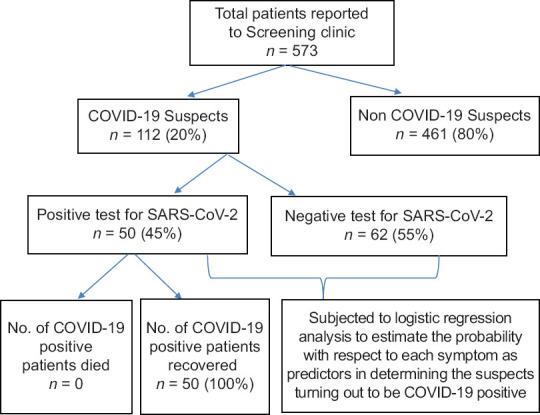
Results: A total of 573 patients reported to the screening clinic were enrolled, and their median age was 36 ± 14 years. Of the total patients, 237 (41%) were females and 112 (20%) patients were COVID-19 suspects. Fifty (45%) suspects tested COVID-19 positive. The majority of the positives had complaints of cough, fever, and sore throat. Running nose (OR = 7.951) and history of contact with a COVID-19-positive case (OR = 169.9) were found to be statistically significant symptom predictors for COVID-19 positivity. All patients recovered with nil case fatality.
Conclusion: Running nose and history of contact with COVID-positive patients were significant predictors for COVID-19 positivity. In this pandemic state, patients who present with any of the upper respiratory infection (URI) symptoms such as cough, sore throat, running nose, headache, and loss of taste/smell should be tested for COVID-19 for early identification and isolation to break the chain of transmission. The public should be encouraged to undergo COVID-19 testing if they develop any of the URI symptoms.
Keywords: COVID-19; Case positivity rate; predictors; severe acute respiratory syndrome coronavirus 2; symptoms.
Copyright: © 2022 Journal of Family Medicine and Primary Care.
Conflict of interest statement
There are no conflicts of interest.
Figures
References
-
- World Health Organization (WHO) Timeline of WHO's response to COVID-19. 2020. [Last accessed on 2021 Jul 15]. Available from: https://www.who.int/news/item/29-06-2020-covidtimeline .
-
- WHO Director-General. Media briefing on COVID-19. World Health Organization; [Last accessed on 2021 Jun 05]. Available from: https://www.who.int/director-general/speeches/detail/who-director-genera... .
-
- GardaWorld. India:First confirmed case of 2019-nCoV announced January 30. [Last accessed on 2020 Aug 28]. Available from: https://www.garda.com/crisis24/news-alerts/309806/india-first-confirmed-... .
-
- World Health Organization (WHO). Coronavirus disease (COVID-19). 2020. [Last accessed on 2020 Aug 28]. Available from: https://www.who.int/health-topics/coronavirus#tab=tab_1 .
LinkOut - more resources
Full Text Sources