


Effects of High-Frequency Oscillatory Ventilation With Volume Guarantee During Surfactant Treatment in Extremely Low Gestational Age Newborns With Respiratory Distress Syndrome: An Observational Study
- PMID: 35310140
- PMCID: PMC8927884
- DOI: 10.3389/fped.2021.804807
Effects of High-Frequency Oscillatory Ventilation With Volume Guarantee During Surfactant Treatment in Extremely Low Gestational Age Newborns With Respiratory Distress Syndrome: An Observational Study
Abstract
Objective: To evaluate the effect of volume guarantee (VG) combined with high-frequency oscillatory ventilation (HFOV) on respiratory and other physiological parameters immediately after lung recruitment and surfactant administration in HFOV elective ventilated extremely low gestational age newborns (ELGAN) with respiratory distress syndrome (RDS).
Design: Observational study.
Setting: Tertiary neonatal intensive care unit.
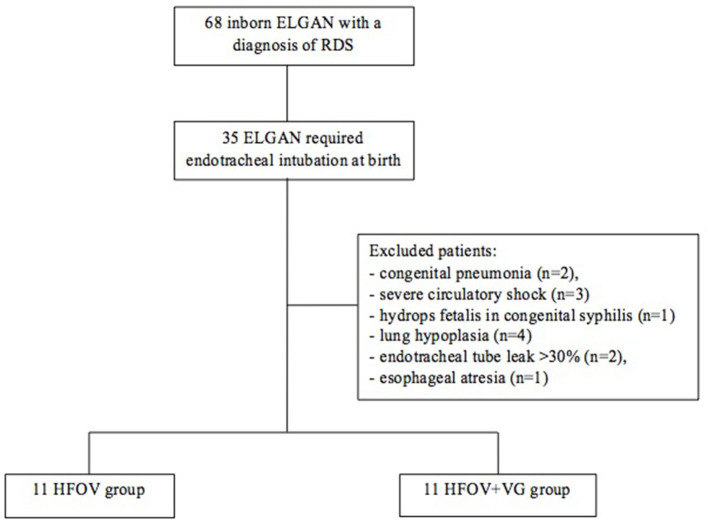
Patients: Twenty-two ELGANs of 25.5 ± 1.1 weeks of gestational age requiring invasive mechanical ventilation and surfactant administration for RDS during the first 6 h of life.
Interventions: All infants intubated in delivery room, were managed with elective HFOV and received surfactant after a lung recruitment manoeuver. Eleven infants received HFOV + VG and were compared with a control group of 11 infants receiving HFOV alone. HFOV was delivered in both groups by Dräger Babylog VN500 ventilator (Dräger, Lubeck, Germany).
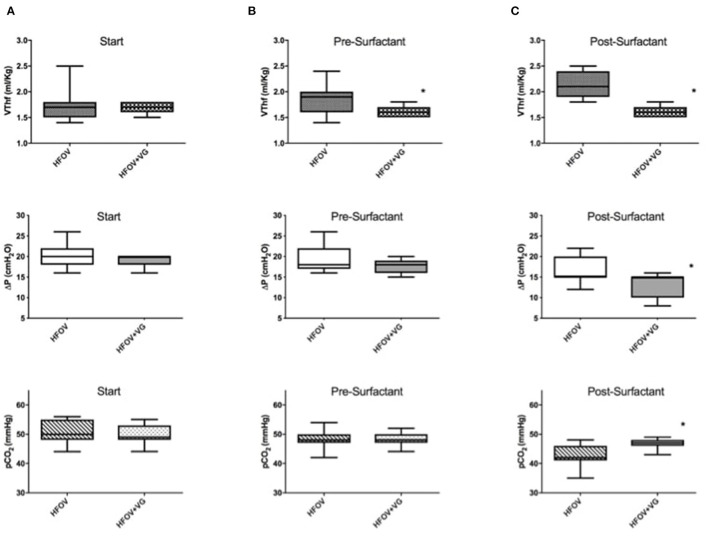
Main outcome measures: Variations and fluctuations of delivered high-frequency tidal volume (VThf), fluctuation of pressure amplitude (ΔP) and partial pressure of CO2 (pCO2) levels after recruitment manoeuver and immediately after surfactant administration, in HFOV + VG vs. HFOV ventilated infants.
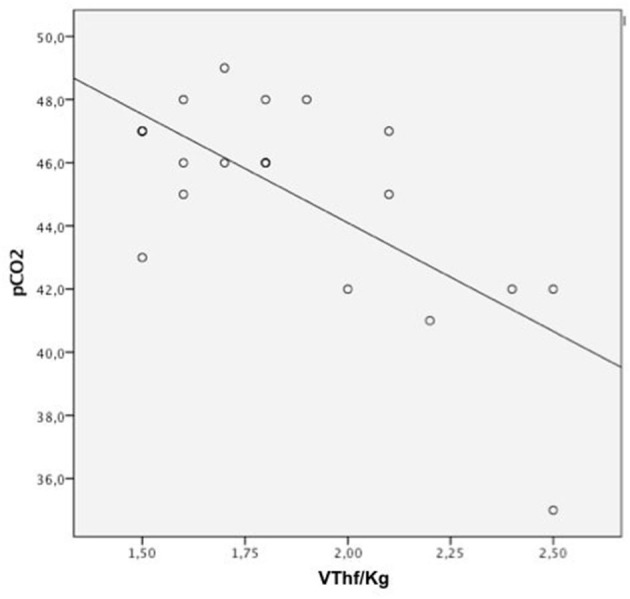
Results: There were no significant differences in the two groups at starting ventilation with or without VG. The mean applied VThf per kg was 1.7 ± 0.3 ml/kg in the HFOV group and 1.7 ± 0.1 ml/kg in the HFOV + VG group. Thirty minutes after surfactant administration, HFOV group had a significant higher VThf/Kg than HFOV + VG (2.1 ± 0.3 vs. 1.6 ± 0.1 ml/kg, p < 0.0001) with significantly lower pCO2 levels (43.1 ± 3.8 vs. 46.8 ± 1.5 mmHg, p = 0.01), 54.4% of patients having pCO2 below 45 mmHg. Measured post-surfactant ΔP values were higher in HFOV group (17 ± 3 cmH2O) than in HFOV + VG group (13 ± 3 cmH2O, p = 0.01).
Conclusion: HFOV + VG maintains pCO2 levels within target range and reduces VThf delivered variations more consistently than HFOV alone after surfactant administration.
Keywords: ELGAN; HFOV; lung recruitment; respiratory distress syndrome; volume guarantee.
Copyright © 2022 Tana, Paladini, Tirone, Aurilia, Lio, Bottoni, Costa, Tiberi, Pastorino and Vento.
Conflict of interest statement
The authors declare that the research was conducted in the absence of any commercial or financial relationships that could be construed as a potential conflict of interest.
Figures
References
-
- Tana M, Zecca E, Tirone C, Aurilia C, Cota F, Lio A, et al. Target fraction of inspired oxygen during open lung strategy in neonatal high frequency oscillatory ventilation: a retrospective study. Minerva Anestesiol. (2012) 78:151–9. - PubMed
LinkOut - more resources
Full Text Sources
Research Materials
Miscellaneous
