Case Reports
. 2022 Mar 10:2022:8253096.
doi: 10.1155/2022/8253096. eCollection 2022.

Brachymetatarsia: Surgical Management, Case Report, and Literature Review

Affiliations
Case Reports

Brachymetatarsia: Surgical Management, Case Report, and Literature Review

David Zhu et al. Case Rep Orthop. .

Abstract

Background: Brachymetatarsia is defined by an abnormal shortening of the metatarsal bone. This rare condition is mostly primary and congenital. Consequences of this malformation are both esthetic and functional, due to pain and mechanical problems in the forefoot. Surgical management is an important part of patient care. There are two main options: gradual lengthening by progressive callotosis distraction using an external fixator and one stage lengthening using bone graft and osteotomy of the bone. This review presents two cases using the one stage lengthening surgical management method. We also discuss some reports in the literature with the aim to compare the advantages and disadvantages of the two surgical methods. Literature concerning the surgical management of brachymetatarsia was identified using the PubMed and Google Scholar databases. Patient Presentation. We describe two female patients aged 20 and 26 years who underwent one stage lengthening surgery of the fourth toe with isolated brachymetatarsia using an iliac bone graft and internal fixator plate. The two patients had a lengthening of around 10 mm after postoperative evaluation. No skin complications were noted, but one of the patients reported flexor stiffness after surgery. Concerning the functional and cosmetic aspects, the two patients are satisfied with the management.

Conclusions: In the literature, one stage lengthening seems to be the most favorable option for the care of brachymetatarsia. Studies show a short healing time and fewer complications like infection, stiffness, malalignment, and malunion. Some reviews note the utility of the gradual lengthening of severe brachymetatarsia when a longer lengthening is necessary. There is no definite consensus concerning the management of brachymetatarsia.


Conflict of interest statement

The authors declare no conflicts of interests related to the present manuscript.

Figures

Figure 1
Figure 1
Illustration showing correction of fourth toe brachymetatarsia. (a) Distraction of the bone with cloward after shaft osteotomy after insertion of a 1.2 mm K-wire. (b) Iliac bone graft placed in the osteotomy and fixation with a LCP foot plate locked by screws.
Figure 2
Figure 2
Case 1, a 20 years old female with a brachymetatarsia of the right fourth toe. (a) Preoperative X-ray of the right foot showing the shortness of around 10 mm. (b) Postoperative X-ray of the right foot. (c) Postoperative X-ray after K-wire removal at 1-month follow-up. (d) Postoperative X-ray after plate removal at 1-year follow-up.
Figure 3
Figure 3
Case 2, a 26-year-old female with bilateral brachymetatarsia of the fourth toes who underwent surgical management of the left foot. (a) Preoperative X-ray of the left foot showing a shortness of the fourth toe of around 10 mm. (b) Postoperative X-ray of the left foot. (c) Post-operative X-ray after the K-wire removal at 1-month follow-up.
Figure 4
Figure 4
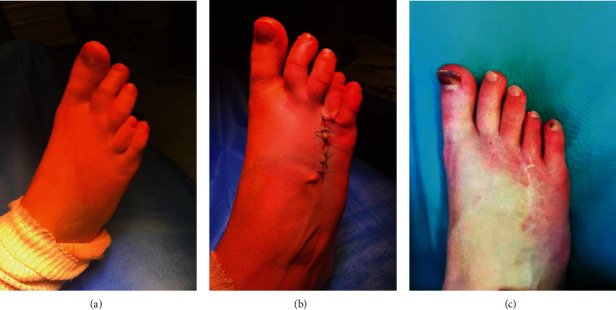
Case 1. (a) Preoperative photography. (b) Postoperative photography after closing the Z-plasty. (c) Photography of the lengthening at 12-month follow-up.

References

    1. Jones M. D., Pinegar D. M., Rincker S. A. Callus distraction versus single-stage lengthening with bone graft for treatment of brachymetatarsia: a systematic review. Journal of Foot and Ankle Surgery . 2015;54(5):927–931. doi: 10.1053/j.jfas.2015.02.013. - DOI - PubMed
    1. Kim D. G., Lee Y. H., Nam I. H., Choi Y. D. Long term result of weil osteotomy and callotasis for bilateral brachymetatarsia: a case report. Journal of Orthopaedic Case Reports . 2019;9(3):84–86. doi: 10.13107/jocr.2250-0685.1434. - DOI - PMC - PubMed
    1. Córdoba-Fernández A., Vera-Gómez M. L. Literature review on brachymetatarsia. Orthopaedic Nursing . 2018;37(5):292–302. doi: 10.1097/NOR.0000000000000487. - DOI - PubMed
    1. Woo S. H., Bang C. Y., Ahn H.-C., Kim S.-J., Choi J.-Y. Anatomical reconstruction of the fourth brachymetatarsia with one-stage iliac bone and cartilage cap grafting. Journal of Plastic, Reconstructive & Aesthetic Surgery . 2017;70(5):666–672. doi: 10.1016/j.bjps.2017.02.020. - DOI - PubMed
    1. Fuiano M., Mosca M., Caravelli S., et al. Callus distraction with external fixator for the treatment of congenital brachymetatarsia of the fourth ray. Foot and Ankle Surgery . 2020;26(6):693–698. doi: 10.1016/j.fas.2019.08.018. - DOI - PubMed

Publication types

LinkOut - more resources