Review
. 2021 Dec 20:14:86-96.
doi: 10.1016/j.bioactmat.2021.11.023. eCollection 2022 Aug.

Biomaterial strategies for the application of reproductive tissue engineering

Affiliations
Review

Biomaterial strategies for the application of reproductive tissue engineering

Xuemin Liu et al. Bioact Mater. .

Abstract

Human reproductive organs are of vital importance to the life of an individual and the reproduction of human populations. So far, traditional methods have a limited effect in recovering the function and fertility of reproductive organs and tissues. Thus, aim to replace and facilitate the regrowth of damaged or diseased tissue, various biomaterials are developed to offer hope to overcome these difficulties and help gain further research progress in reproductive tissue engineering. In this review, we focus on the biomaterials and their four main applications in reproductive tissue engineering: in vitro generation and culture of reproductive cells; development of reproductive organoids and models; in vivo transplantation of reproductive cells or tissues; and regeneration of reproductive tissue. In reproductive tissue engineering, designing biomaterials for different applications with different mechanical properties, structure, function, and microenvironment is challenging and important, and deserves more attention.

Keywords: Biomaterials; Organoids and models; Reproductive tissue engineering.


Conflict of interest statement

The authors declare that they have no known competing financial interests or personal relationships that could have appeared to influence the work reported in this paper.

Figures
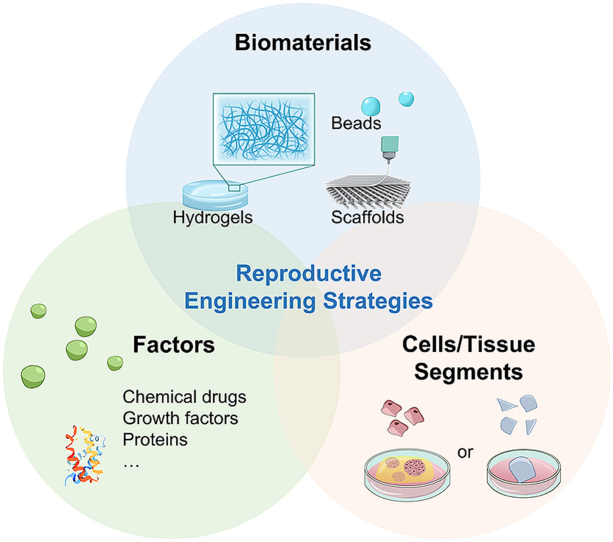
Image 1
Graphical abstract
Fig. 1
Fig. 1
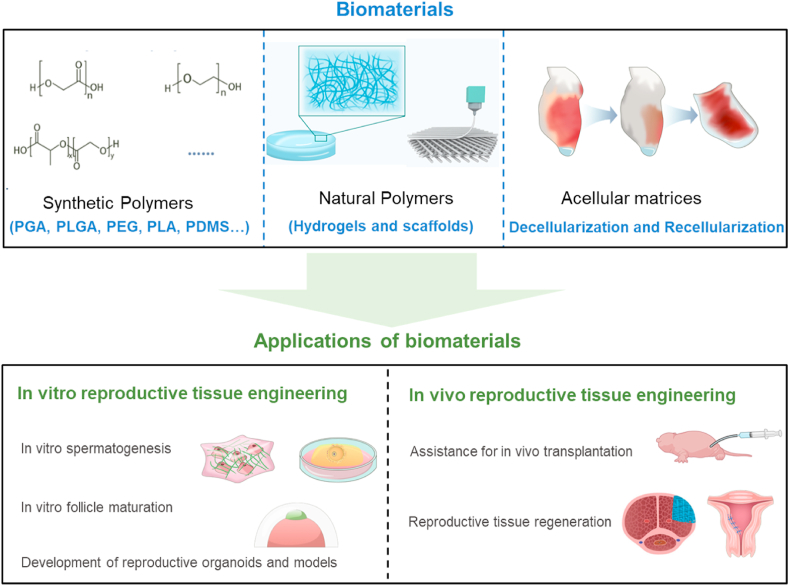
Diagram of biomaterial for the applications of reproductive tissue engineering.
Fig. 2
Fig. 2
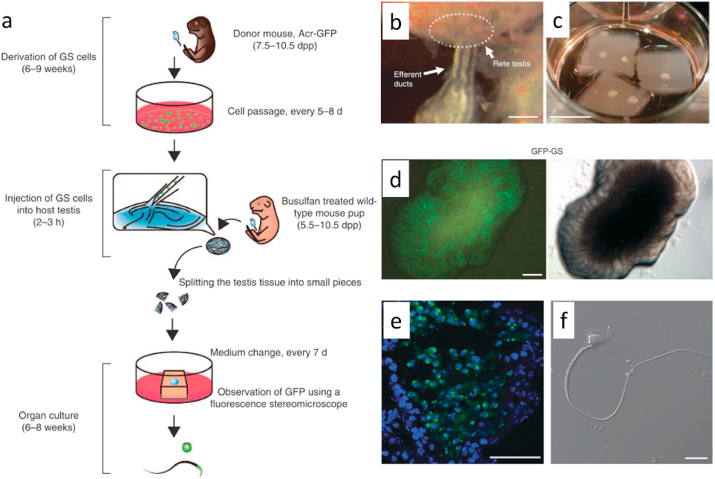
Testicular tissue fragments cultured in the gas–liquid interphase of an agarose gel to reconstitute mouse sperm in vitro. (a) Schematic diagram of the protocols of the gas–liquid interphase culture method. (b) Efferent ducts and rete testis, Scale bars: 0.5 cm. (c) The testis tissue fragments were placed on agarose gel and half-soaked in the medium. (Scale bars: 1 cm) (d) GFP-expressing germline stem cells (GFP-GS). (e) Immunostaining of the host testis tissue. GFP (green), Hoechst 33342 dye (blue). Scale bars: 50 μm. (f) The flagellated sperm were found after 57 days of culture of mouse testicular tissue fragments. Scale bars: 10 μm. Reproduced with permission [80]. Copyright 2013, Nature Protocols.
Fig. 3
Fig. 3
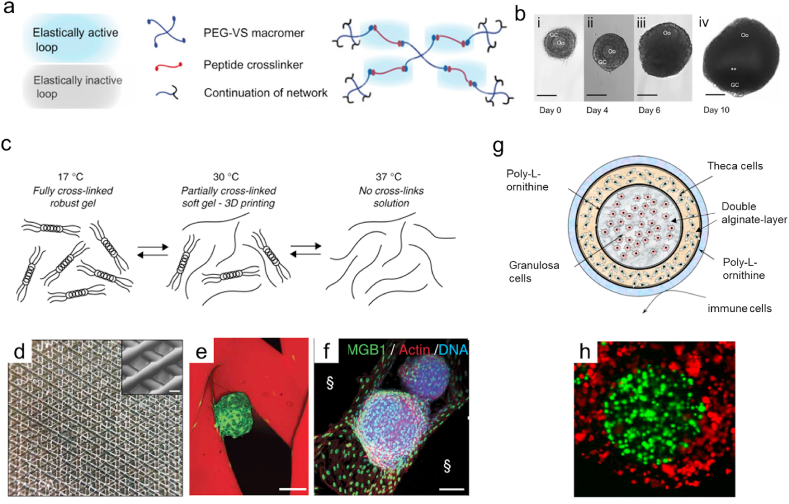
Hydrogels and scaffolds designed for a 3D follicle culture. (a–b) PEG-based hydrogels with a difunctional peptide as the cross-linker for an ovarian follicle culture. (b) i-iii Morphology of ovarian follicles cultured in PEG hydrogel within 10 days. Scale bars: 100 mm. Reproduced with permission [92]. 2011, Biomaterials. (c–f) 3D-printed microporous gelatin scaffolds seeded with follicles. (c) Schematic of the thermoreversible properties of gelatin. (d) Photographs of a five-layered 3D-printed scaffold. Scale bar: 250 mm. (e) Follicles were seeded in a 60° scaffold, and confocal fluorescence images (f) of follicles cultured for 2 days. Scale bars: 100 mm. Reproduced with permission [30]. Copyright 2017, Nature Communication. (g) Schematic of the ovarian constructs. The ovarian constructs were fabricated using a cross-linked alginate layer and poly-l-ornithine (PLO) layer encapsulated with granulosa and theca cells to replicate the key structure of ovarian follicles. (h) Different cells and granulosa cells were labeled with CellTracker Green, and theca cells were labeled with CellTracker orange within the constructs. Reproduced with permission [34]. Copyright 2012, Reproductive Biology and Endocrinology.
Fig. 4
Fig. 4
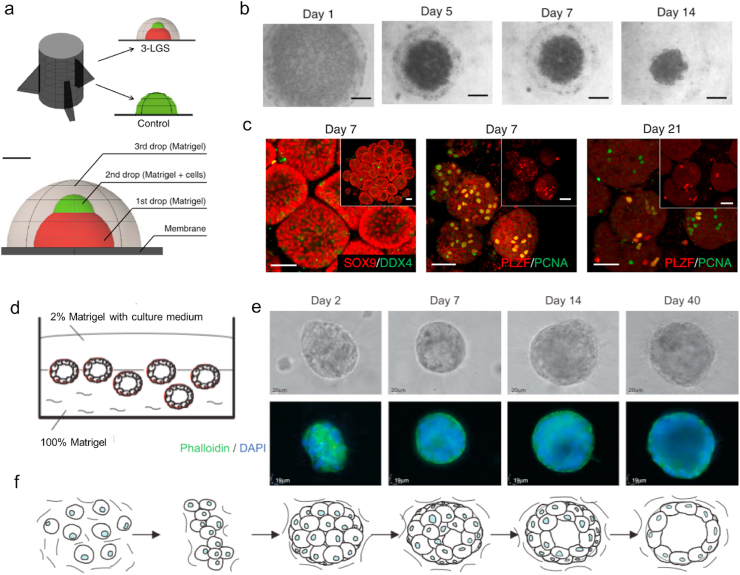
Formation of testicular and ovarian organoids using Matrigel. (a–c) Scheme of testicular organoids using a three-layer gradient system (3-LGS). (b) Formation of 3-LGS testicular organoids after days 1, 5, 7, and 21 by bright-field microscopy. (c) Cells that were positive for SOX9 (Sertoli cell marker) and DDX4 (germ cell marker) in spherical–tubular structures of the testicular organoids after days 7 and 21 in culture. Reproduced with permission [42]. Copyright 2018, Nature Protocol. (d) Schematic diagram of the in vitro ovarian organoid model with spheroids of normal HOSE cells cultured in 3D matrix. (e) Phase-contrast images and fluorescence staining of F-actin and nuclei in the spheroids of normal HOSE cells. (f) Schematic diagram of morphogenesis in the spheroids of normal HOSE cells. Reproduced with permission [45]. Copyright 2009, Neoplasia.
Fig. 5
Fig. 5
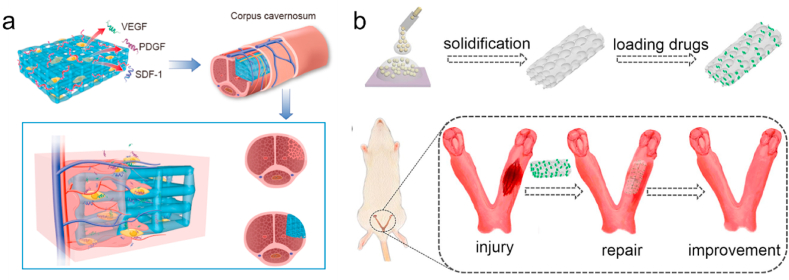
3D scaffolds were implanted for reproductive tissue regeneration in vivo. (a) 3D-printed methacrylated gelatin hydrogels seeded with stem cells for penile reconstruction [59]. Copyright 2020, Nature Communications. (b) Drug-loaded porous scaffolds (prepared from methacrylated gelatin and Na-alginate) were developed by the droplet microfluidics method for endometrial repair [119]. Copyright 2019, Acta Biomaterialia.

References

    1. Gargus E.S., Rogers H.B., McKinnon K.E., Edmonds M.E., Woodruff T.K. Engineered reproductive tissues. Nat. Biomed. Eng. 2020;4:381–393. - PMC - PubMed
    1. Poels J., Van Langendonckt A., Many M.C., Wese F.X., Wyns C. Vitrification preserves proliferation capacity in human spermatogonia. Hum. Reprod. 2013;28:578–589. - PubMed
    1. Ibrahim M., Richardson M.K. Beyond organoids: in vitro vasculogenesis and angiogenesis using cells from mammals and zebrafish. Reprod. Toxicol. 2017;73:292–311. - PubMed
    1. Concepts C., Jeruss J.S., Woodruff T.K. Preservation of fertility in patients with cancer. Assessment. 2009;360:245–251. - PMC - PubMed
    1. Laronda M.M. Engineering a bioprosthetic ovary for fertility and hormone restoration. Theriogenology. 2020;150:8–14. - PubMed

LinkOut - more resources