


Trends in older adults' alcohol use in Norway 1985-2019
- PMID: 35310776
- PMCID: PMC8899062
- DOI: 10.1177/1455072520954325
Trends in older adults' alcohol use in Norway 1985-2019
Abstract
Aims: To examine the prevalence of and trends in older adults' (60-79 years) alcohol use in Norway between 1985 and 2019.
Methods: Data stem from two repeated cross-sectional surveys in the Norwegian population: Statistics Norway's Health and Living Conditions Surveys from 1985 (N = 7799), 1995 (N = 3518) and 2005 (N = 6487), and the Norwegian Institute of Public Health's (NIPH) annual surveys on alcohol, tobacco and drug use from 2012/2013 (N = 4047), 2014/2015 (N = 4378), 2016/2017 (N = 4264) and 2018/2019 (N = 4330). The following measures were used to examine trends in alcohol use among women and men aged 60 and older: drinking status, drinking frequency, number of drinks per occasion, and frequency of heavy episodic drinking (HED).
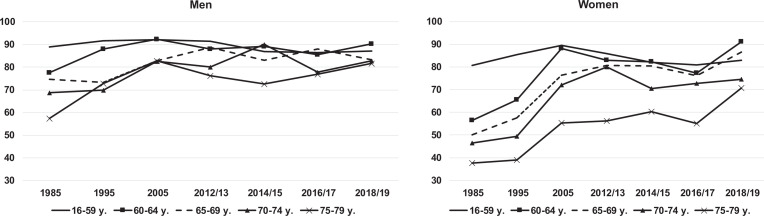
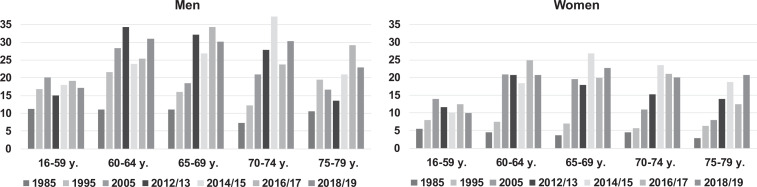
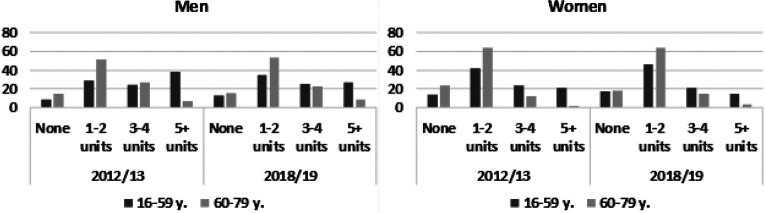
Results: Between 1985 and 2019, there has been a substantial increase in the proportions of older adults in Norway who drink alcohol and who drink relatively often. The increase was particularly marked between 1985 and 2012/2013, and for elderly women. However, the majority of older adults drink small amounts of alcohol on typical drinking occasions, illustrating that the increased frequency of drinking is not accompanied by a corresponding increase in risky drinking.
Conclusions: There has been a marked increase in alcohol use among older adults the past 30 years, particularly among older women, suggesting that the age and gender gap traditionally found in alcohol use in Norway is diminishing. Due to the lower alcohol tolerance among elderly, monitoring the changing trends in alcohol use in this group, as well as the possible consequences of these changes, is important.
Keywords: Norway; alcohol use; gender differences; heavy episodic drinking; older adults; time trends.
© The Author(s) 2020.
Conflict of interest statement
Declaration of conflicting interests: The authors declared no potential conflicts of interest with respect to the research, authorship, and/or publication of this article.
Figures
References
-
- Amdam S. (2015. a). Undersøkelse om rusmidler og tobakk 2014. Dokumentasjon [Survey on drugs and tobacco 2014. Documentation report]. Notat 2015/20, Statistisk Sentralbyrå/Statistics Norway, Oslo–Kongsvinger.
-
- Amdam S. (2015. b). Undersøkelse om rusmidler og tobakk 2015. Dokumentasjon [Survey on drugs and tobacco 2015. Documentation report]. Notat 2015/45, Statistisk Sentralbyrå/Statistics Norway, Oslo–Kongsvinger.
-
- Anderson P., Scafato E., Galluzzo L. (2012). Alcohol and older people from a public health perspective. Annali dell’Istituto Superiore di Sanità, 48(3), 232–247. - PubMed
-
- Babor T. F., Higgins-Biddle J. C., Saunders J. B., Monteiro M. G. (2001). The Alcohol Use Disorders Identification Test: Guidelines for Use in Primary Care. (2nd ed.). Geneva: World Health Organization.
-
- Berg C. (Ed.). (2019). Reseptregisteret 2014–2018 [The Norwegian Prescription Database 2014–2018]. Legemiddelstatistikk 2019:2. Folkehelseinstituttet.
LinkOut - more resources
Full Text Sources
Miscellaneous