. 2022 Mar 30;144(12):5450-5460.
doi: 10.1021/jacs.1c13295. Epub 2022 Mar 19.

Self-Sorting Governed by Chelate Cooperativity

Affiliations

Self-Sorting Governed by Chelate Cooperativity

David Serrano-Molina et al. J Am Chem Soc. .

Abstract

Self-sorting phenomena are the basis of manifold relevant (bio)chemical processes where a set of molecules is able to interact with no interference from other sets and are ruled by a number of codes that are programmed in molecular structures. In this work, we study, the relevance of chelate cooperativity as a code for achieving high self-sorting fidelities. In particular, we establish qualitative and quantitative relationships between the cooperativity of a cyclic system and the self-sorting fidelity when combined with other molecules that share identical geometry and/or binding interactions. We demonstrate that only systems displaying sufficiently strong chelate cooperativity can achieve quantitative narcissistic self-sorting fidelities either by dictating the distribution of cyclic species in complex mixtures or by ruling the competition between the intra- and intermolecular versions of a noncovalent interaction.


Conflict of interest statement

The authors declare no competing financial interest.

Figures
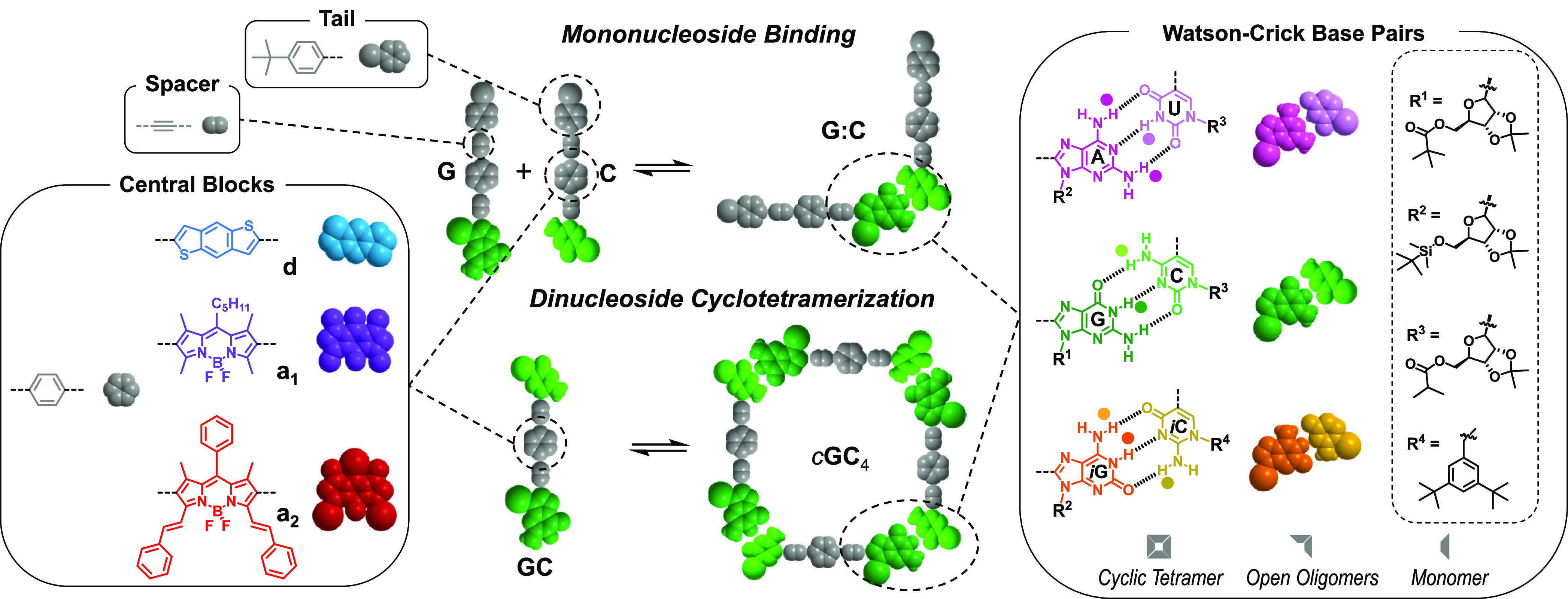
Figure 1
Figure 1
Schematic representation of the mono- and dinucleoside molecules employed in this work to assess self-sorting phenomena, comprising different terminal nucleobases and central blocks (see the Supporting Information. for full details on the molecular structure and characterization). Proton nuclear magnetic resonance (1H NMR) signals will be labeled in this work by a color code (type of proton) and a shape code (type of supramolecular species: cyclic tetramer, open oligomer, or monomer).
Figure 2
Figure 2
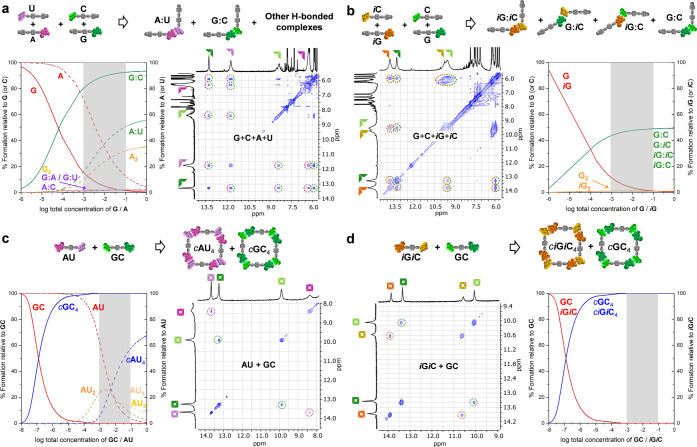
Speciation curves and downfield region of the NOESY spectra of (a) a 1:1:1:1 mixture of G + C + A + U (CDCl3; 10–2 M; 298 K), (b) a 1:1:1:1 mixture of G + C + iG + iC (CDCl3; 10–2 M; 298 K), (c) a 1:1 mixture of AU + GC (CDCl3/CCl4 2:3; 10–2 M; 253 K), and (d) a 1:1 mixture of iGiC + GC (THF-D8; 10–2 M; 298 K). These NMR solvents were chosen either to (c) maintain a high association constant (K) between the corresponding Watson–Crick pairs and thus a high population of associated species, or (d) to conveniently dissolve the mixtures (see Figure S2C for more details). For proton NMR codes, see Figure 1. Speciation curves were simulated using reported association constants and effective molarities (see Section S1).,
Figure 3
Figure 3
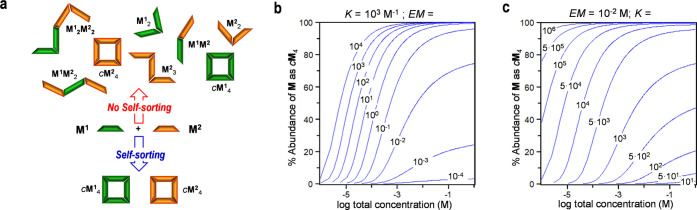
(a) Hypothetic situation in which two monomers (M1 and M2) are mixed that are endowed with complementary binding units at the edges, similar to GC + iGiC. Each monomer can form linear supramolecular oligomers with itself or with the other with an identical association constant K. In addition, each monomer can self-associate into cyclic tetramer species with identical effective molarity EM. Narcissistic self-sorting occurs when M1 and M2 exclusively self-associate into cyclic cM41 and cM42 species. (b, c) Relationship between self-sorting fidelity (% relative abundance of M1 (or M2) in the cyclic cM41 (or cM42) species) as a function of total concentration: (b) cyclotetramerization EM of cM41 (or cM42) at a fixed K = 103 M–1, or (c) association constant K between M1 and/or M2 fixing EM at 10–2 M.
Figure 4
Figure 4
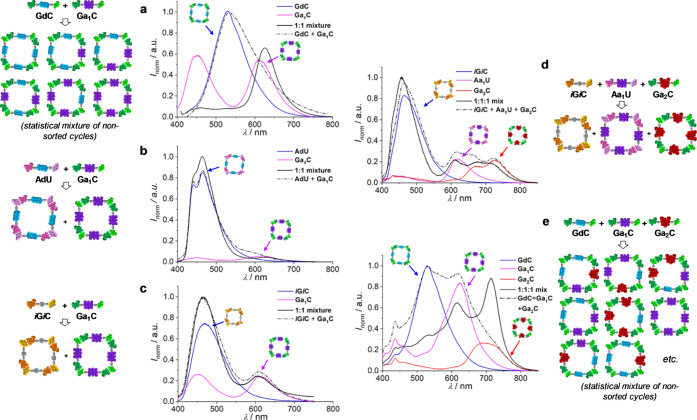
Emission spectra in toluene of (a) GdC, Ga1C, and their 1:1 mixture (λexc = 385 nm), (b) AdU, Ga1C, and their 1:1 mixture (λexc = 360 nm), (c) iGiC, Ga1C, and their 1:1 mixture (λexc = 381 nm), (d) iGiC, Aa1U, Ga2C, and their 1:1:1 mixture (λexc = 381 nm), or (e) GdC, Ga1C, Ga2C, and their 1:1:1 mixture (λexc = 386 nm). In all cases, the sum spectrum of the individual samples is shown with a dotted line so as to compare it with the experimental spectrum of the corresponding binary/ternary mixtures.
Figure 5
Figure 5
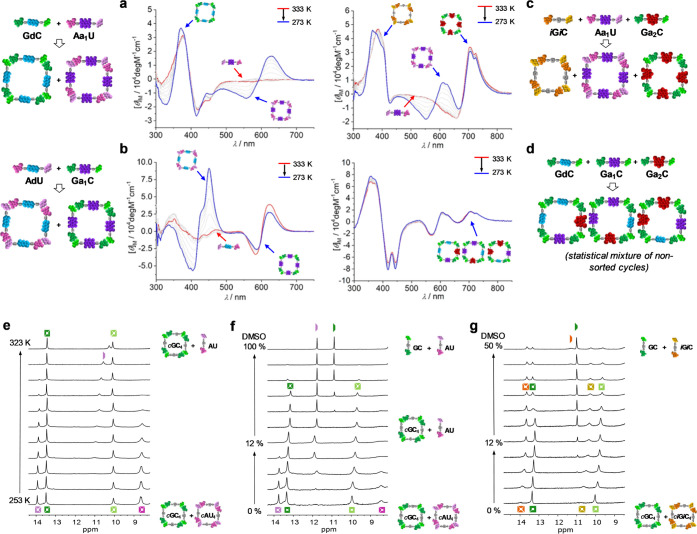
Selective cyclic tetramer dissociation. (a–d) Temperature-dependent CD spectra in toluene of (a) a 1:1 GdC + Aa1U mixture, (b) a 1:1 AdU + Ga1C mixture, (c) a 1:1:1 iGiC + Aa1U + Ga2C mixture, and (d) a 1:1:1 GdC + Ga1C + Ga2C mixture. (e, f) Downfield region of the 1H NMR spectra of a 1:1 mixture of GC + AU in (e) CDCl3 with increasing temperature or (f) CDCl3:CCl4 (2:3) with increasing DMSO-D6 content. (g) Downfield region of the 1H NMR spectra of a 1:1 mixture of GC + iGiC in CDCl3 with increasing DMSO-D6 content. In the last mixture, the 1H signals of the c(iGiC)4 species are initially broad due to strong aggregation in pure CDCl3. A small amount of DMSO needs to be added to achieve complete solubility. For proton NMR codes, see Figure 1.
Figure 6
Figure 6
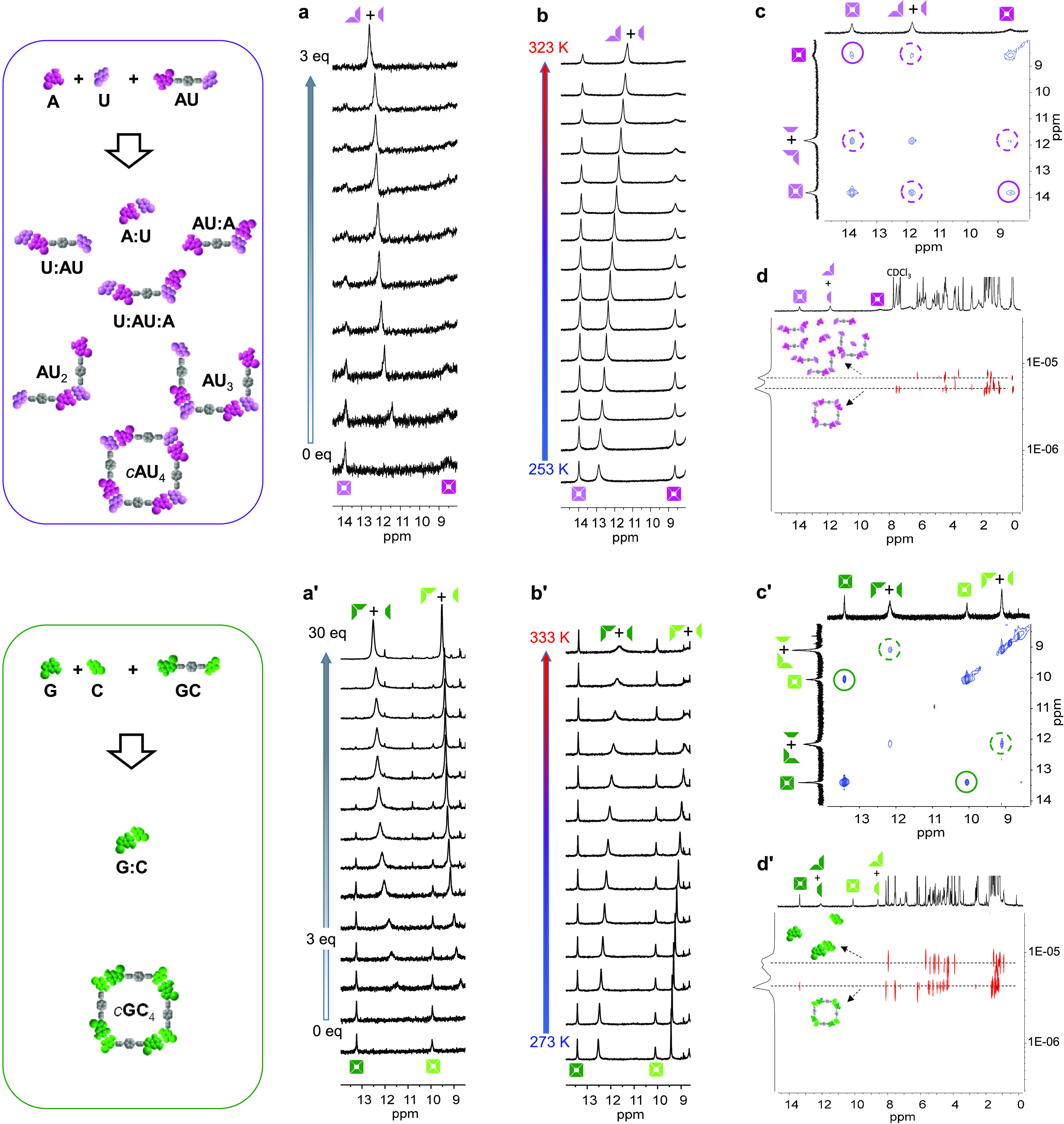
Analysis of ternary mixtures of dinucleoside and complementary mononucleosides. Top: AU + A + U. The c(AU)4 macrocycle having a low chelate cooperativity is expected to self-sort the mixture, to a small extent, leading to different associated species. Bottom: GC + G + C. On the contrary, the high cooperativity of the c(GC)4 macrocycle leads mainly to a narcissistically self-sorted mixture of c(GC)4 and the G:C complex. (a, a′) Titration experiments of a 1:1 mixture of mononucleosides onto a dinucleoside solution monitored in the 8–15 ppm region of the 1H NMR spectra, where the most relevant H-bonded proton signals are found: (a) AU + 1:1 A + U in CDCl3:CCl4 (2:3) and (a′) GC + 1:1 G + C in THF-D8. (b, b′) Evolution of the 8–15 ppm region of the 1H NMR spectra as a function of temperature for (b) a 1:1:1 mixture of AU + A + U and (b′) a 1:2:2 mixture of GC + G + C. (c, c′) NOESY spectra at τm = 500 ms and (d, d′) DOSY spectra for (c, d) a 1:1:1 mixture of AU + A + U in CDCl3:CCl4 (2:3) and (c′, d′) a 1:2:2 mixture of GC + G + C in THF-D8 (see Figure S5A–D for more details). For proton NMR codes, see Figure 1.
Figure 7
Figure 7
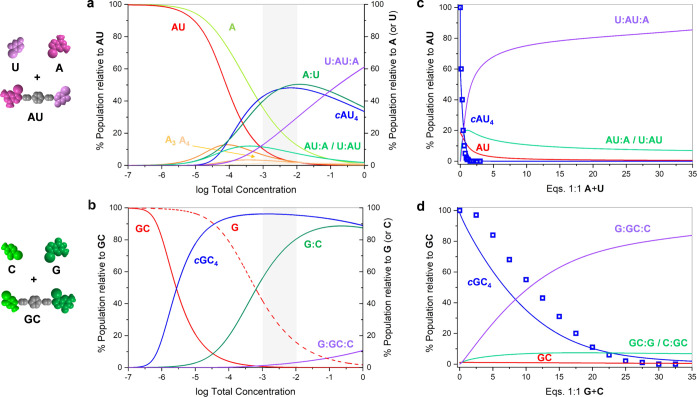
Simulation of ternary mixtures of dinucleoside and complementary mononucleosides. (a, b) Speciation curves showing the abundance of diverse species as a function of total concentration for 1:1:1 mixtures of (a) AU + A + U and (b) GC + G + C. (c, d) Distribution of species as a function of the amount of 1:1 mononucleoside mixture added: (c) AU + 1:1 A + U and (d) GC + 1:1 G + C. In both cases, the experimental titration data (squares; see Figure 6a,a′), obtained by 1H NMR signal integration, has been overlapped for comparison. Simulations were obtained using reported association constants and effective molarities (see Section S1).

References

    1. Li J.; Nowak P.; Otto S. Dynamic Combinatorial Libraries: From Exploring Molecular Recognition to Systems Chemistry. J. Am. Chem. Soc. 2013, 135, 9222–9239. 10.1021/ja402586c. - DOI - PubMed
    1. Ruiz-Mirazo K.; Briones C.; de la Escosura A. Prebiotic Systems Chemistry: New Perspectives for the Origins of Life. Chem. Rev. 2014, 114, 285–366. 10.1021/cr2004844. - DOI - PubMed
    1. Mattia E.; Otto S. Supramolecular systems chemistry. Nat. Nanotechnol. 2015, 10, 111–119. 10.1038/nnano.2014.337. - DOI - PubMed
    1. Islam S.; Powner M. W. Prebiotic Systems Chemistry: Complexity Overcoming Clutter. Chem. 2017, 2, 470–501. 10.1016/j.chempr.2017.03.001. - DOI
    1. Das K.; Gabrielli L.; Prins J. Chemically Fueled Self-Assembly in Biology and Chemistry. Angew. Chem., Int. Ed. 2021, 60, 20120–20143. 10.1002/anie.202100274. - DOI - PMC - PubMed

Publication types