Mycoplasma pneumoniae and Adenovirus Coinfection Cause Pediatric Severe Community-Acquired Pneumonia
- PMID: 35311565
- PMCID: PMC9045297
- DOI: 10.1128/spectrum.00026-22
Mycoplasma pneumoniae and Adenovirus Coinfection Cause Pediatric Severe Community-Acquired Pneumonia
Abstract
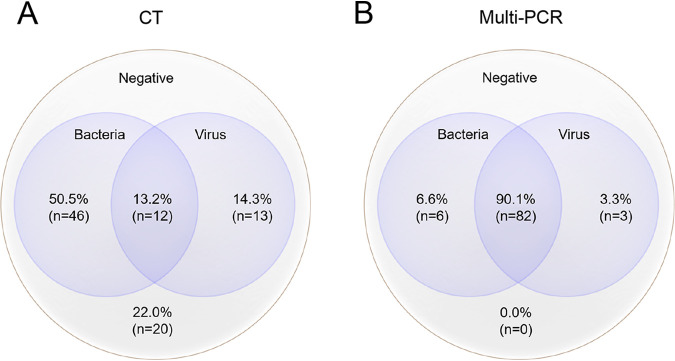
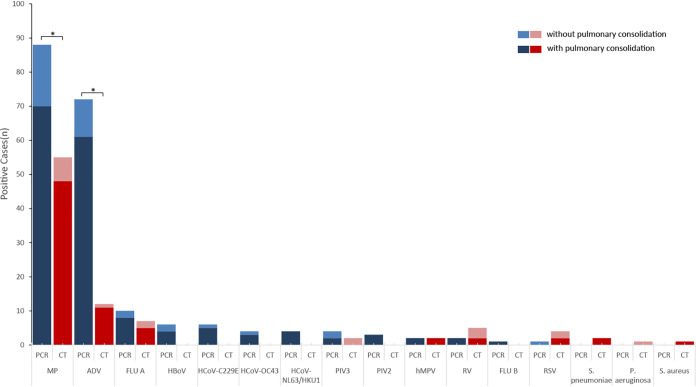
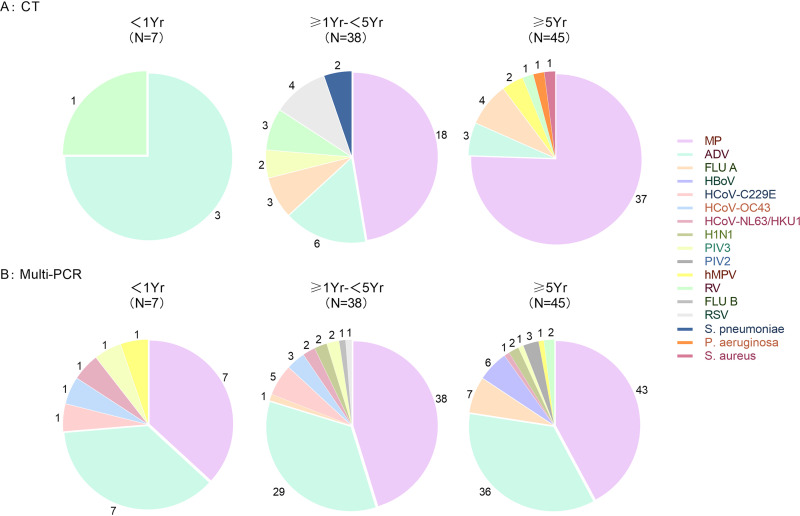
Consolidation is one complication of pediatric severe community-acquired pneumonia (SCAP) that can respond poorly to conservative medical treatment. We investigated the pathogens that cause pediatric SCAP including cases with persistent consolidation that need bronchoscopy intervention. Alveolar lavage fluid (ALF) samples collected from cases admitted to Children's Hospital of Fudan University with SCAP during January 2019 to March in 2019 were retrospectively tested by the RespiFinder 2SMART multiplex PCR (multi-PCR) assay targeting 22 respiratory pathogens. A total of 90 cases and 91 samples were enrolled; 80.0% (72/90) of the cases had pulmonary consolidation and/or atelectasis. All samples were positive with targeted pathogens tested by multi-PCR, and 92.3% (84/91) of the samples were co-detected with pathogens. Mycoplasma pneumoniae (MP) and adenovirus (ADV) as the two dominant pathogens, with the positive rates of 96.7% (88/91) and 79.1% (72/91), respectively. Most of the samples were positive with MP and ADV simultaneously. As a control, 78.0% (71/91) of the samples were positive by conventional tests (CT), in which MP had the detection rate of 63.9% (55/86) by a traditional real-time PCR assay, while ADV were positive in 13.1% (12/91) of the samples by a direct immunofluorescence assay (DFA). In cases with persistent pulmonary consolidation, the positive rates of pathogens by multi-PCR and CT were 100% (72/72) and 81.9% (59/72), respectively. There were no significant differences of MP or ADV positive rates between cases with and without pulmonary consolidation. MP and ADV most prevalent in pediatric SCAP cases required fiberscope intervention, and presented with coinfections dominantly. IMPORTANCE Pathogens that cause pediatric severe community-acquired pneumonia (SCAP) requiring bronchoscopy intervention are understudied. Through this study, we explore the etiology of SCAP form alveolar lavage fluid (ALF) samples by the RespiFinder 2SMART multi-PCR assay. It is observed that high mixed detection rates of Mycoplasma pneumoniae and adenovirus in ALF samples collected from hospitalized SCAP children experienced bronchoscopy intervention. Eighty percent of the cases had pulmonary consolidation and/or atelectasis. The presence of possible coinfection of these two pathogens might contribute to poor clinical anti-infection response. The results of this study might be helpful for the selection of clinical strategies for the empirical treatment of such pediatric SCAP cases.
Keywords: alveolar lavage fluid; children; consolidation; multiple polymerase chain reaction; pathogen; severe community-acquired pneumonia.
Conflict of interest statement
The authors declare no conflict of interest.
Figures
References
-
- Jain S, Williams DJ, Arnold SR, Ampofo K, Bramley AM, Reed C, Stockmann C, Anderson EJ, Grijalva CG, Self WH, Zhu Y, Patel A, Hymas W, Chappell JD, Kaufman RA, Kan JH, Dansie D, Lenny N, Hillyard DR, Haynes LM, Levine M, Lindstrom S, Winchell JM, Katz JM, Erdman D, Schneider E, Hicks LA, Wunderink RG, Edwards KM, Pavia AT, McCullers JA, Finelli L. 2015. Community-acquired pneumonia requiring hospitalization among U.S. children. N Engl J Med 372:835–845. doi: 10.1056/NEJMoa1405870. - DOI - PMC - PubMed
-
- Baron EJ, Miller JM, Weinstein MP, Richter SS, Gilligan PH, Thomson RB, Jr, Bourbeau P, Carroll KC, Kehl SC, Dunne WM, Robinson-Dunn B, Schwartzman JD, Chapin KC, Snyder JW, Forbes BA, Patel R, Rosenblatt JE, Pritt BS. 2013. A guide to utilization of the microbiology laboratory for diagnosis of infectious diseases: 2013 recommendations by the Infectious Diseases Society of America (IDSA) and the American Society for Microbiology (ASM). Clin Infect Dis 57:e22-121–e121. doi: 10.1093/cid/cit278. - DOI - PMC - PubMed
Publication types
MeSH terms
LinkOut - more resources
Full Text Sources
Medical
Research Materials