Vaginal Atopobium is Associated with Spontaneous Abortion in the First Trimester: a Prospective Cohort Study in China
- PMID: 35311570
- PMCID: PMC9045190
- DOI: 10.1128/spectrum.02039-21
Vaginal Atopobium is Associated with Spontaneous Abortion in the First Trimester: a Prospective Cohort Study in China
Abstract
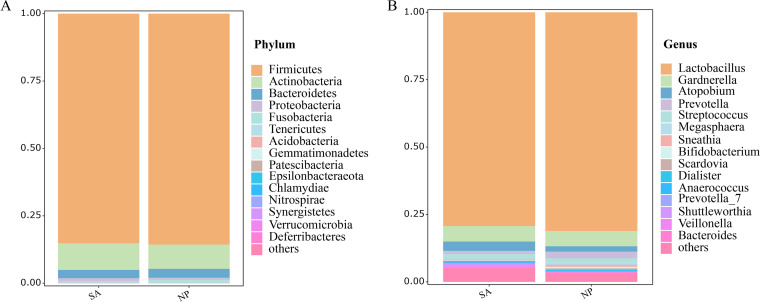
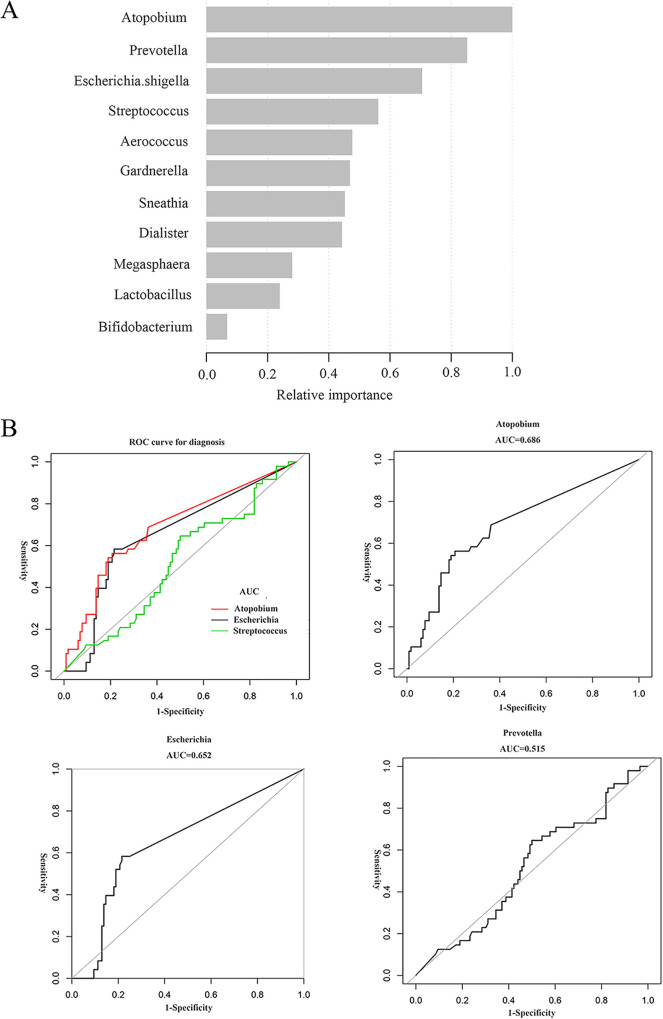
Spontaneous abortion (SA) has received more and more attention in light of its increasing incidence. However, the causes and pathogenesis of SA remain largely unknown, especially for those without any pathological features. In this study, we characterized the vaginal microbiota diversity and composition of pregnant women in their first trimester and evaluated the association between the vaginal microbiota and SA before 12 weeks of gestation. Participants' bacterial profiles were analyzed by 16S rRNA gene sequencing in the V3-V4 regions at 5-8 weeks of gestation. A total of 48 patients with SA at 12 weeks of gestation were included as the study group, while 116 women with normal pregnancies (NPs) were included as a control group. The results indicated that the richness of the vaginal microbiome in SA patients was higher (Chao1, P < 0.05) and different in composition relative to that of women with NPs (unweighted UniFrac, R = 0.15, P < 0.01; binary Jaccard, R = 0.15, P < 0.01). Furthermore, the genus Apotobium was significantly enriched in SA patients. An extreme gradient-boosting (XGBoost) analysis was able to classify Atopobium-induced SA more reliably (area under the receiver operating characteristic curve, 0.69; threshold, 0.01%). Moreover, after adjusting for potential confounders, the results showed a robust association between Apotobium and SA (as a categorical variable [<0.01%]; adjusted odds ratio, 2.9; 95% confidence interval, 1.3 to 6.5; P = 0.01). In conclusion, higher vaginal Apotobium levels were associated with SA in the first trimester. IMPORTANCE Spontaneous abortion (SA) is the most common adverse pregnancy outcome in the first trimester. The causal drivers of SA have become a substantial challenge to reveal and overcome. We hypothesize that vaginal microbial dysbiosis is associated with SA, as it was related to several female reproductive disorders in previous studies. In our study, we characterized the vaginal microbiota of patients with SA at 12 weeks of gestation as the study group, and women with normal pregnancies were enrolled as a control group. Generally, significant differences were discovered in the vaginal microbiota between the two groups. Our study also revealed that Apotobium may play an important role in the pathogenesis of SA. To our knowledge, this study is the first detailed elaboration of the vaginal microbiota composition and vaginal Apotobium in association with SA. We believe that our findings will inspire more researchers to consider dynamic changes in the vaginal microbiota as critical features for further studies of nosogenesis not only for SA but also other reproductive diseases.
Keywords: 16S rRNA; Apotobium; machine learning; spontaneous abortion; vaginal microbiota.
Conflict of interest statement
The authors declare no conflict of interest.
Figures

Similar articles
-
A prospective cohort study examining the association between the periconceptual vaginal microbiota and first-trimester miscarriage in Kenyan women.Paediatr Perinat Epidemiol. 2024 Sep;38(7):599-611. doi: 10.1111/ppe.13099. Epub 2024 Jul 1. Paediatr Perinat Epidemiol. 2024. PMID: 38949435
-
The association between vaginal bacterial composition and miscarriage: a nested case-control study.BJOG. 2020 Jan;127(2):264-274. doi: 10.1111/1471-0528.15972. Epub 2019 Oct 31. BJOG. 2020. PMID: 31573753 Free PMC article.
-
Alterations in Vaginal Microbiota and Associated Metabolome in Women with Recurrent Implantation Failure.mBio. 2020 Jun 2;11(3):e03242-19. doi: 10.1128/mBio.03242-19. mBio. 2020. PMID: 32487762 Free PMC article.
-
Vaginal Dysbiotic Microbiome in Women With No Symptoms of Genital Infections.Front Cell Infect Microbiol. 2022 Jan 12;11:760459. doi: 10.3389/fcimb.2021.760459. eCollection 2021. Front Cell Infect Microbiol. 2022. PMID: 35096634 Free PMC article.
-
Role of the vaginal microbiome in miscarriage: exploring the relationship.Front Cell Infect Microbiol. 2023 Sep 13;13:1232825. doi: 10.3389/fcimb.2023.1232825. eCollection 2023. Front Cell Infect Microbiol. 2023. PMID: 37780845 Free PMC article. Review.
Cited by
-
Expert Opinion on the Use of Probiotics in Recurrent Pregnancy Loss.Cureus. 2025 Mar 23;17(3):e81056. doi: 10.7759/cureus.81056. eCollection 2025 Mar. Cureus. 2025. PMID: 40271290 Free PMC article. Review.
-
Vaginal microbes confounders and implications on women's health.World J Clin Cases. 2023 Mar 26;11(9):2119-2122. doi: 10.12998/wjcc.v11.i9.2119. World J Clin Cases. 2023. PMID: 36998952 Free PMC article.
-
Effects of Dietary Quality on Vaginal Microbiome Composition Throughout Pregnancy in a Multi-Ethnic Cohort.Nutrients. 2024 Oct 8;16(19):3405. doi: 10.3390/nu16193405. Nutrients. 2024. PMID: 39408372 Free PMC article.
-
The Role of the Vaginal and Endometrial Microbiomes in Infertility and Their Impact on Pregnancy Outcomes in Light of Recent Literature.Int J Mol Sci. 2024 Dec 9;25(23):13227. doi: 10.3390/ijms252313227. Int J Mol Sci. 2024. PMID: 39684937 Free PMC article. Review.
-
Clinical Relevance of Vaginal and Endometrial Microbiome Investigation in Women with Repeated Implantation Failure and Recurrent Pregnancy Loss.Int J Mol Sci. 2024 Jan 3;25(1):622. doi: 10.3390/ijms25010622. Int J Mol Sci. 2024. PMID: 38203793 Free PMC article. Review.
References
-
- Quenby S, Gallos ID, Dhillon-Smith RK, Podesek M, Stephenson MD, Fisher J, Brosens JJ, Brewin J, Ramhorst R, Lucas ES, McCoy RC, Anderson R, Daher S, Regan L, Al-Memar M, Bourne T, MacIntyre DA, Rai R, Christiansen OB, Sugiura-Ogasawara M, Odendaal J, Devall AJ, Bennett PR, Petrou S, Coomarasamy A. 2021. Miscarriage matters: the epidemiological, physical, psychological, and economic costs of early pregnancy loss. Lancet 397:1658–1667. doi:10.1016/S0140-6736(21)00682-6. - DOI - PubMed
-
- Tsikouras P, Deftereou T, Anthoulaki X, Bothou A, Chalkidou A, Gaitatzi F, Tsirkas I, Bourazan AC, Bampageorgaka E, Stanulov G, Chatzimichael E, Zervoudis S, Lambropoulou M, Rath W, Galazios G, Michalopoulos S, Petsidis P, Iatrakis G. 2019. Abortions in first trimester pregnancy, management, treatment. IntechOpen; 1–28.
Publication types
MeSH terms
Substances
LinkOut - more resources
Full Text Sources
Medical