. 2022 Mar 21;79(4):199.
doi: 10.1007/s00018-022-04223-3.

GRASP depletion-mediated Golgi fragmentation impairs glycosaminoglycan synthesis, sulfation, and secretion

Affiliations

GRASP depletion-mediated Golgi fragmentation impairs glycosaminoglycan synthesis, sulfation, and secretion

Erpan Ahat et al. Cell Mol Life Sci. .

Abstract

Synthesis of glycosaminoglycans, such as heparan sulfate (HS) and chondroitin sulfate (CS), occurs in the lumen of the Golgi, but the relationship between Golgi structural integrity and glycosaminoglycan synthesis is not clear. In this study, we disrupted the Golgi structure by knocking out GRASP55 and GRASP65 and determined its effect on the synthesis, sulfation, and secretion of HS and CS. We found that GRASP depletion increased HS synthesis while decreasing CS synthesis in cells, altered HS and CS sulfation, and reduced both HS and CS secretion. Using proteomics, RNA-seq and biochemical approaches, we identified EXTL3, a key enzyme in the HS synthesis pathway, whose level is upregulated in GRASP knockout cells; while GalNAcT1, an essential CS synthesis enzyme, is robustly reduced. In addition, we found that GRASP depletion decreased HS sulfation via the reduction of PAPSS2, a bifunctional enzyme in HS sulfation. Our study provides the first evidence that Golgi structural defect may significantly alter the synthesis and secretion of glycosaminoglycans.

Keywords: Chondroitin sulfate (CS); GRASP55; GRASP65; Golgi; Heparan sulfate (HS); Proteomic; RNAseq; Sulfation; Synthesis.


Conflict of interest statement

The authors declare that no competing interests exist.

Figures
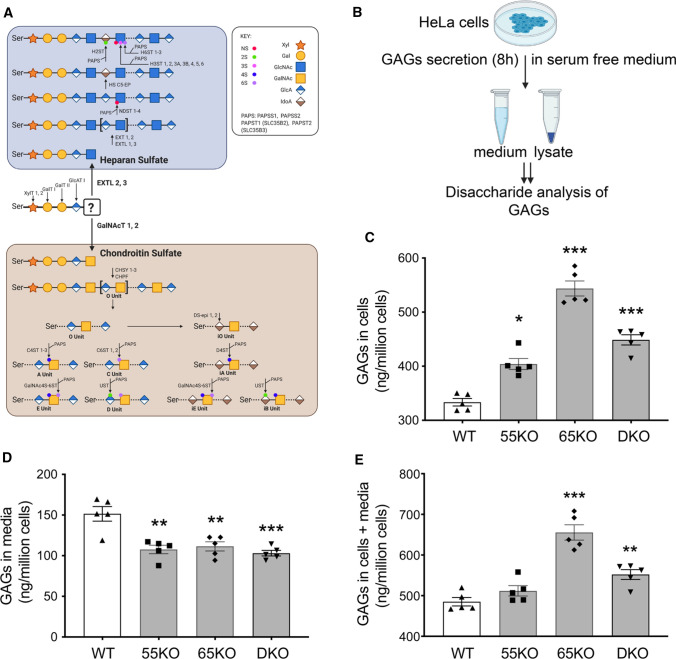
Fig. 1
Fig. 1
Golgi structure disruption by GRASP KO increases GAG synthesis but reduces its secretion. A Schematic diagram illustrating the HS and CS synthesis pathways; major enzymes in each pathway are indicated at their designated steps of reactions. B Schematic workflow for cell lysate and medium sample preparation to analyze GAGs by LC–MS. C GRASP KO increases the amount of GAGs in cells. Shown are the amounts of GAGs in the lysates of wildtype (WT), GRASP55 knockout (55KO), GRASP65 knockout (65KO), and GRASP55 and GRASP65 double knockout (DKO) HeLa cells. D GRASP KO decreases GAG secretion. WT and indicated GRASP KO cells were incubated in serum-free medium for 8 h and GAGs in the conditioned media were analyzed by LC–MS. E GRASP KO increases the total amount of GAGs in cells and media. Shown is the total amount of GAGs per million cells in both cell lysates and conditioned medium in each cell line. Results are presented as mean ± SEM, statistical analysis was assessed by comparing KO cells to WT cells by Student’s t test. *p < 0.05; **p < 0.01; ***p < 0.001
Fig. 2
Fig. 2
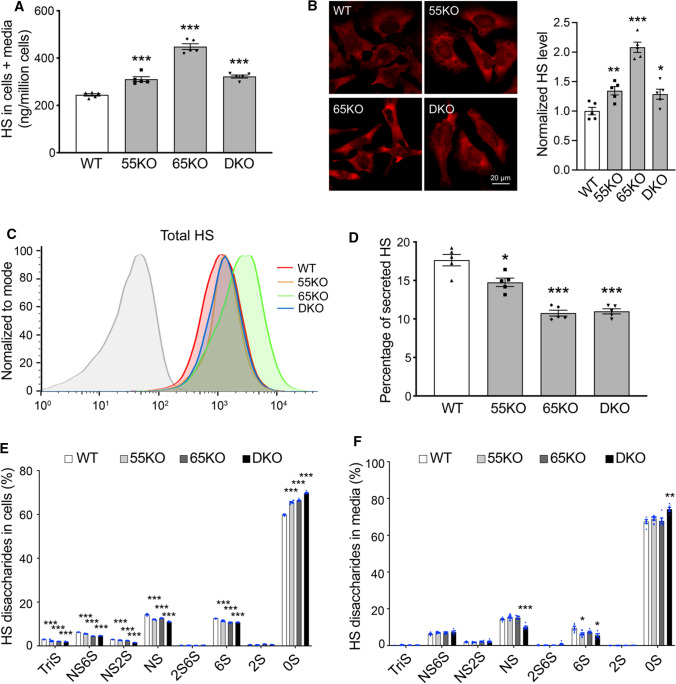
GRASP KO increases HS synthesis but reduces its sulfation and secretion. A GRASP KO increases HS synthesis analyzed by LC–MS. Shown are the total amount of HS in both cells and medium of indicated cell lines. B GRASP KO increases HS synthesis analyzed by immunofluorescence microscopy. Indicated cells were permeabilized and stained for HS with an HS antibody 10E4. Shown are microscopic images (left) and quantitation (right). C GRASP KO increases HS synthesis analyzed by flow cytometry. Indicated cells were permeabilized, stained for HS with an HS antibody and analyzed by flow cytometry. D GRASP KO decreases HS secretion. The percentage of secreted HS (HS in conditioned media/HS in both cell lysate and conditioned media) was analyzed by LC–MS. E GRASP KO reduces HS sulfation in the cell lysate. Shown is the percentage of each sulfated form of HS in cells. F GRASP KO reduces HS sulfation in the conditioned media. Shown is the percentage of each sulfated form of HS in the conditioned media
Fig. 3
Fig. 3
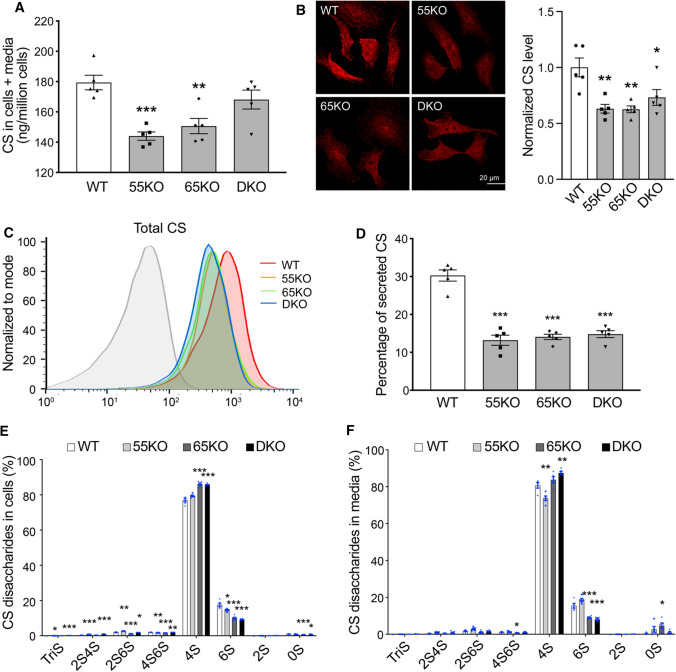
GRASP KO reduces CS synthesis and secretion. A GRASP KO reduces CS synthesis analyzed by LC–MS. Shown is the total amount of CS in both cells and medium of indicated cell lines. B GRASP KO decreases CS synthesis analyzed by immunofluorescence microscopy. Indicated cells were permeabilized and stained for CS with a CS antibody (CS-56). Shown are microscopic images (left) and quantitation (right). C GRASP KO decreases CS synthesis shown by flow cytometry. Indicated cells were permeabilized, stained for CS with a CS antibody and analyzed by flow cytometry. D GRASP KO decreases CS secretion. The percentage of secreted CS (CS in conditioned media/CS in both cell lysate and conditioned media) was analyzed by LC–MS. E GRASP KO alters CS sulfation in the cell lysate. Shown is the percentage of each sulfated form of CS in cells. F GRASP KO alters CS sulfation in the conditioned media. Shown is the percentage of each sulfated form of CS in the conditioned media. Note that GRASP depletion increased 4-sulfation while decreased 6-sulfation in both the cell lysate (E) and conditioned media (F)
Fig. 4
Fig. 4
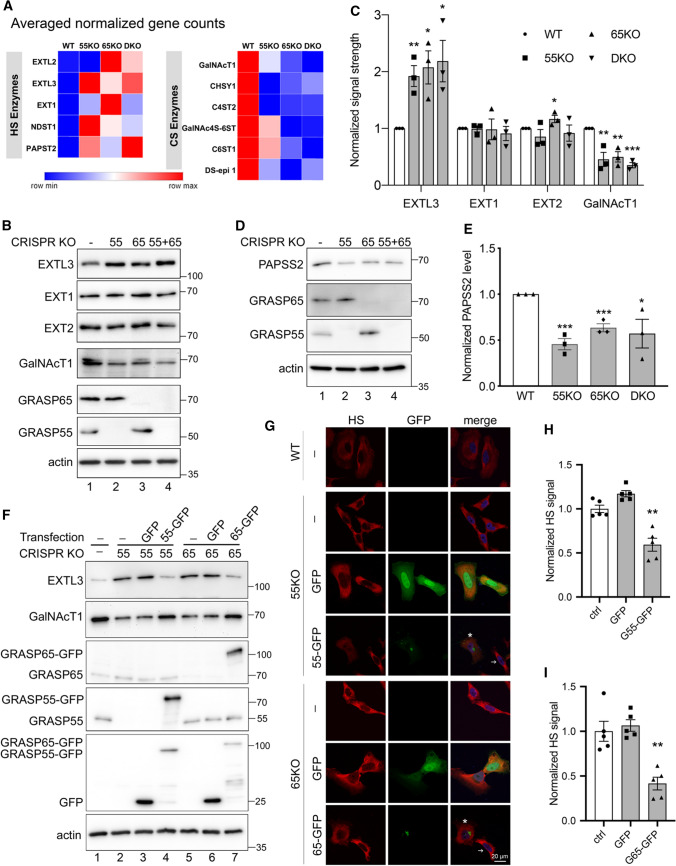
GRASP KO alters the expression level of GAG synthesis and sulfation enzymes. A GRASP KO increases the expression of HS synthesis enzymes while decreases CS synthesis enzymes. Results are based on RNA-Seq analysis of each cell line for indicated genes. B GRASP KO increases the protein level of HS synthesis enzymes while decreases that of CS synthesis enzymes. Cell lysate of indicated cells were analyzed for three HS synthesis enzymes EXTL3, EXT1 and EXT2, and a key CS synthesis enzyme GalNAcT1. Note the increased level of EXTL3 and decreased GalNAcT1 level in GRASP KO cells. Results are representative of three independent experiments. C Quantification of B. D GRASP KO decreases the protein level of the HS sulfation enzyme PAPSS2. Shown are representative Western blots of indicated proteins in the four cell lines from three independent experiments. E Quantitation of D. F Re-expression of GRASP proteins in GRASP KO cells corrects the expression level of HS and CS synthesis enzymes. Indicated cell lines were transfected with GRASP constructs and probed for EXTL3, GalNAcT1, GRASP65, GRASP55, GFP, and actin. The major enzymes EXTL3 and GalNAcT1 in 55KO and 65KO cells were rescued by expressing GRASP55-GFP or GRASP65-GFP, respectively, but not by GFP alone (lanes 4 & 7 vs. 3 & 6). G Re-expression of GRASP proteins corrects the HS and CS defects in GRASP KO cells. Confocal images of WT HeLa cells and GRASP KO cell lines transfected with indicated constructs followed by HS staining. The level of HS in 55KO and 65KO cells was decreased by the expression of GRASP55-GFP or GRASP65-GFP, respectively, but not by GFP alone. Note the different HS signals in cells expressing GRASP55- or GRASP65-GFP (asterisks) vs. non-transfected cells (arrows). H–I Quantification of G. Results are presented as mean ± SEM, statistical analysis was assessed by comparing KO cells to WT cells by Student’s t test. *p < 0.05; **p < 0.01; ***p < 0.001

References

    1. Li J, Ahat E, Wang Y. Golgi Structure and function in health, stress, and diseases. Results Probl Cell Differ. 2019;67:441–485. doi: 10.1007/978-3-030-23173-6_19. - DOI - PMC - PubMed
    1. Xiang Y, Wang Y. GRASP55 and GRASP65 play complementary and essential roles in Golgi cisternal stacking. J Cell Biol. 2010;188:237–251. doi: 10.1083/jcb.200907132. - DOI - PMC - PubMed
    1. Bekier ME, 2nd, Wang L, Li J, Huang H, Tang D, Zhang X, Wang Y. Knockout of the Golgi stacking proteins GRASP55 and GRASP65 impairs Golgi structure and function. Mol Biol Cell. 2017;28:2833–2842. doi: 10.1091/mbc.e17-02-0112. - DOI - PMC - PubMed
    1. Ahat E, Li J, Wang Y. New insights into the golgi stacking proteins. Front Cell Dev Biol. 2019;7:131. doi: 10.3389/fcell.2019.00131. - DOI - PMC - PubMed
    1. Zhang Y, Seemann J. Rapid degradation of GRASP55 and GRASP65 reveals their immediate impact on the Golgi structure. J Cell Biol. 2021 doi: 10.1083/jcb.202007052. - DOI - PMC - PubMed

MeSH terms

LinkOut - more resources