Review
. 2022 Mar 12:2022:2249834.
doi: 10.1155/2022/2249834. eCollection 2022.

Psoriasis between Autoimmunity and Oxidative Stress: Changes Induced by Different Therapeutic Approaches

Affiliations
Review

Psoriasis between Autoimmunity and Oxidative Stress: Changes Induced by Different Therapeutic Approaches

Marija V Medovic et al. Oxid Med Cell Longev. .

Abstract

Psoriasis is defined as chronic, immune-mediated disease. Regardless of the development of new therapeutic approaches, the precise etiology of psoriasis remains unknown and speculative. The aim of this review was to systematize the results of previous research on the role of oxidative stress and aberrant immune response in the pathogenesis of psoriasis, as well as the impact of certain therapeutic modalities on the oxidative status in patients with psoriasis. Complex immune pathways of both the innate and adaptive immune systems appear to be major pathomechanisms in the development of psoriasis. Oxidative stress represents another important contributor to the pathophysiology of disease, and the redox imbalance in psoriasis has been reported in skin cells and, systemically, in plasma and blood cells, and more recently, also in saliva. Current immune model of psoriasis begins with activation of immune system in susceptible person by some environmental factor and loss of immune tolerance to psoriasis autoantigens. Increased production of IL-17 appears to be the most prominent role in psoriasis pathogenesis, while IL-23 is recognized as master regulator in psoriasis having a specific role in cross bridging the production of IL-17 by innate and acquired immunity. Other proinflammatory cytokines, including IFN-γ, TNF-α, IL-1β, IL-6, IL-22, IL-26, IL-29, or IL-36, have also been reported to play important roles in the development of psoriasis. Oxidative stress can promote inflammation through several signaling pathways. The most noticeable and most powerful antioxidative effects exert various biologics compared to more convenient therapeutic modalities, such as methotrexate or phototherapy. The complex interaction of redox, immune, and inflammatory signaling pathways should be focused on further researches tackling the pathophysiology of psoriasis, while antioxidative supplementation could be the solution in some refractory cases of the disease.


Conflict of interest statement

The authors declare that they have no conflicts of interest.

Figures

Figure 1
Figure 1
Clinical manifestations of psoriasis. Psoriasis vulgaris manifested through typical erythematous plaques with silvery scales of various sizes from guttate lesions through nummular to giant lumbar plaque (a). Psoriasis vulgaris and guttate psoriasis (b, d). Generalized psoriasis (c, h, i). Inverse psoriasis (g). Psoriatic lesions on the feet and hands (e, f, j, k), including psoriatic nail dystrophy (f, k) and psoriatic arthritis (l). Erythrodermic psoriasis, erythema, and squamous cover 90% of the skin (m, n, o, p). Pictures presented are part of the private collection of Vesna M. Milicic and Ana B. Ravic Nikolic.
Figure 2
Figure 2
Immune response in psoriasis. Complex interaction of various parts of innate (dendritic cells, NKT cells, and neutrophils) and acquired immunity (T cells) in pathophysiology of psoriasis. IFN: interferon; IL: interleukin; NKT: natural killer T; Th: T-helper cell; TGF: transforming growth factor; TNF: tumour necrosis factor.
Figure 3
Figure 3
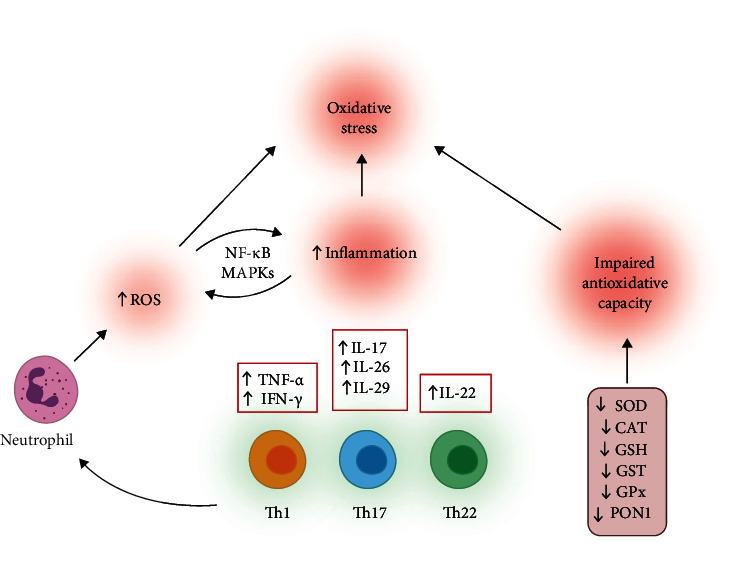
Mechanisms involved in increasing oxidative stress in psoriasis and interactions between oxidative stress and inflammation. IFN: interferon; IL: interleukin; MAPKs: mitogen-activated protein kinases, NF-κB: nuclear factor kappa B; ROS: reactive oxygen species; Th: T-helper cell; TNF: tumour necrosis factor.
Figure 4
Figure 4
Clinical efficacy of IL-12 and IL-23 blockade (ustekinumab). Patient before starting therapy (a, b), after 8 weeks from the introduction of the IL-12/IL-23 blocker (c, d), and after 16 weeks after the introduction of the IL-12/IL-23 blocker (e, f). Pictures presented are part of the private collection of Vesna M. Milicic and Ana B. Ravic Nikolic.
Figure 5
Figure 5
Clinical efficacy of IL-17A blockade (secukinumab). Patient before starting therapy (a, b), after 8 weeks from the introduction of the IL-17A blocker (c, d), and after 16 weeks after the introduction of the IL-17A blocker (e, f). Pictures presented are part of the private collection of Vesna M. Milicic and Ana B. Ravic Nikolic.
Figure 6
Figure 6
Clinical efficacy of methotrexate (MTX). Patient before starting therapy (a, b), after 8 weeks from the introduction of the MTX (15 mg per week) (c, d), and after 16 weeks after the introduction of the MTX (15 mg per week) (e, f). Pictures presented are part of the private collection of Vesna M. Milicic and Ana B. Ravic Nikolic.

References

    1. Glickman F. S. Lepra, psora, psoriasis. Journal of the American Academy of Dermatology . 1986;14(5):863–866. doi: 10.1016/S0190-9622(86)70101-1. - DOI - PubMed
    1. Michalek I. M., Loring B., John S. M. A systematic review of worldwide epidemiology of psoriasis. Journal of the European Academy of Dermatology and Venereology . 2017;31(2):205–212. doi: 10.1111/jdv.13854. - DOI - PubMed
    1. Griffiths C. E. M., Armstrong A. W., Gudjonsson J. E., Barker J. N. W. N. Psoriasis. Lancet. . 2021;397(10281):1301–1315. doi: 10.1016/S0140-6736(20)32549-6. - DOI - PubMed
    1. Boehncke W. H., Schön M. P. Psoriasis. Lancet. . 2015;386(9997):983–994. doi: 10.1016/S0140-6736(14)61909-7. - DOI - PubMed
    1. Muñoz-Aceituno E., Martos-Cabrera L., Ovejero-Benito M. C., Reolid A., Abad-Santos F., Daudén E. Pharmacogenetics update on biologic therapy in psoriasis. Medicina (Kaunas, Lithuania) . 2020;56(12):p. 719. - PMC - PubMed