


Prenatal cannabis exposure predicts attention problems, without changes on fMRI in adolescents
- PMID: 35314358
- PMCID: PMC9136933
- DOI: 10.1016/j.ntt.2022.107089
Prenatal cannabis exposure predicts attention problems, without changes on fMRI in adolescents
Abstract
Objectives: We hypothesized that prenatal cannabis exposure (PCE) would be associated with increased attention problems and altered neurocognition in young adolescents.
Methods: Data were obtained from the Adolescent Brain Cognitive Development (ABCD study®), a cohort of approximately 12,000 children. Presence or absence of PCE after knowledge of pregnancy was measured by caregiver report. All participants with PCE (N = 224) were included and compared to two control groups; those matched on tobacco and alcohol exposure and those without prenatal tobacco or alcohol exposures. Outcomes were measured with the ABCD baseline assessment when participants were 9-10 years old and included attention, internalizing, externalizing and total problems scales on the Child Behavior Checklist (CBCL). Teacher reports were used when available. Mixed effects modeling assessed the association between PCE and outcomes controlling for parental psychopathology, prematurity and socioeconomic status. For participants with available data, patterns of brain activity during three fMRI tasks (the Stop Signal Task measuring response inhibition, the Monetary Incentive Delay (MID) task measuring reward processing and the EN-Back task measuring working memory) were analyzed using Permutation Analyses of the Linear Model.
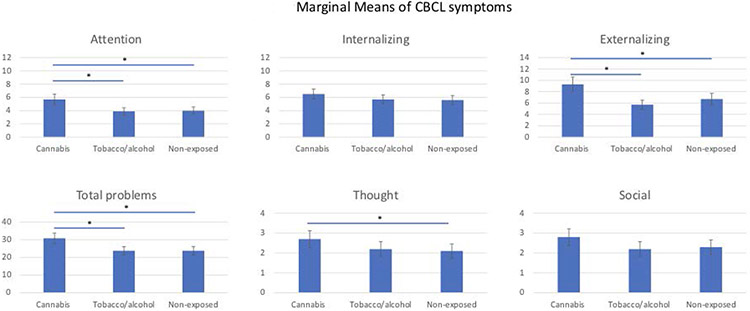
Results: Compared to both control groups, participants with PCE had significantly higher attention problems, externalizing, and total problem scores. PCE did not impact cognitive performance or patterns of brain activation during fMRI tasks.
Conclusions: There are long-term associations between PCE and early adolescent attention and behavioral problems. These are not reflected in cognitive performance or task fMRI measures, a finding that is consistent with reports that fewer than half of children with ADHD have any specific cognitive deficit (Nigg et al., 2005; Willcutt et al., 2005). The young age of the sample may also relate to this finding and future investigation of neurodevelopmental trajectories of youth with PCE is warranted.
Keywords: Attention; Brain development; Child behavior; Prenatal cannabis; fMRI.
Copyright © 2022. Published by Elsevier Inc.
Conflict of interest statement
Figures
References
-
- Achenbach T, McConaughy S, Ivanova M, & Rescorla L (2017). Manual for the ASEBA Brief Problem Monitor for Ages 6-18 (BPM/6-18). Burlington: University of Vermont Research Center for Children, Youth, and Families.
-
- Achenbach TM, & Rescorla LA (2000). Manual for the ASEBA preschool forms and profiles (Vol. 30). Burlington, VT: University of Vermont, Research center for children, youth & families.
-
- Antonelli T, Tomasini MC, Tattoli M, Cassano T, Tanganelli S, Finetti S, Mazzoni E, Trabace L, Steardo L, Cuomo V, & Ferraro L (2005, Dec). Prenatal exposure to the CB1 receptor agonist WIN 55,212-2 causes learning disruption associated with impaired cortical NMDA receptor function and emotional reactivity changes in rat offspring. Cereb Cortex, 15(12), 2013–2020. 10.1093/cercor/bhi076 - DOI - PubMed
Publication types
MeSH terms
Substances
Grants and funding
- U24 DA041147/DA/NIDA NIH HHS/United States
- U01 DA051039/DA/NIDA NIH HHS/United States
- U01 DA041120/DA/NIDA NIH HHS/United States
- U01 DA051018/DA/NIDA NIH HHS/United States
- U01 DA041093/DA/NIDA NIH HHS/United States
- U24 DA041123/DA/NIDA NIH HHS/United States
- U01 DA051038/DA/NIDA NIH HHS/United States
- U01 DA051037/DA/NIDA NIH HHS/United States
- U01 DA051016/DA/NIDA NIH HHS/United States
- U01 DA041106/DA/NIDA NIH HHS/United States
- U01 DA041117/DA/NIDA NIH HHS/United States
- U01 DA041148/DA/NIDA NIH HHS/United States
- U01 DA041134/DA/NIDA NIH HHS/United States
- U01 DA041022/DA/NIDA NIH HHS/United States
- U01 DA041156/DA/NIDA NIH HHS/United States
- U01 DA050987/DA/NIDA NIH HHS/United States
- U01 DA041025/DA/NIDA NIH HHS/United States
- U01 DA050989/DA/NIDA NIH HHS/United States
- U01 DA041089/DA/NIDA NIH HHS/United States
- U01 DA050988/DA/NIDA NIH HHS/United States
- U01 DA041028/DA/NIDA NIH HHS/United States
- U01 DA041048/DA/NIDA NIH HHS/United States
- U01 DA041174/DA/NIDA NIH HHS/United States
- UG1 OD024955/OD/NIH HHS/United States
LinkOut - more resources
Full Text Sources
Research Materials
