Review
. 2022 Mar 21;7(1):92.
doi: 10.1038/s41392-022-00932-0.

The secretion profile of mesenchymal stem cells and potential applications in treating human diseases

Affiliations
Review

The secretion profile of mesenchymal stem cells and potential applications in treating human diseases

Yuyi Han et al. Signal Transduct Target Ther. .

Abstract

Mesenchymal stromal/stem cells (MSCs) possess multi-lineage differentiation and self-renewal potentials. MSCs-based therapies have been widely utilized for the treatment of diverse inflammatory diseases, due to the potent immunoregulatory functions of MSCs. An increasing body of evidence indicates that MSCs exert their therapeutic effects largely through their paracrine actions. Growth factors, cytokines, chemokines, extracellular matrix components, and metabolic products were all found to be functional molecules of MSCs in various therapeutic paradigms. These secretory factors contribute to immune modulation, tissue remodeling, and cellular homeostasis during regeneration. In this review, we summarize and discuss recent advances in our understanding of the secretory behavior of MSCs and the intracellular communication that accounts for their potential in treating human diseases.


Conflict of interest statement

The authors declare no competing interests.

Figures

Fig. 1
Fig. 1
MSC-based clinical trials involve a variety of diseases in different organs and tissues. MSC-based clinical trials are mainly applied to the diseases associated with inflammation, wound healing, infection, as well as degeneration in diverse organs and tissues. The figure shows the types of diseases that have completed clinical trials (reproductive diseases and aging are not listed), and the most widely applied diseases involve the bone and nervous system. MSCs possess a strong capacity in balancing immune responses, especially in autoimmune disorders, such as GvHD and Crohn’s disease. As a lot of refractory diseases are often combined with poor repairing of damaged tissues and dysfunction of diseased organs, such as bones nonunion and multiple sclerosis, the clinicians also favor the multi-directional differentiation potential and pleiotropic effects of MSCs, to promote wound healing and functional recovery. In addition, researchers have been gradually investigating the therapeutic potential of MSC-based therapy in some congenital diseases. (Created with BioRender.com)
Fig. 2
Fig. 2
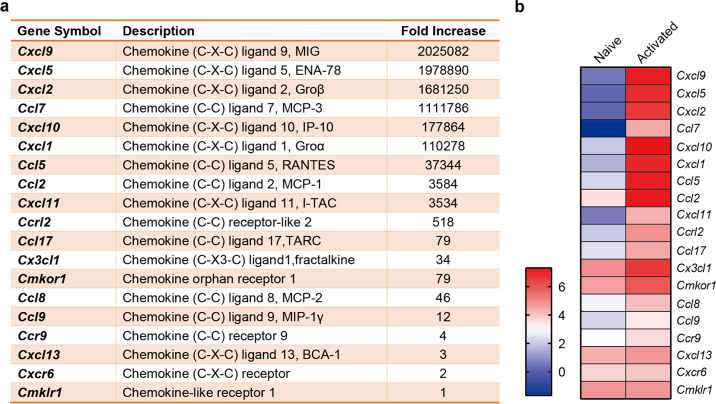
Supernatant of anti-CD3-activated splenocytes increased the gene expression of chemotactic factors in MSCs. a Fold increase of gene expression in the MSCs treated with supernatant from anti-CD3-activated splenocytes, relative to the ones treated by supernatant from naive splenocytes. b Heatmap for log value of chemotactic genes expression in MSCs. (Modified from Ren et al., Cell Stem Cell, 2008)
Fig. 3
Fig. 3
Schemes of cell/molecule-based therapy in MSCs application. The designed chemokine delivery devices have emerged as a novel approach for stem cell recruitment and tissue regeneration. Another strategy to potentiate MSCs’ secretory actions, is cultivating MSCs under low oxygen or stimulating MSCs with PRP and cytokines. Importantly, MSCs possess a unique chemotactic network to orient their transmission as the cell ark and deliver specific factors on purpose. MSCs encapsulated in biomaterials such as collagen gels or fibrous protein-based gels have increased migrating capacity to converge in damaged tissues. The factors produced by MSCs support the function and development of other cell types, such as HSC in the bone marrow. MSC also serves as a prominent vehicle to carry antibiotics to the deeply infected sites and accelerate tissue repair. The genetically modified MSCs not only achieve more homing capacity to reach target sites but also recruit more immune cells in the tumor environment to elicit an anti-tumor immunity, which bypasses the side effects caused by chemotherapeutic drugs. (Created with BioRender.com)

References

    1. Phinney DG. Building a consensus regarding the nature and origin of mesenchymal stem cells. J. Cell. Biochem. Suppl. 2002;38:7–12. - PubMed
    1. Hu X, et al. Identification of a common mesenchymal stromal progenitor for the adult haematopoietic niche. Nat. Commun. 2016;7:13095. - PMC - PubMed
    1. Cordeiro Gomes A, et al. Hematopoietic stem cell niches produce lineage-instructive signals to control multipotent progenitor differentiation. Immunity. 2016;45:1219–1231. - PMC - PubMed
    1. Méndez-Ferrer S, et al. Mesenchymal and haematopoietic stem cells form a unique bone marrow niche. Nature. 2010;466:829–834. - PMC - PubMed
    1. Del Toro R, et al. Nestin(+) cells direct inflammatory cell migration in atherosclerosis. Nat. Commun. 2016;7:12706. - PMC - PubMed

Publication types