


A new self-understanding as chemo sufferer - a phenomenological study of everyday life with chemotherapy induced neuropathy among survivors after colorectal cancer
- PMID: 35315728
- PMCID: PMC8942531
- DOI: 10.1080/17482631.2022.2049437
A new self-understanding as chemo sufferer - a phenomenological study of everyday life with chemotherapy induced neuropathy among survivors after colorectal cancer
Abstract
Purpose: To explore the essential meaning of how sensory disturbances caused by Oxaliplatin influence self-understanding and freedom to live an everyday life among survivors after colorectal cancer.
Methods: Data was generated by means of a semi-structured individual interview with eight survivors after colorectal cancer who continued to experience chemotherapy-induced peripheral neuropathy at least one year after completing chemotherapy with Oxaliplatin. Data analysis was guided by existential phenomenology and descriptive life-world research.
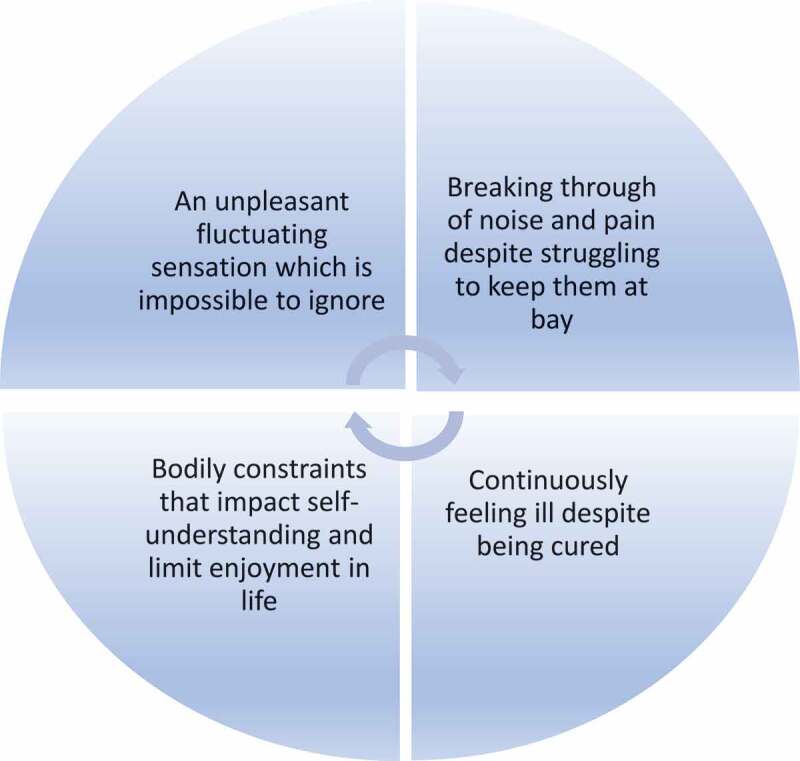
Results: The essential meaning was structured by four constituents. 1) An unpleasant fluctuating sensation which is impossible to ignore, 2) Breaking through of noise and pain despite struggling to keep them at bay, 3) Continuously feeling ill despite being cured, and 4) Bodily constraints that impact self-understanding and limit enjoyment of life.
Conclusion: The survivors used distraction to keep the sensory disturbances at bay but were forced to adapt to a new self-understanding as sufferers after chemotherapy despite being cured of their cancer disease. This way of being-in-the-world was understood by survivors, their families and healthcare professionals as a necessary price to pay to be alive. However, marked as sufferer after chemotherapy, the participants' everyday style of experience and life revealed as an ill health condition, which limited their ability to accomplish everyday activities as before and their freedom to realize their potential-the "I can".
Keywords: Colorectal cancer; cancer survivorship; descriptive life-world research; embodiment; everyday life; existential phenomenology; long-term side effects; peripheral neuropathy; quality of life.
Conflict of interest statement
No potential conflict of interest was reported by the author(s).
Figures
References
-
- Bakare-Yusuf, B. (2008). Rethinking diasporicity: Embodiment, emotion, and displaced origin. African and Black Diaspora: An International Journal, 1(2), 12. 10.1080/17528630802224056 - DOI
-
- Brinkmann, S., & Kvale, S. (2015). InterViews: learning the craft of qualitative research interviewing (third ed.). Sage.
MeSH terms
Substances
LinkOut - more resources
Full Text Sources
Medical
